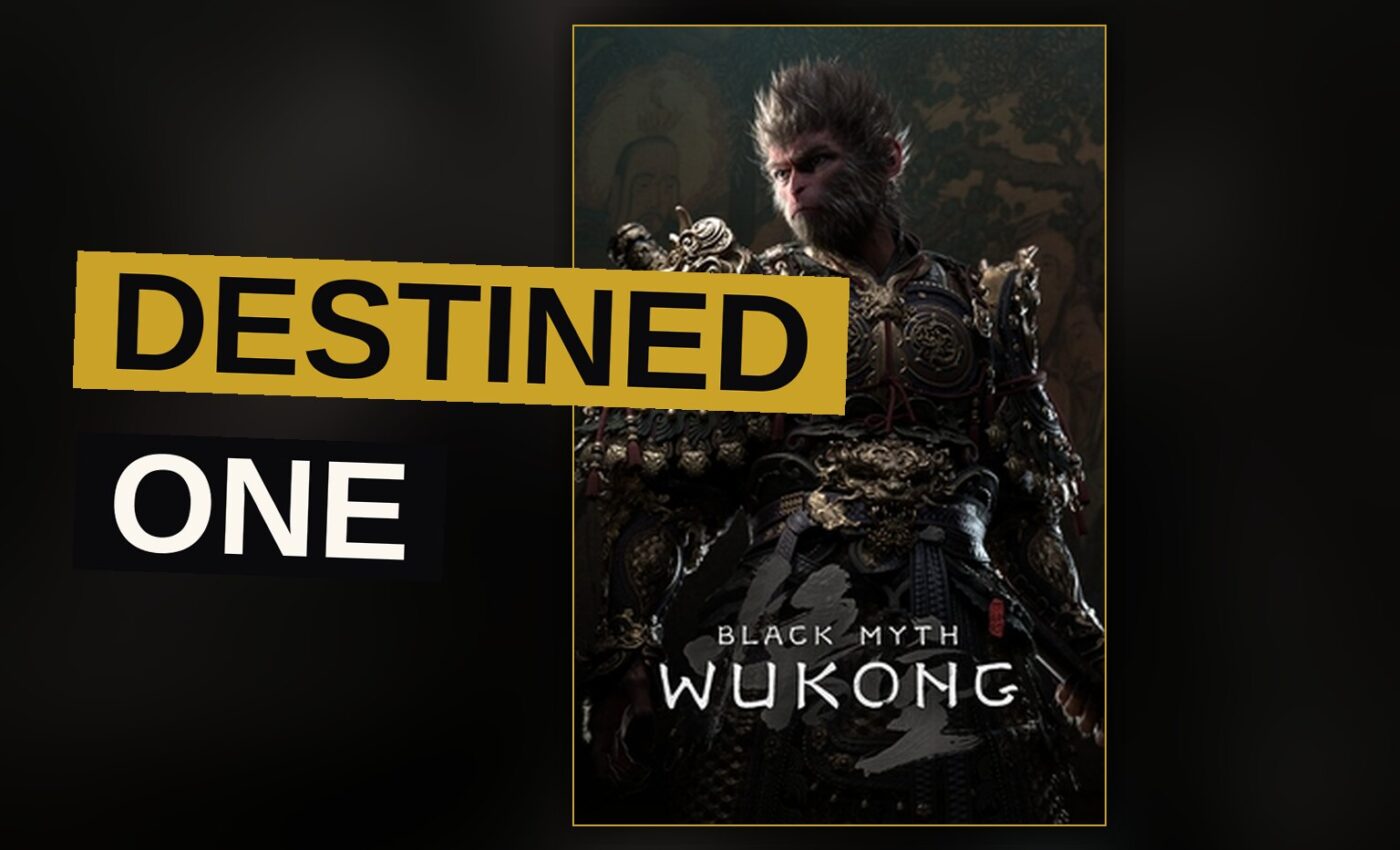
Black Myth: Wukong sold 20 million copies in its first month. That figure, more than any boss fight, is the story of Game Science’s action role-playing game, and it is the reason the game matters beyond its own frame. It is also the reason to be careful with it.
The game is the first installment in the Black Myth series and is widely regarded as the first AAA game from the Chinese video game industry. It launched for PlayStation 5 and Windows on August 20, 2024, then reached Xbox Series X/S on August 20, 2025. It is a good game. It is not a flawless one, and the distance between those two facts is what this review is about.
Trailer, via IGN.
A Monkey, a Staff, and Six Relics
The player controls the Destined One, a monkey based on Sun Wukong from the classical Chinese novel Journey to the West. The weapon is a staff in the mold of the Ruyi Jingu Bang, able to grow and shrink mid-fight. Play is single-player, third-person, and mostly linear, with wider areas breaking up the path.
The setup is clean. Wukong finishes his pilgrimage with the Tang Monk, takes Buddhahood, then walks away from the Celestial Court for a quiet life on Mount Huaguo. The Court does not take the rejection well. Erlang Shen leads an army to force his submission, the circlet binding Wukong cripples him, and he ends up sealed in stone, cut off from six relics tied to his six senses.
Centuries pass. The monkeys of the mountain want their king back. The Destined One is one of them, and the six relics become the spine of the campaign across Black Wind Mountain, Yellow Wind Ridge, The New West, The Webbed Ridge, Flaming Mountains, and Mount Huaguo.
How the Staff Actually Feels
Combat runs on two meters. Focus builds through light attacks and well-timed dodges, and each full meter hands the player a point to spend on a heavy attack, either alone or woven into a light combo. Stamina drains when you sprint, dodge, or swing. The staff carries three stances — smash, pillar, and thrust — which is a real decision rather than a cosmetic toggle.
Abilities are split into four groups: mysticism, alteration, strand, and transformations. The first three run on cooldowns and drain mana. Transformations only run on cooldowns. Each one lets the Destined One take another form with its own moves and its own health bar, and it lasts until its might is spent or the health runs out.
Red Tides is the clean example, turning the player into Guangzhi, a wolfman with a flaming glaive. Spirits and vessels sit alongside as equippable pieces with passive bonuses and active skills, each with its own qi that refills as you land hits. Beat a yaoguai chief and it may leave its spirit behind.
The Temples Are the Argument
The world is populated by gods from the Chinese pantheon — Buddhist, Daoist, and others — alongside yaoguais, beings with strange appearances and preternatural abilities. Underneath the main quest sits a colder thread: the relationship between the Buddhist deities of Mount Lingshan and the Daoist deities of the Celestial Court is coming apart.
Game Science pulls real places into the game. Scenes are built on the Kaiyuan Temple in Quanzhou, the Wulong Temple in Langzhong, and the Dazu Rock Carvings, among others. That choice is not set dressing. It is the game telling you where it comes from, and it is the most confident thing in the whole package.
Every chapter closes with an animated cutscene. The first three sit in Chinese philosophy, the fourth turns to love, the fifth takes on grief and anger, and the last runs backward through key events of Journey to the West.
The reception matched the ambition. As Wikipedia’s entry on the game puts it:
It received generally favorable reviews from critics and won several accolades including Game of the Year awards.
Six Chapters, Front-Loaded
Six chapters is a lot of ground, and the game does not hold the same weight across all of it. Black Wind Mountain and Yellow Wind Ridge land hardest. The Webbed Ridge and Flaming Mountains have their defenders, but the back half leans on the player’s investment in the relics rather than on fresh ideas.
The Lingshan-Celestial Court conflict is the most interesting material in the game and it never steps out of the background. That is a choice, and a defensible one, but it leaves the central relic hunt carrying weight the world-building already carries better.
The Soulslike tag will also mislead. This is not a game built to punish the way the genre’s hardest entries punish. The flexible skill tree and the transformations hand the player more outs than the label suggests. That is a difference worth naming before someone buys in expecting a wall.
What 20 Million Copies Proves
Black Myth: Wukong sold 20 million units in its first month, making it one of the fastest-selling games of all time. That number is the headline and also the thing most likely to be misread. A big launch proves a game was wanted. It does not prove a game is good.
The distinction matters because this game arrived carrying a burden few releases carry. It was the first AAA game from the Chinese video game industry, and every conversation about it turned into a conversation about that fact. It holds up under the weight better than it had any right to.
The confidence is earned by the world, not by the systems. Stances, focus economy, transformations — competent. Temples, yaoguai, animated chapter endings — the reason to play.
What Comes Next
The next installment, Black Myth: Zhong Kui, is currently in development. That is the real verdict on this one. Game Science is no longer being asked whether it can make a game. It is being asked whether it can make a second one.
Where Black Myth: Wukong Lands
Ranked against what it is trying to do, here is where Black Myth: Wukong lands:
- Setting and art direction. The Kaiyuan Temple, Wulong Temple, and Dazu Rock Carvings work is the strongest asset in the game.
- Combat and transformation systems. Two meters, three stances, and shapeshifting give the player real choices.
- The animated chapter cutscenes. Philosophy, love, grief, and a reverse-chronological finale.
- The six-chapter structure. Strong opening, uneven middle, and a background conflict that stays in the background.
The 20 million units are not why to play it. They are why a sequel exists, and the sequel is where the real test starts. For now, this is a first installment that earns its place.
Get the Notebook.
The day's best stories and every fresh verdict, in plain English, in your inbox by seven. One email a day, no more.