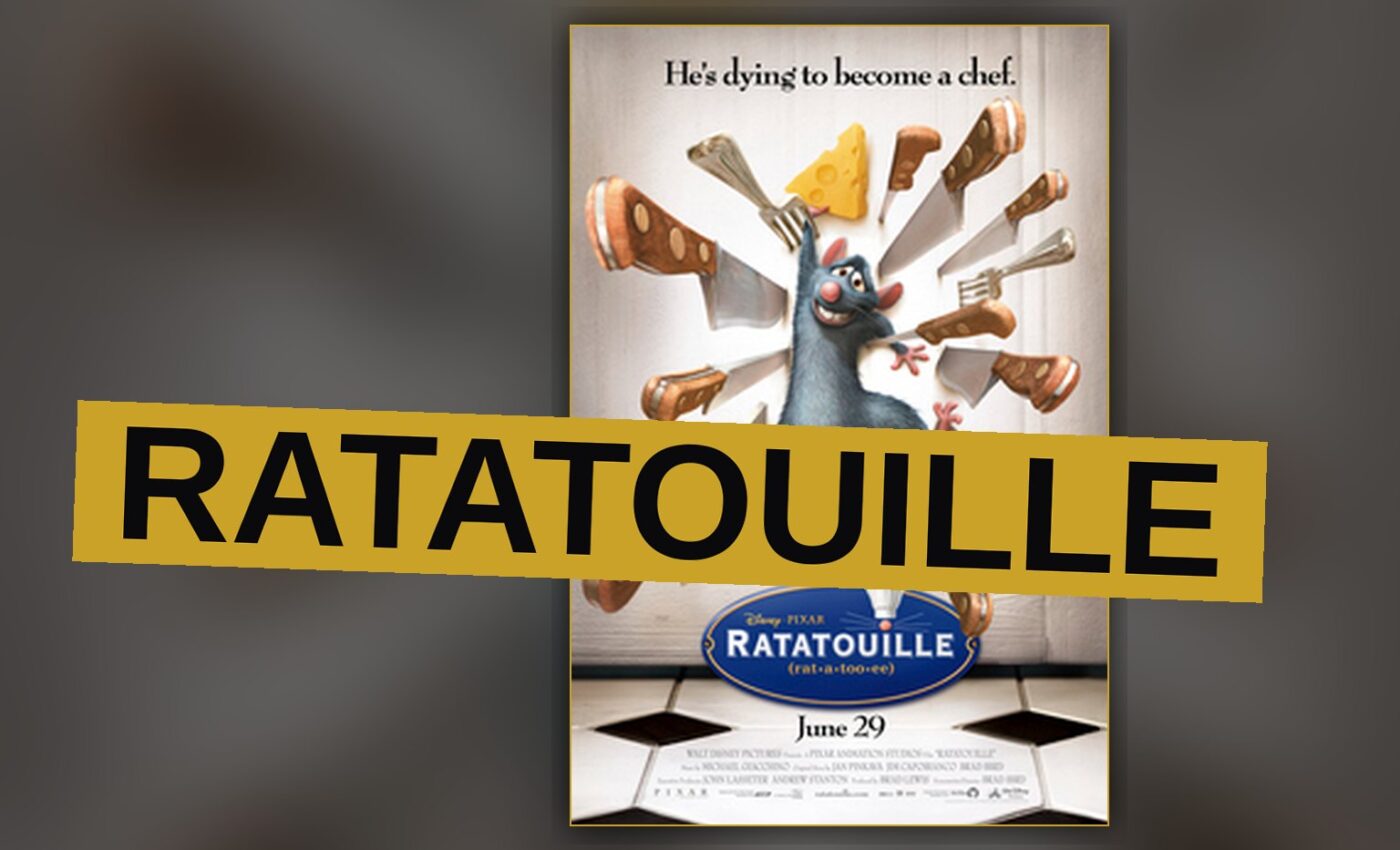
Pixar’s Ratatouille is a film about a rat who wants to be a chef, and it shouldn’t work. The premise is absurd, the hero is a pest, and the setting is a stuffy Parisian restaurant where perfection is the only standard. Yet the movie pulls it off with such skill that it feels inevitable, not silly. It is a story about art, obsession, and the difference between following rules and following taste.
The film centers on Remy, a rat with a refined palate and a gift for flavor. He lives in the French countryside with a colony that eats garbage without question, and he cannot stand it. When a flood sweeps him into the sewers of Paris, he finds himself in the kitchen of Gusteau’s, the restaurant once run by the late chef Auguste Gusteau, whose motto was “Anyone can cook.” Remy teams up with Linguini, a hapless garbage boy who cannot cook at all, and the two form a secret partnership: Linguini’s hands, Remy’s brain.
Trailer, via Pixar.
The Kitchen as a Stage
What makes Ratatouille work is its respect for the craft. The film treats cooking as a serious art form, not a joke. Remy’s first great dish is a soup he fixes in a panic, and the camera lingers on the ingredients, the heat, the timing. The movie understands that flavor is a kind of knowledge, and it shows that knowledge in motion. The kitchen at Gusteau’s is a place of order and violence, where the head chef Skinner rules with a thin smile and a sharp eye. Skinner is a villain of the small kind: he cares about the brand, not the food.
The film’s director, Brad Bird, had already made The Incredibles, and he brings the same energy to this world. The action sequences are precise, the comedy is quick, and the emotional beats land without sentimentality. The voice cast is strong across the board. Patton Oswalt gives Remy a nervous, hungry intelligence, and Lou Romano makes Linguini a lovable fool without turning him into a cartoon. Janeane Garofalo plays Colette, the only woman in the kitchen, and she brings a sharp edge to every line.
The Rat and the Man
The partnership between Remy and Linguini is the heart of the film, and it is a strange one. Linguini gets the credit for Remy’s work, and he does not handle it well. He becomes a celebrity, a face for the restaurant, and he starts to believe his own press. Remy, meanwhile, is stuck in the shadows, pulling strings from under a chef’s hat. The film does not pretend this arrangement is fair. It shows the strain, the resentment, and the way success can poison a good thing.
There is a moment when Linguini tries to cook on his own, and it goes badly. The scene is played for laughs, but it is also a quiet tragedy: the man has no gift, and he knows it. Remy, for his part, cannot step into the light without being seen as a rat, and the film does not let him forget that. The world is not ready for a rat chef, and the movie does not wave that away. It makes the point that talent is not enough. You also need a place to stand.
The Critic’s Table
The film’s best scene belongs to Anton Ego, the food critic who has never praised a dish in his life. Ego is voiced by Peter O’Toole, and he is a skeleton in a suit, a man who has eaten so much that he has lost the joy of eating. He arrives at Gusteau’s expecting to destroy it, and instead he is served a simple dish: ratatouille, the peasant vegetable stew that gives the film its title. The dish reminds him of his mother’s cooking, and for a moment, he is a child again.
Ego’s review is the film’s thesis. He writes that “the average piece of junk is probably more meaningful than our criticism designating it so,” and he admits that a great artist can come from anywhere. It is a bold move for a film to put its moral in the mouth of its harshest critic, but Ratatouille earns it. The scene is quiet, almost silent, and it is the most powerful moment in the movie. O’Toole’s voice carries the weight of a man who has been wrong for years and finally knows it.
The Dish That Changes Everything
The ratatouille itself is a simple thing. It is not a fancy dish, and that is the point. Remy makes it with care, layering the vegetables in a precise pattern, and the film treats the act as a kind of prayer. The dish does not save the restaurant or fix the world. It just makes one man feel something, and that is enough.
The film ends with Remy running his own bistro, a small place where he is free to cook what he likes. It is a modest ending, not a triumph. The rat does not conquer Paris. He finds a corner of it, and he makes it his own. That feels right. Ratatouille is not a film about winning. It is a film about doing good work in a world that does not always want it.
The Score
| Ratatouille | 7.8/10 |
|---|---|
| The Incredibles | 8.4/10 |
Ratatouille is not perfect. The middle section drags a little, and the romance between Linguini and Colette is thin. But the film’s strengths are so large that these flaws barely register. It is a movie about taste, and it has taste in every frame. The animation is beautiful, the writing is sharp, and the message is earned. It is one of Pixar’s best, and it holds up on every rewatch.
I score it 7.8/10.