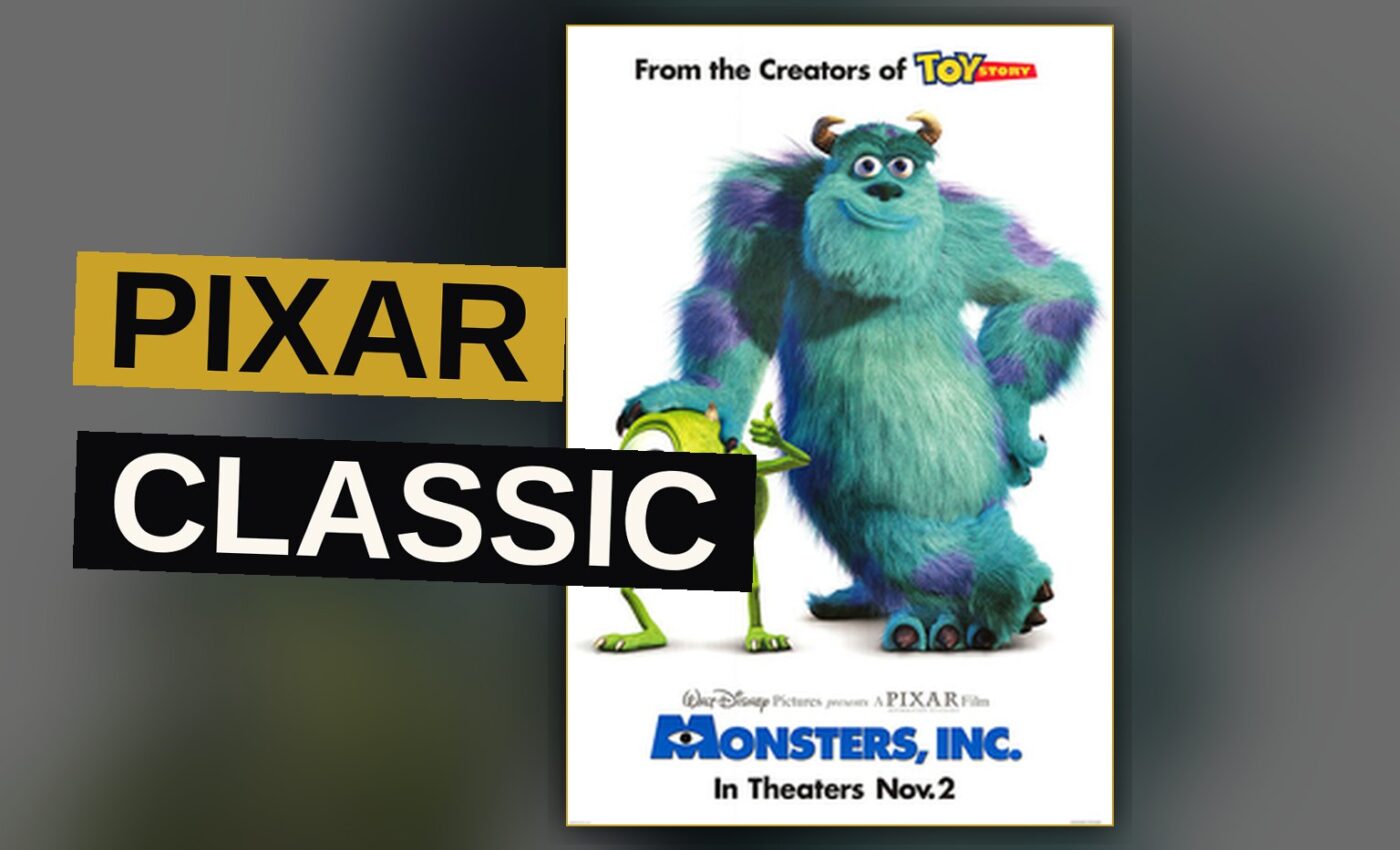
In 2001, Pixar released Monsters, Inc., a film about the creatures who live in our closets and the energy they harvest from our screams. It was a massive hit, and more than two decades later, it still holds up as one of the studio’s finest works. The film’s premise is a clever inversion of a childhood fear, turning the monsters under the bed into blue-collar workers just trying to make a living.
Trailer, via Pixar.
Inside the Scare Floor
The story centers on the city of Monstropolis, a bustling metropolis powered entirely by the screams of human children. The top scarer at the Monsters, Inc. factory is James P. Sullivan, known to his friends as Sulley, a large, furry, blue behemoth with a heart of gold. His partner and roommate is Mike Wazowski, a short, green, one-eyed ball of ambition who handles the administrative side of the scare business.
Their world is thrown into chaos when a human child, whom they call Boo, accidentally follows Sulley back through a door from the human world. The presence of a child in Monstropolis is considered a catastrophe, as contact with human children is believed to be toxic. The film’s central conflict then becomes a frantic effort to return Boo home while evading the company’s paranoid boss, Henry J. Waternoose III, and the treacherous chameleon-like lizard, Randall Boggs.
The film’s world-building is exceptional. The scare floor is a vast, industrial space filled with doors that slide along overhead tracks, each one a portal to a child’s bedroom. The process of scaring is treated with the gravity of a corporate job, complete with productivity charts, performance reviews, and a constant pressure to meet quotas. This workplace satire is the engine of the film’s comedy, and it remains sharp and relevant.
Sulley and Mike’s Odd Couple
The heart of the movie, however, is the friendship between Sulley and Mike. Their dynamic is a classic odd-couple pairing, but it is executed with such warmth and specificity that it never feels tired. Sulley is the reluctant hero, burdened by his natural talent for scaring, while Mike is the scheming optimist, always convinced he is one step away from greatness.
Their banter is fast and witty. Mike’s frustration with Sulley’s attachment to Boo is palpable, and Sulley’s growing paternal instinct is the film’s emotional core. The moment when Sulley realizes that laughter is more powerful than screams is a revelation, but it is earned through his relationship with Boo, not just a clever plot device. The film argues that connection and joy are stronger than fear, a message delivered without being saccharine.
Crafting the Animation
Technically, Monsters, Inc. was a leap forward for computer animation. The rendering of Sulley’s fur was a monumental achievement at the time, requiring the development of new software to simulate the millions of individual strands that make up his coat. The result is a character who feels tangible and soft, a stark contrast to the rigid, plastic look of earlier CGI characters.
The animation of Boo is also a triumph. She is rendered with a childlike simplicity, her oversized head and tiny limbs making her instantly adorable. The animators captured the unpredictable, chaotic energy of a toddler with remarkable accuracy, from her wobbly gait to her sudden bursts of laughter. The film’s visual language is expressive and clear, with every character’s physicality telling us who they are before they even speak.
Voices and Visual Gags
The voice performances are impeccable. John Goodman gives Sulley a booming yet gentle presence, while Billy Crystal’s Mike is a rapid-fire machine gun of nervous energy. Steve Buscemi’s Randall is a perfect villain, his slithering, hissing delivery making him a genuinely unsettling presence. The supporting cast, including James Coburn as Waternoose and Frank Oz as the paranoid yet lovable fungus, Jeff Fungus, adds depth to the world.
The film is also packed with memorable gags. The sushi restaurant where Mike takes his date, Harryhausen’s, is a visual feast of tentacled creatures and misinterpreted gestures. The scene where Sulley and Mike disguise Boo in a tiny monster costume is a masterclass in physical comedy. The film’s humor is derived from its characters and their world, never from cheap pop-culture references, which has allowed it to age gracefully.
The Emotional Payoff
The climax of the film is a thrilling chase through the door vault, but the true payoff is emotional. Sulley’s decision to prioritize Boo’s safety over his own career is a powerful moment. He rejects the cynical logic of his company, which would exploit children for profit, and chooses to protect a single child out of love.
The final act, in which Sulley and Mike are exiled to the Himalayas and must find their way back, serves as a test of their friendship. It is Mike who ultimately devises the plan to return, using a door fragment he has kept as a memento. This act of loyalty cements their bond and sets the stage for the film’s final, tear-jerking resolution.
Laughter Beats Fear
The film’s central thesis is stated explicitly near the end: laughter is ten times more powerful than screams. This is not just a plot contrivance but a philosophical statement. The film suggests that fear is a finite, diminishing resource, while joy is renewable and expansive. The energy crisis in Monstropolis is solved not by more efficient scaring but by a fundamental shift in how the monsters relate to children.
This message is delivered with sincerity, and it lands. The final scene, where Sulley opens Boo’s door one last time to hear her laugh, is a masterful piece of storytelling. The door, once a tool of fear, becomes a symbol of connection. The film ends on a note of quiet hope, suggesting that the monsters and the children have found a new way to coexist.
A Lasting Legacy
Monsters, Inc. was a critical and commercial success upon its release. It won the Oscar for Best Original Song for “If I Didn’t Have You.” Its success spawned a prequel, Monsters University, in 2013, and a series of short films, cementing its place in the Pixar canon.
The film’s legacy, however, is not just about its box office numbers. It is a movie that has been watched by generations of children, and its themes of friendship, empathy, and the power of laughter remain as relevant today as they were in 2001. It is a film that respects its young audience, offering complex emotions and a sophisticated satire of corporate culture without ever talking down to them.
The film argues that connection and joy are stronger than fear.
The animation may have been cutting-edge in 2001, but the story is timeless. The relationship between Sulley and Boo is one of the most genuine and moving depictions of a found family in cinema. The film’s humor is intelligent, its action is thrilling, and its heart is enormous.
It is a rare film that can be enjoyed equally by a five-year-old and a fifty-year-old, and that is a sign of its quality. The world of Monstropolis is fully realized, and the characters are unforgettable. The movie’s final message, that we should replace fear with laughter, is one that bears repeating.
The film is a complete package, delivering on every level. It is a comedy, a drama, an action movie, and a buddy picture, all rolled into one seamless narrative. The pacing is brisk, the voice acting is superb, and the emotional beats hit with precision.
It is a film that rewards repeated viewings, with small details and background gags that reveal themselves over time. The attention to detail in the animation, from the textures of the monster fur to the grime on the factory floor, creates a world that feels lived-in and real. The filmmakers clearly loved this world and its characters, and that love is infectious.
In the end, Monsters, Inc. is a near-perfect piece of family entertainment. It is a film that understands that children are not fragile, that they can handle complex themes and big emotions. It is a film that believes in the power of kindness and the importance of doing the right thing. It is a film that makes you laugh, makes you cry, and leaves you feeling better than when you started.
The film’s success is a sign of the power of a good story, well told. It is a reminder that the best art is not just entertaining but also meaningful. Monsters, Inc. is a classic, and it will continue to be watched and loved for many years to come.
It is a bright, funny, and deeply affecting work of art. The film’s ability to balance its silly premise with genuine emotional weight is its greatest strength. It is a movie about work, family, and the choices we make, and it handles all of these themes with grace and intelligence.
The film earns a score of 7.9/10.