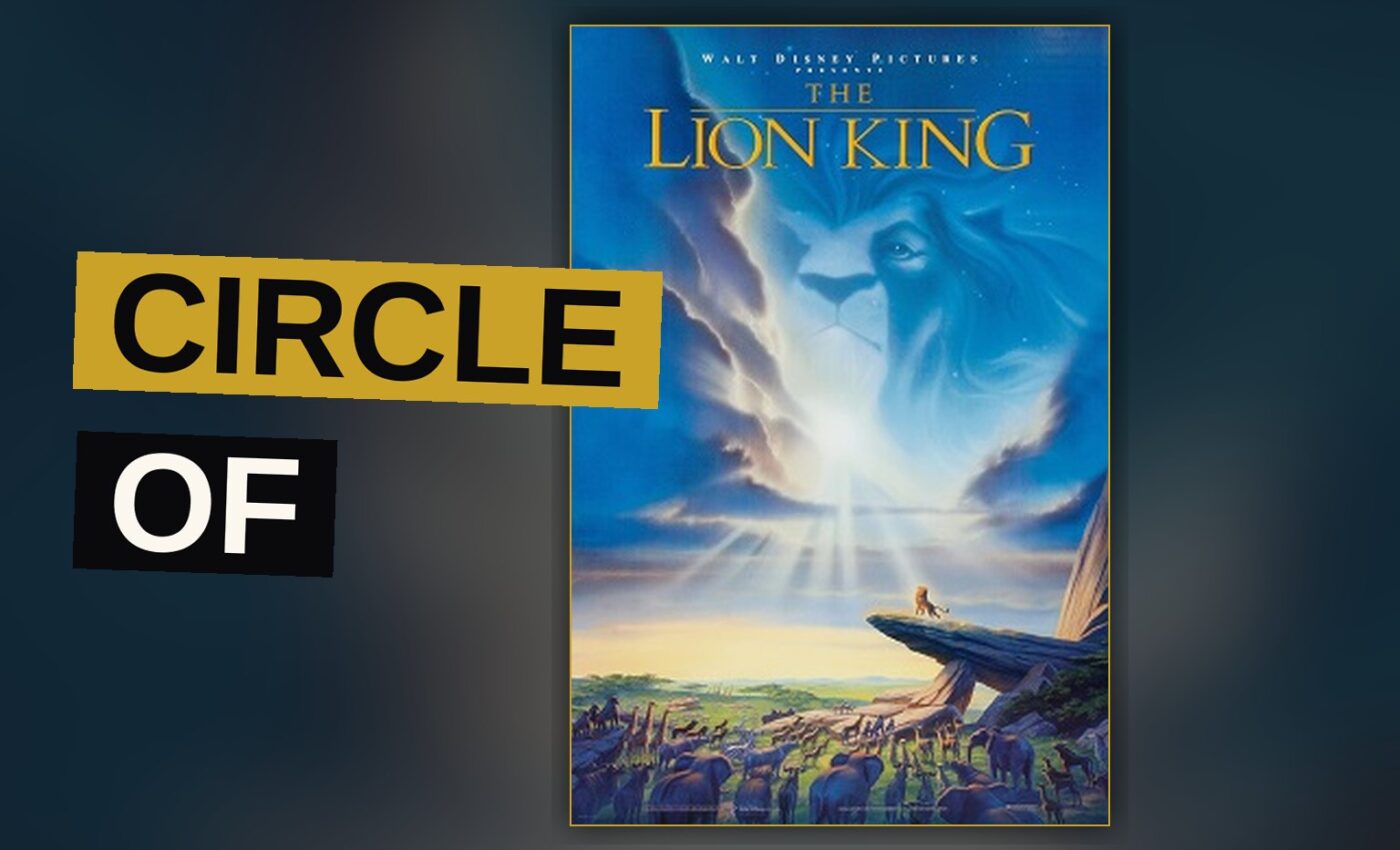
The Lion King remains the strangest kind of blockbuster: a film that is at once a brutal family tragedy, a Broadway-style musical, and a nature documentary about a talking meerkat. It opened in 1994 to near-universal praise, and thirty years later, it still holds the attention of children who have never seen a VHS tape and adults who can recite every line of “Be Prepared.” The film is not perfect, and its middle act drags in ways that a shorter runtime might have fixed, but the whole is so grand and so confident that its flaws read as ambition rather than error.
What makes The Lion King work is its willingness to take the story seriously. This is a film about murder, guilt, and the weight of a crown, dressed in the bright colors of a Saturday morning cartoon. The opening sequence, with the sunrise over Pride Rock and the assembled animals bowing to the newborn Simba, sets a tone of solemn majesty that the film never fully abandons. It is a bold choice, and it pays off.
Trailer, via Disney UK.
Pride Rock and the Opening Sequence
The first twenty minutes of The Lion King are arguably the best stretch of any animated film from the 1990s. The music swells, the giraffes bend their necks, and the Rafiki raises the cub to the sky. It is pure cinema, and it establishes the stakes without a single line of dialogue about politics or succession. You understand that this is a kingdom, and that the king matters.
Then comes the death of Mufasa. The stampede sequence is still shocking, even for viewers who know it is coming. The animation of the wildebeests is chaotic and terrifying, and the moment when Scar closes his claws over Simba’s grasp is a betrayal that lands like a physical blow. The film does not soften this. Simba finds his father’s body, and the camera holds on his small, trembling form. It is a rare moment in children’s entertainment where grief is allowed to be ugly and unresolved.
Scar’s Menace and His Song
Scar is the reason the film’s drama works. He is not a misunderstood antihero or a comic nuisance. He is a scheming, bitter brother who murders his sibling and then spends years letting his nephew believe it was his fault. The voice performance by Jeremy Irons is precise and theatrical, and the character’s wit is used sparingly enough that it never undercuts his menace.
His song, “Be Prepared,” is the film’s best musical number. The marching hyenas, the green fire, the choreography of the skulls — it is a sequence that feels more like a Bond villain’s monologue than a Disney tune. It also gives the film its clearest statement of theme: “The world moves on, and the world will live with you.” Scar is a nihilist, and the film treats that as a genuine threat, not a joke.
Hakuna Matata’s Slow Stretch
The film loses some of its grip once Simba runs away. The jungle sequence with Timon and Pumbaa is charming, and “Hakuna Matata” is a catchy song, but it is also a long stretch where the plot stalls. Simba grows up, eats bugs, and sings about ignoring his problems. The comedy is fine, but it sits awkwardly beside the tragedy that preceded it.
The problem is that the film needs Simba to be happy enough that his return feels like a sacrifice, but it does not want to show the cost of that happiness. Timon and Pumbaa are not bad characters, but their world is a vacation from the story, not a part of it. The sequence could have been trimmed by ten minutes without losing anything essential.
Returning to Pride Rock
The film recovers when Nala finds Simba. The reunion scene is brief, but it carries the weight of years. Nala tells him that the Pride Lands are dying, that the herds have left, and that Scar has let the hyenas take over. Simba refuses to listen, and it takes the ghost of Mufasa to shake him out of his denial.
The confrontation with Scar is the film’s second great set piece. The lightning storm, the fire, the revelation of the truth — it all builds to a climax that is both physical and moral. Scar’s death, with the hyenas closing in on him, is darker than most Disney endings, and it is better for it. The film does not pretend that justice is clean.
Music and Voice Cast
The songs by Elton John and Tim Rice are uneven, but the best of them are superb. “Circle of Life” and “Be Prepared” are the standouts, while “Can You Feel the Love Tonight” is pleasant but forgettable. The score by Hans Zimmer does the heavy lifting, giving the film a grandeur that the songs sometimes lack.
The voice cast is strong across the board. Matthew Broderick is fine as adult Simba, though his performance is the least distinctive. James Earl Jones gives Mufasa a gravity that makes the character feel like a god, and Nathan Lane and Ernie Sabella bring real comic energy to Timon and Pumbaa. The standout is Irons, who turns Scar into a theatrical villain without ever becoming camp.
Legacy of the 2019 Remake
The Lion King spawned a sequel, a television series, and a stage musical that has run for decades. In 2019, Disney released a photorealistic remake that drew audiences back to the story. The original, though, has something the remake does not. The hand-drawn animation gives the characters a flexibility and a warmth that the CGI versions lack. Simba’s face can show fear, joy, and confusion in a way that a realistic lion’s face cannot. The stylization is not a limitation; it is the point.
Final Score and Breakdown
The Lion King is not the best animated film ever made, and it is not even the best film Disney released in the 1990s. But it is a film that understands its own scale. It is a tragedy with a happy ending, a musical with a body count, and a children’s film that trusts its audience to handle real emotion.
The pacing issues in the middle act are real, but the film’s treatment of the hyenas is a minor flaw that does not damage the overall experience. The core of the film — the relationship between Simba and his father, the weight of responsibility, and the idea that running away is not the same as healing — remains powerful.
- The opening sequence sets a standard that few animated films have matched.
- Scar is a villain with genuine menace and a memorable song.
- The middle act drags, but the return to Pride Rock restores the momentum.
- The hand-drawn animation gives the film a warmth that the remake cannot replicate.
- The opening sequence is the film’s greatest achievement.
- Scar’s performance and song elevate the villain role.
- The pacing falters in the jungle, but recovers fully.
- The animation style remains superior to the 2019 remake.
The Lion King earns its place in the canon. It is a film that rewards attention, that holds up to repeated viewings, and that treats its youngest viewers with respect. It is not flawless, but it is essential.