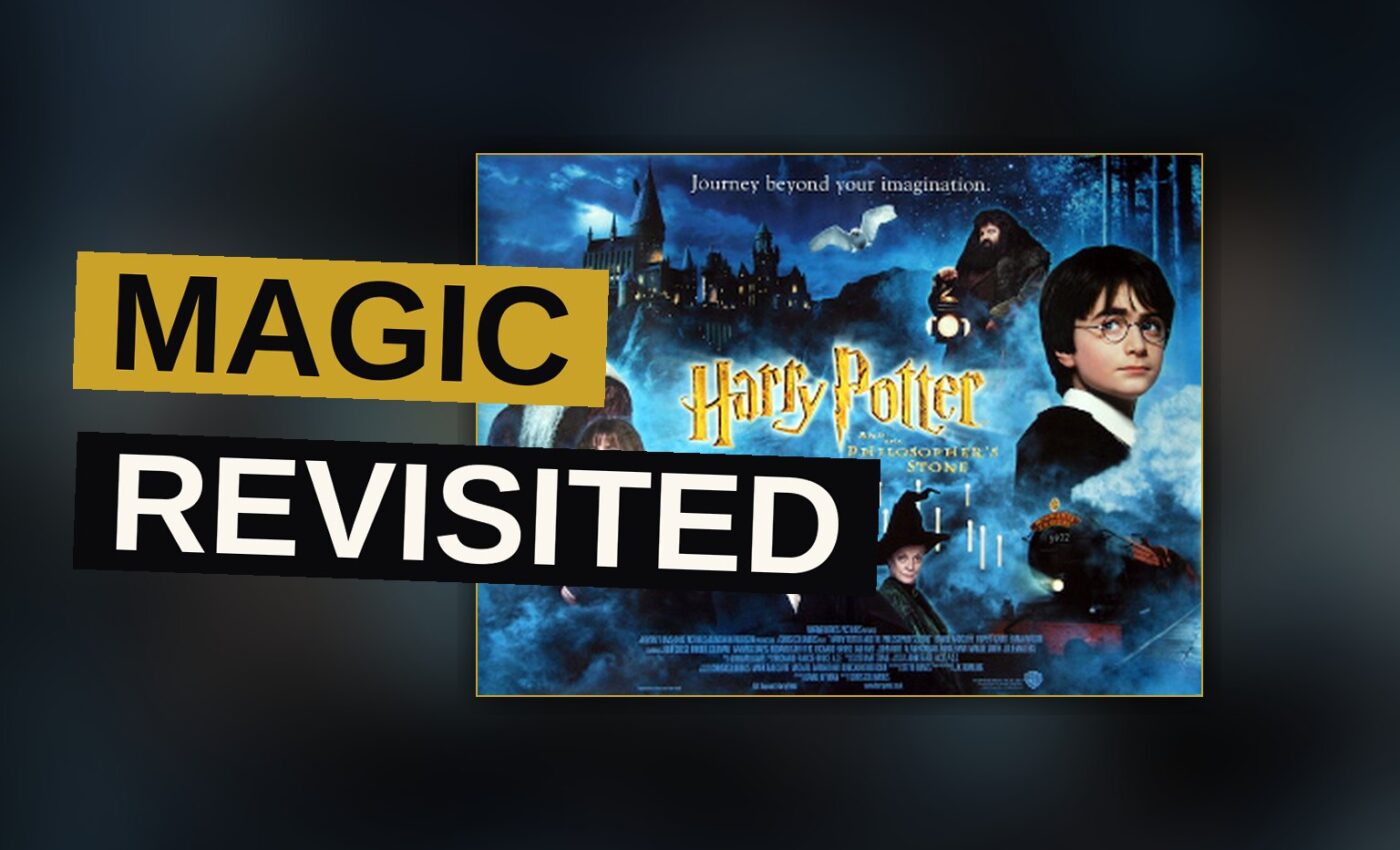
It has been 25 years since Harry Potter and the Philosopher’s Stone first brought J.K. Rowling’s world to the screen, and the film remains a sturdy, sincere piece of blockbuster craft. It is not the darkest or the slickest entry in the series, but it is the one that had to get everything right. It did.
Trailer, via Warner On Demand.
Casting the Trio
The film lives or dies on its three leads, and they deliver. Daniel Radcliffe, Rupert Grint and Emma Watson are raw, occasionally stiff, but utterly right for their roles. They do not act like seasoned professionals; they act like children discovering a magical world, which is exactly what the story requires. Grint’s comic timing as Ron provides the film’s warmest laughs, while Watson’s Hermione carries a bossy intelligence that never tips into caricature.
Building Hogwarts
Production designer Stuart Craig built a castle that feels both ancient and lived-in. The Great Hall, with its floating candles and enchanted ceiling, remains the defining image of the franchise. The film leans on practical sets and prosthetics rather than digital gloss, and that choice has aged well. The troll in the bathrooms looks like a creature, not a cartoon, and the chess scene retains a tangible weight that later CGI-heavy sequels often lack.
Chris Columbus at the Helm
Chris Columbus directed Harry Potter and the Philosopher’s Stone with a straightforward, family-friendly hand. He does not push for dark nuance or complex subtext. Instead, he trusts the material’s inherent wonder. The pacing is leisurely, almost to a fault, with the film running past two and a half hours. Some sequences, like the early scenes at the Dursleys’, drag. But Columbus earns his keep in the set pieces, particularly the final confrontation with Professor Quirrell.
John Williams and the Score
John Williams provided the score, and his “Hedwig’s Theme” has become as iconic as the lightning bolt scar. The music does the heavy lifting in the quieter moments, selling the awe of Diagon Alley and the melancholy of the Mirror of Erised. The film’s emotional core rests on that mirror scene, where Harry sees his dead parents. It is a brief, quiet beat, and it works.
Where It Stumbles
The film is not perfect. The final act’s logic is a little rushed. The trio solves puzzles more by luck than by wit, and the reveal of Voldemort’s face on Quirrell’s head remains a strange special effect. The movie also truncates several subplots from the book, leaving non-readers with a few dangling threads.
A Franchise Blueprint
Harry Potter and the Philosopher’s Stone set the template for everything that followed. It established the tone, the casting and the visual language of a franchise that would span a decade. It is not the best film in the series, but it is the most important one. It had to convince millions of readers that their imagined world could exist on screen, and it did.
The film holds up as a charming, earnest introduction to a beloved story. It is a solid 7.9/10.
| Film detail | Value |
|---|---|
| Release year | 2001 |
| Director | Chris Columbus |
| Composer | John Williams |
| Audience score | 7.9/10 |