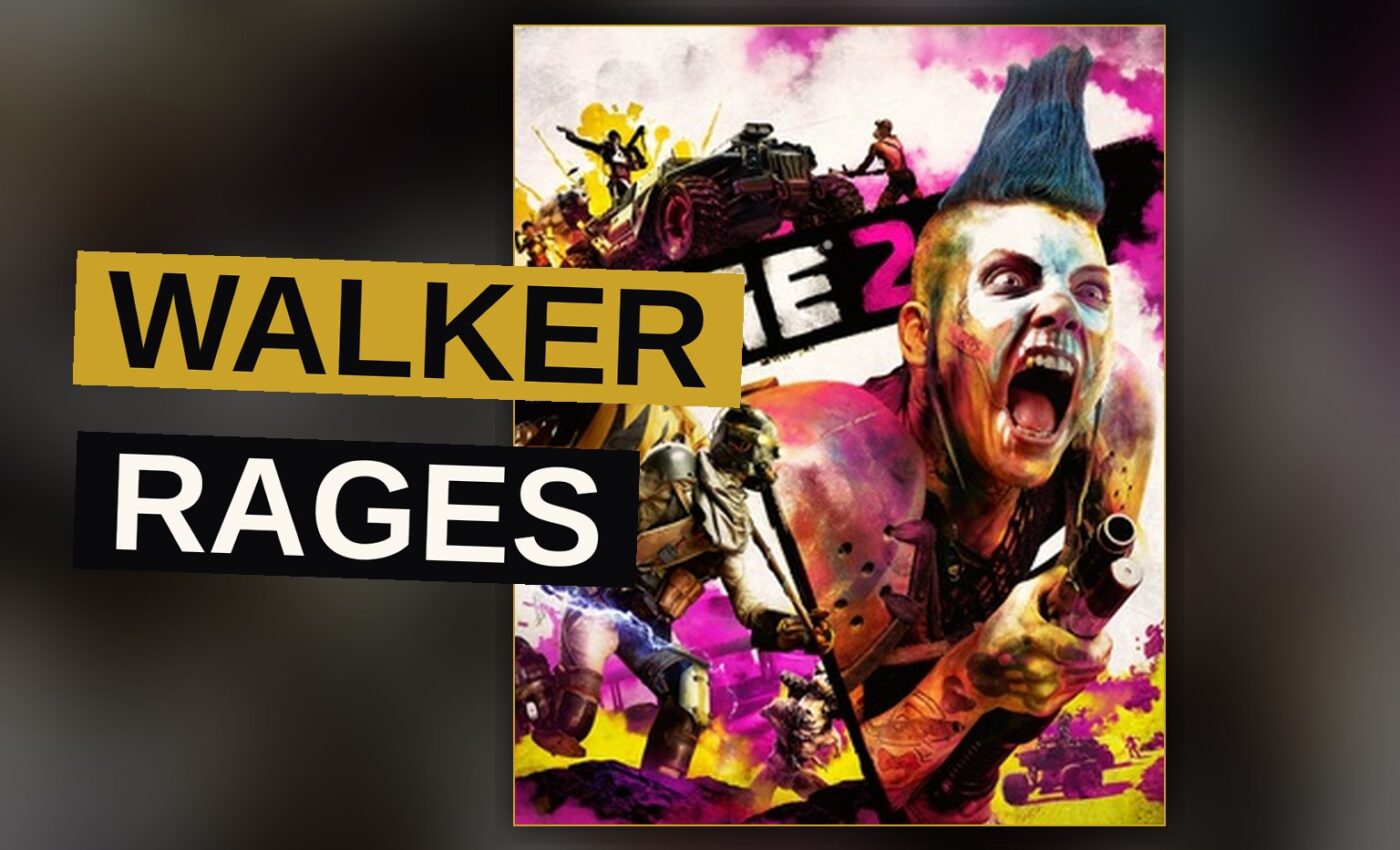
Rage 2 wants you to remember one thing: the shooting. Everything else in Avalanche Studios and id Software’s 2019 sequel is scaffolding around that, and the scaffolding wobbles.
The game lands on PlayStation 4, Xbox One, Windows PC and Google Stadia. Bethesda Softworks published it. It is a first-person shooter with an open world, vehicles, Nanotrite powers and a hero named Walker. It is also a sequel to 2011’s Rage, and it treats that inheritance loosely — the wingstick returns, the Nanotrites return, and little else does.
Trailer, via Bethesda Softworks.
Walker Wakes Up in Vineland
The prologue sets a clear stake. Walker is the last Ranger of Vineland, a city built by former Ark residents and their descendants. The Authority storms it with rebuilt Abadon mutant armies. General Cross kills Walker’s adoptive Aunt Prowley, who leaves a pre-recorded holotape asking Walker to carry out Project Dagger — a mission meant to stop Cross.
That is a strong opening. It gives the player a home, a loss and a target in one pass. Then Rage 2 spends the rest of its runtime forgetting how to build on any of it.
Walker is inducted as the last Ranger. The nanotrite-powered suit gives enhanced combat abilities, and Prowley’s recording sends Walker after the three other members of Project Dagger: Loosum Hagar, Marshall and Dr. Kvasir. Prowley’s biological daughter, Lily, hands over the Phoenix, an indestructible vehicle, and promises to rebuild Vineland while Walker is away.
The Gut and the Bunker
Follow Marshall and you get the game’s best and worst instincts in a single thread. He is found in Gunbarrel, where Walker helps restore power and then hunts for Gulo, a scout Marshall sent out from a hostile clan called the Immortal Shrouded.
Gulo swallowed the recorder holding the bunker’s location. Walker recovers it from her already-carved-out gut. The pair then wipe out the Immortal Shrouded and an Authority patrol sent to dislodge them, and secure the data needed to get past the Authority’s security scans.
That is a memorable beat. It is also the kind of beat Rage 2 keeps reaching for without earning — shock as texture, not as story.
Dive headfirst into a dystopian world devoid of society, law, and order.
Loosum Hagar runs Wellspring, a major travel hub in the Wasteland, and the game’s structure fans out from there. The pitch is a true open world FPS where you can go anywhere, shoot anything and explode everything. That pitch is honest about what Rage 2 is. It is less honest about what it costs.
Overdrive Does the Heavy Lifting
Combat is the argument for the game, and it mostly wins. Players pick up firearms and tools, including the returning wingstick, and build Walker’s skills through Nanotrite-based powers. Overdrive is the centerpiece: guns do more damage, enemies drop more energy, and Walker gets healed constantly. It rewards aggression over cover.
The result is an aggressive way to mow down enemies, and it works. Nanotrites from the first game return as special powers and ability boosts that raise combat efficiency. Vehicles matter too — trucks, buggies and gyrocopters, and the player can drive any vehicle in the world.
Here is the problem. Rage 2 is a shooter with racing, role-playing and adventure ambitions layered on top, and the layers do not fuse. The open world is where the game is weakest, and it is where most of your hours go.
An Open World That Fights Back
The setting is a wasteland after the asteroid 99942 Apophis wiped out the majority of mankind. New settlements and factions emerged. The Authority declared themselves the new military power. Dangerous mutants and crazed bandits fill the gaps.
That is a serviceable frame. It is not a world. Rage 2 gives you territory to cross and outposts to clear, and it rarely gives you a reason to care which one you are standing in. The emergent madness the pitch promises mostly means the same fight in a different dirt lot.
Compare the combat loop to the story delivery and the split becomes obvious. Overdrive is tuned, specific and confident. The plot is a checklist of names, factions and errands. Aunt Prowley dies in a holotape. Lily stays behind. Marshall, Loosum and Kvasir are objectives before they are people.
What Rage 2 Gets Right
- Overdrive — the best idea in the game, and the reason to keep playing past the first hour.
- The wingstick — a returning weapon that still feels good in the hand.
- Vehicle combat — trucks, buggies and gyrocopters, all drivable, all usable in a fight.
- Nanotrite powers — meaningful boosts that change how encounters play out.
- The Phoenix — an indestructible vehicle that makes the Wasteland navigable.
That list is not a defense. It is a diagnosis. Rage 2 knows exactly what it is good at, and it is good at exactly those things. Everything outside them — the story, the characters, the open world — reads as obligation.
Where the Sequel Goes Wrong
The clearest failure is that Rage 2 has no idea what to do with its own premise. An asteroid killed most of humanity. A military faction called the Authority took over. Mutants and bandits roam the roads. That is a setup for a game about scarcity, fear and control. Rage 2 uses it as a backdrop for shooting galleries.
Walker is customizable in gender, skills and attire, which should matter. It does not. Walker is a suit of nanotrites with a gun, and the game never asks the player to be anything else. The last Ranger of Vineland is a title, not a character.
The Authority are the villains, and General Cross is the man who killed Prowley. That is the whole of their interior life. They rule with an iron fist because the story needs a fist to rage against.
What Rage 2 Leaves Behind
Rage 2 earns its keep in the moment-to-moment. Overdrive, the wingstick, the drivable gyrocopters and the Nanotrite powers make a case for the game that the campaign cannot sustain over its full length. If you come for the shooting, you will get the shooting, and it is loud and fast and frequently excellent.
If you come for anything else, you will leave empty. The story is thin, the characters are names attached to errands, and the open world is a container rather than a place. Avalanche Studios and id Software built a great combat system and then asked it to carry a game that needed more than combat.
The mixed reception the game drew is the right read. Praise for the combat is earned. Criticism of the story, characters and open world gameplay is also earned, and it is not a small complaint — those are most of what Rage 2 is.
This is the part worth watching for anyone weighing a purchase: Rage 2 is a game you play for the fight, not the fiction. The fight is good enough to justify the trip. The fiction is not good enough to remember the trip by.
Rage 2 scores 6.9 of 10.
Get the Notebook.
The day's best stories and every fresh verdict, in plain English, in your inbox by seven. One email a day, no more.