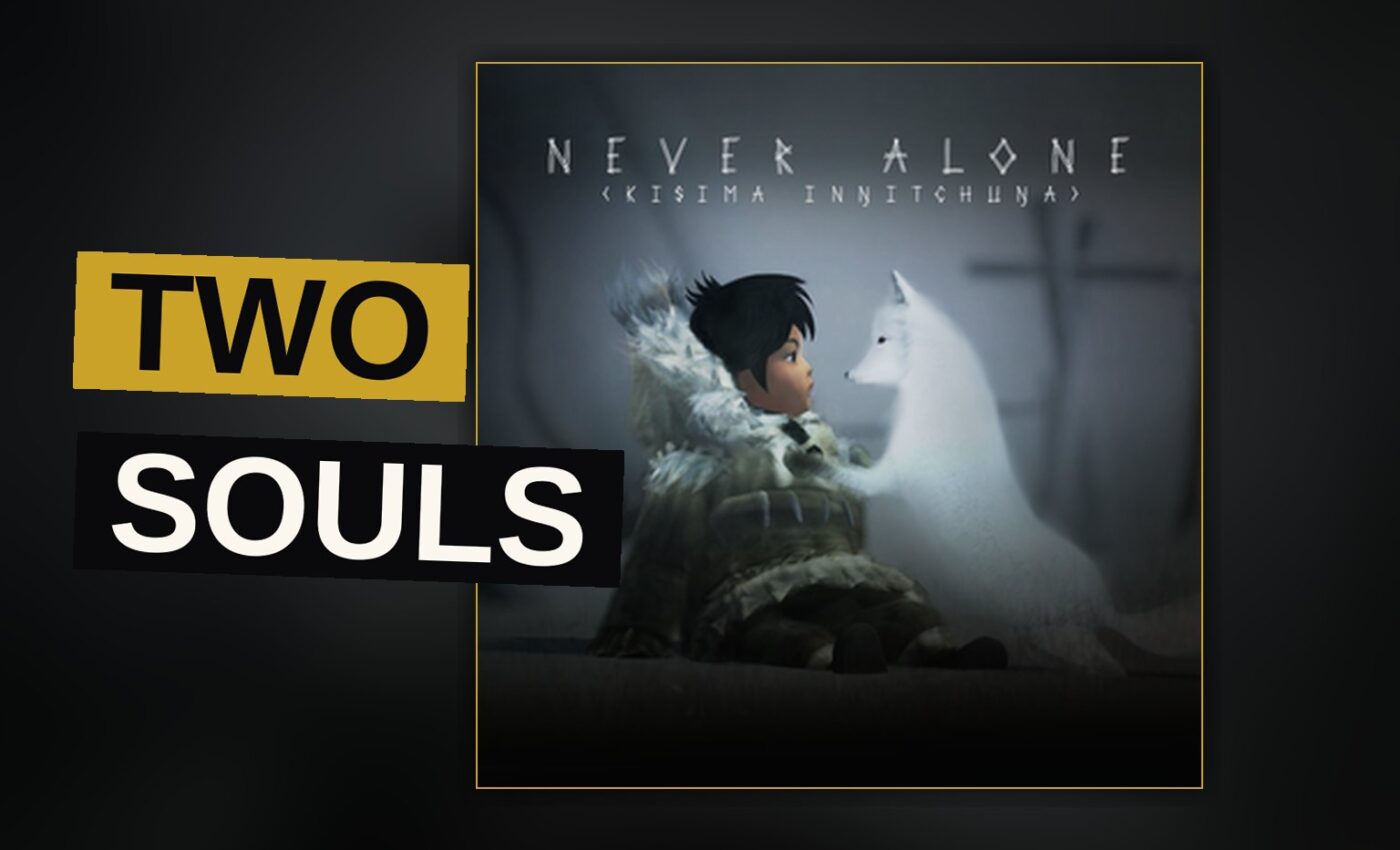
Never Alone: Kisima Ingitchuna opens on a girl and an Arctic fox walking into a blizzard that will not stop. The game came out in 2014, developed by Upper One Games and published by E-Line Media, and it carries a claim no other puzzle platformer can make: it is the first game built in collaboration with the Iñupiat, an Alaska Native people.
That collaboration is not a marketing line. Nearly 40 Alaska Native elders, storytellers and community members worked on the game. Their voices sit inside it, and the story it tells was shared across generations before it was ever playable.
Trailer, via IGDBcom.
Nuna and the Arctic Fox
You play Nuna, a young Iñupiat girl, and the fox that travels with her. Their goal is simple to state and hard to survive: find the source of the eternal blizzard that threatens everything they have ever known.
The two characters are the whole design. You can play alone, switching between them, or play cooperatively with a friend. The fox is not a cosmetic companion. The pair moves through frozen tundra, leaps across treacherous ice floes, swims through underwater caverns, and faces enemies both strange and familiar. Each character does what the other cannot, which is why the co-op mode is the one that makes the most sense.
What the Iñupiaq Language Carries
A master storyteller narrates the entire game in spoken Iñupiaq. That choice does more work than any single level. You are not reading a translation of a myth repackaged for a console audience. You are hearing the story told the way it was told.
The environments follow the same rule. They are drawn from Iñupiaq stories rather than from the standard platformer playbook, and legendary characters from those stories appear as you travel. The game is atmospheric in the literal sense — weather is the antagonist, and the weather never lets up.
The Platforming Itself
Here is where Never Alone is ordinary. The jumping is fine. The puzzles are fine. The ice floes and caverns are arranged competently, and the side-view perspective does what side-view perspectives do.
Nothing in the moment-to-moment movement will surprise anyone who has played a puzzle platformer in the last decade. The fox’s abilities and Nuna’s abilities are distinct, but the challenges built around them rarely push past the obvious use.
The Genres on the Box
The store page lists the game as platform, puzzle, adventure and indie. It also tags it action, historical and educational. Every one of those tags holds up.
- Single player, with character switching
- Multiplayer, cooperative
- Side-view perspective
- Platform, puzzle, adventure, indie
The genre list is accurate. So is the theme list. That is rarer than it sounds.
Where It Ships
Never Alone went wide. It arrived on PlayStation 3, PlayStation 4, Linux, Android, PC (Microsoft Windows), iOS, Mac, Wii U and Xbox One. That is an unusually broad spread for a 2014 indie release, and it matters, because the game’s value is not in its difficulty curve. It is in who gets to play it.
| Element | What Never Alone does |
|---|---|
| Story source | Traditional Iñupiaq story, shared across generations |
| Development | Collaboration with the Iñupiat; nearly 40 elders, storytellers and community members |
| Narration | Master storyteller, spoken Iñupiaq |
| Play modes | Single player or cooperative |
| Characters | Nuna, a young Iñupiat girl, and an Arctic Fox |
| Goal | Find the source of the eternal blizzard |
Put that table next to almost any other 2014 platformer and the difference is not the mechanics. It is the column on the left.
The Score, and What It Means
Published critical aggregate puts Never Alone: Kisima Ingitchuna at 7.1/10 across 10 outlets. That number is fair, and it is also a little misleading if you read it as a measure of importance.
The 7.1 is a platformer score. It reflects competent jumping, puzzles that rarely surprise, and a side-view adventure that runs out of mechanical ideas before it runs out of story. If you came for tight challenge design, you will find a game that is good and not great.
The parts that are not mechanics are the parts that last. Nearly 40 Alaska Native elders, storytellers and community members did not consult on this game from a distance. They built it. A master storyteller narrates it in Iñupiaq. The blizzard, the tundra, the ice floes and the underwater caverns are not set dressing borrowed from a myth. They are the myth.
What Actually Matters Here
The most important thing Never Alone: Kisima Ingitchuna proves is not that a traditional story can become a video game. It is that the people who own the story can be the ones who make it. Upper One Games and E-Line Media did not extract a folk tale and hand it to a studio. They built the studio around the collaboration.
That is why the co-op mode reads differently than it would in another game. Nuna and the fox need each other to cross the ice. The design says something the dialogue never has to.
The enemies are both strange and familiar. The legendary characters arrive out of Iñupiaq stories. The narration never switches to English to make you comfortable. None of that is a difficulty setting. It is the game.
Our verdict: Never Alone: Kisima Ingitchuna is a good puzzle platformer and a genuinely important release, and those are two different measurements. The first earns the 7.1. The second is not something a critic aggregate can score. Play it cooperatively if you can, and play it for the parts that no other 2014 game has.
Get the Notebook.
The day's best stories and every fresh verdict, in plain English, in your inbox by seven. One email a day, no more.