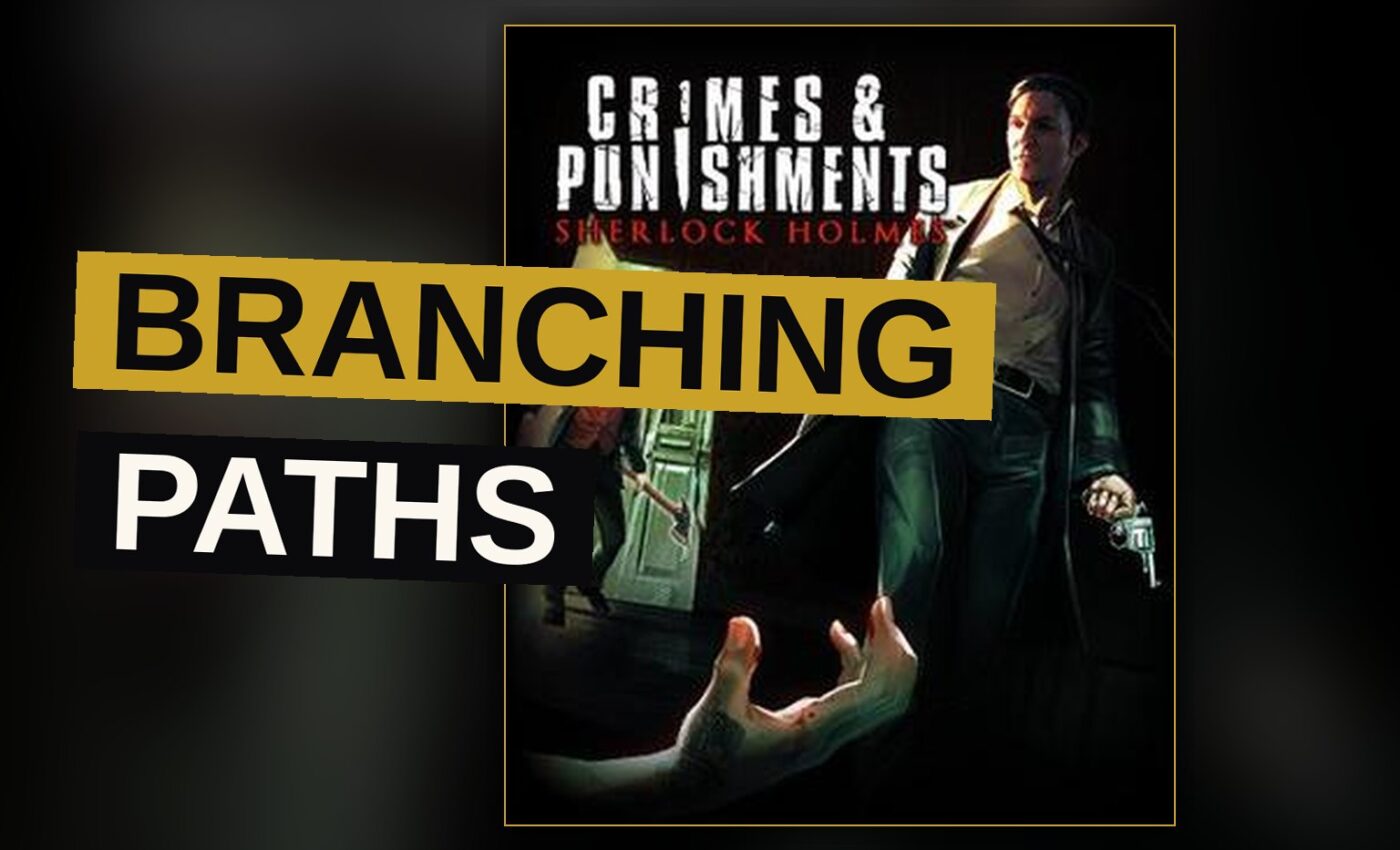
Sherlock Holmes: Crimes & Punishments asks a simple question: what if the detective story was a choose-your-own-adventure? The answer, mostly, is fun. Developer Frogwares built a branching investigation system around the original cases, letting players interrogate witnesses, examine crime scenes and make moral choices that change the outcome. It is a bold experiment, and it mostly works.
The game launched in 2014 for PS3, PS4, PC and Xbox 360. It is based on Sir Arthur Conan Doyle’s stories, though it takes some liberties with the canon. The core loop is straightforward: Holmes investigates a case, gathers evidence, and then presents his findings to Scotland Yard. The twist is that players can make choices along the way, affecting who gets arrested, who walks free, and sometimes even who lives or dies. Those choices determine the final verdict, with charges declined, dismissed, denied or still unresolved depending on the evidence and the player’s decisions.
Trailer, via IGDBcom.
The Case Files
The game includes six main cases, each based on a different original story. They range from murder mysteries to theft investigations to political intrigue. Each case is self-contained, and each has multiple endings depending on player decisions. That structure rewards replayability, since a second pass through a case can lead to a very different conclusion.
The cases are not presented in chronological order. Players jump between different points in Holmes’s career, from early cases to later ones. This non-linear approach means there is no single “correct” path through the story, which is a deliberate design choice.
Here is a quick look at the six cases:
| Case | Original Story Basis | Focus |
|---|---|---|
| The Case of the Missing Man | “A Study in Scarlet” | Murder and identity |
| The Case of the Dead Man | “The Adventure of the Speckled Band” | Poisoning and revenge |
| The Case of the Stolen Goods | “The Sign of the Four” | Theft and blackmail |
| The Case of the Disappearance | “The Adventure of the Dancing Men” | Cryptography and deception |
| The Case of the Political Scandal | “The Adventure of the Second Stain” | Espionage and corruption |
| The Case of the Final Solution | “The Adventure of the Bruce-Partington Plans” | Espionage and betrayal |
Making Choices Matter
The interrogation system is the heart of the game. Players can ask witnesses open-ended questions, challenge their statements, or offer them incentives like money or leniency. Each response affects the witness’s trust level, which in turn affects how much information they are willing to share.
This system is cleverly designed. It rewards patience and deduction, since a player who reads a witness carefully can often guess the truth before the dialogue options appear. The game also tracks player reputation with Scotland Yard, so a persistent liar or a harsh interrogator can find themselves working alone.
The moral choices are where the game stumbles slightly. Some decisions feel arbitrary, with outcomes that depend more on the player’s whims than on the evidence at hand. A player who chooses mercy in one case might see a guilty party walk free, while a player who chooses justice might see an innocent person suffer. These moments are rare, but they stand out precisely because they break the illusion of Holmes’s omniscient reasoning.
Investigation Tools
Players spend a lot of time examining crime scenes. The game offers a detailed inspection mode, allowing Holmes to look for fingerprints, footprints, and other clues. The tools are functional, if not revolutionary, and they work well enough to keep the player engaged.
The deduction system is also present, though it is less prominent than in previous Frogwares games. Players can still make logical leaps based on the evidence, but the game leans more on dialogue and observation than on abstract puzzles. This shift suits the episodic format, but it means some longtime fans of the series may miss the deeper logic challenges.
Performance Across Platforms
The game runs on four platforms, and the differences show. The PS3 version is the weakest, with lower frame rates and reduced texture detail. The PS4 and Xbox 360 versions perform better, though they share similar limitations. The PC version is the strongest, offering higher resolutions and smoother performance.
The loading times vary significantly across platforms. On slower machines, the game can take several seconds to transition between scenes, which breaks immersion during the more dramatic moments.
Sound Design
The audio design is strong. The voice acting is excellent, with a standout performance from the lead actor playing Holmes. The sound effects are atmospheric, and the music complements the mood without overpowering it.
The dialogue pacing is well handled. Players get enough context to understand the stakes without being overwhelmed by exposition. The game also includes optional text descriptions for those who want to read the dialogue rather than hear it spoken.
Length and Replay Value
Each case takes about three to five hours to complete, depending on how thoroughly a player examines the environment. The total playtime for all six cases is substantial, especially when replayed with different choices.
The replay value is high for those interested in seeing every ending. The game also includes a “detective mode,” which strips away hints and forces players to solve cases on their own. This mode is challenging and rewarding for completionists.
Weak Points
The game is not without flaws. Some of the voice acting is uneven, particularly in supporting roles. The combat, when it occurs, is simple and repetitive, and it feels tacked on rather than integrated into the overall experience.
The pacing can drag in the middle of cases, especially when the player is examining a scene for the second or third time. The game also lacks a strong multiplayer component, which limits its appeal beyond solo play.
Ranking the Cases
Not all cases are created equal. Here is how the six cases rank in terms of quality and replay value:
- The Case of the Dead Man — the most tightly constructed and satisfying case.
- The Case of the Final Solution — the most morally complex and rewarding to replay.
- The Case of the Disappearance — the most visually distinct and memorable.
- The Case of the Missing Man — the weakest, with a less interesting premise.
- The Case of the Political Scandal — the most convoluted and frustrating.
- The Case of the Stolen Goods — the most forgettable, despite its potential.
Final Word
Sherlock Holmes: Crimes & Punishments is a solid entry in the series. Its branching narrative and interrogation system give players real agency, even if the moral choices are occasionally blunt. The investigation tools are serviceable, and the performances are strong.
The game is a mixed bag across platforms, but the PC version remains the best way to experience it. For fans of the detective genre, this is a worthwhile addition to the library.
The game earns a 7.5 out of 10.