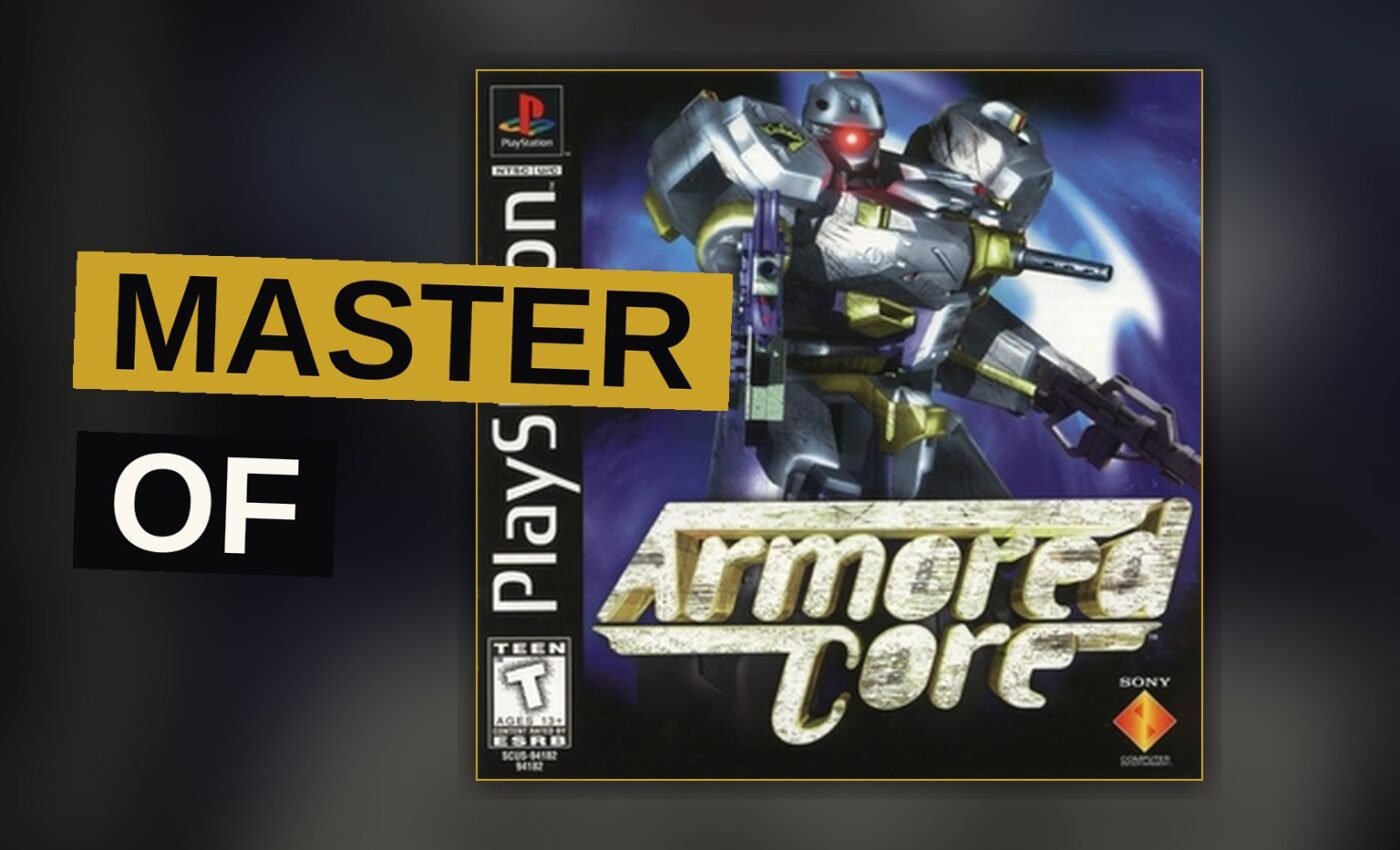
Armored Core: Master of Arena arrived on the original PlayStation in 1999 as the third game in FromSoftware’s mech series and the last chapter of the original trilogy. It was not released in Europe. FromSoftware moved on to Armored Core 2 on the PlayStation 2 the following year. What Master of Arena left behind was a reputation: the entry that turned the Arena from a side attraction into the spine of the series. That reputation holds up. The game around it does not always.
The Arena becomes the point
Project Phantasma had introduced the Arena as an optional diversion. Master of Arena makes it required. The story runs through it. You climb by beating ranked pilots, and the game structures its whole campaign around that ladder. The Arena is split across two discs: the first carries matches woven into the story, while the second, EX Arena, holds the bulk of the fighting separate from the plot. A “Ranker MK” mode on EX Arena lets players build custom opponents and fight them in special matches.
That is a lot of Arena. It is also the right amount. The fights are short, legible and repeatable, and losing teaches you something specific about your build rather than your reflexes. This is the part of Master of Arena that aged best.
Nineteen missions, ten arenas
The scale is real. Master of Arena ships with 19 missions and 10 arenas covering over a hundred opponents. Weapons and items from both earlier games return alongside equipment exclusive to this one. The import feature — a constant across the franchise — carries over, letting players bring a character from Project Phantasma or the original Armored Core via a memory card save. Start fresh instead and you are locked out of certain weapons and items from the earlier games.
That trade is the sharpest design decision in the package. It rewards the player who stayed, and it taxes the one who did not. For a 1999 sequel built on two prior discs of parts, that is a fair bargain, and it gives the Arena ladder a reason to matter beyond bragging rights.
Two discs, one link cable
Master of Arena keeps the series’ split-screen multiplayer and its link mode, which connects two PlayStation consoles with the Link Cable for 1-on-1 battles. Earlier games in the series required two separate copies of the title for system linking. Master of Arena does not. The two discs in the box cover it.
That is a small, practical kindness, and it is the kind of thing that decides whether a multiplayer mode gets used at all. Split-screen was already there. The link mode was already there. Making it cheaper to actually try is the improvement.
A survivor, a manager, a sponsor
The plot is thin and delivered mostly through short mission briefings and arena context. What is there: a massive battle in Isaac City between two corporations kills a large number of civilians. The player’s Raven is a survivor who lost their entire family. Swearing revenge, the survivor joins the Raven’s Nest to fight to the top and kill Hustler One, the pilot of the famed Nine-Ball mech at the center of that battle.
Two allies appear. Lana Nielsen becomes the player’s manager. Elan Cubis, an influential figure at a company called Progtech, becomes the player’s sponsor while investigating the Raven’s Nest. Progtech facilities come under attack. High-ranking pilots turn out to be involved in stealing secret materials. An assault on Progtech headquarters reveals Elan is the target, and the attackers follow him to a laboratory deep in Isaac City. Hustler One leads them and confronts the player. His Nine-Ball is damaged and he retreats. The player takes the fight to the Arena and seemingly defeats him.
Then a message from Lana pulls the player to an abandoned factory. Lana and Hustler One are components of a master AI controlling numerous Nine-Ball mechs — an AI that built both the corporations and the Raven’s Nest to rebuild humanity. The player narrowly beats the powerful Nine-Ball and seemingly ends it.
The twist earns its place
That ending is doing more work than the rest of the script. The Arena ladder, the corporate war, the revenge errand — all of it turns out to be machinery inside a larger machine. The game does not build to that with much craft. Briefings stay short. Lana and Elan have agendas, but the game tells you they have agendas rather than letting you feel them.
Still, the reveal lands because it re-reads the whole structure. You spent the game climbing a ladder that was built for you. That is a better idea than most mech games of the era bothered to have, and Master of Arena gets credit for it even when the delivery is dry.
What the customization actually buys
The mech building is the other half of the argument. Master of Arena expands it, offering more parts and finer performance tuning than its predecessors. The result is a game where the answer to a hard Arena opponent is usually a rebuild, not a better run. Each slot moves the numbers, and the numbers decide whether a fight is winnable.
For players who came from the first two games, this is the point. For anyone arriving cold in 1999, the barrier was steep, and it has not gotten shallower. Master of Arena assumes fluency. It does not teach.
The score
Armored Core: Master of Arena is the strongest of the original trilogy and the least welcoming of them. Its Arena is the reason the feature survived into later games, and its two-disc structure, import support and link-cable battles make it a more generous package than it had any obligation to be. The campaign around that Arena is thin, the story is told in fragments, and the difficulty curve is a wall.
8 of 10.
Hard numbers
- Title: Armored Core: Master of Arena
- Release year: 1999
- Developer: FromSoftware
- Publisher: Agetec, FromSoftware
- Genre: Shooter (third-person)
- Platform: PlayStation (also playable on PlayStation 3 and PlayStation Portable)
- Series position: Third entry; final game of the original Armored Core trilogy
- Europe release: None
- Missions: 19
- Arenas: 10
- Discs: Two — main game plus EX Arena
- Multiplayer: Split-screen and PlayStation Link Cable, 1-on-1
- Score: 8 of 10
Release timeline
| Date | Release |
|---|---|
| — | Armored Core: Project Phantasma (PlayStation) |
| 1999 | Armored Core: Master of Arena (PlayStation) |
| August 3, 2000 | Armored Core 2 (PlayStation 2), indirect sequel |
The thing worth watching here is not the twist. It is the Arena. FromSoftware took an optional mode from Project Phantasma and built an entire game’s progression on top of it, then shipped a second disc so players could keep fighting after the story ran out. That decision is why the Arena is a core feature of the series today and not a footnote. The revenge plot is scaffolding. The ladder is the building.
Get the Notebook.
The day's best stories and every fresh verdict, in plain English, in your inbox by seven. One email a day, no more.