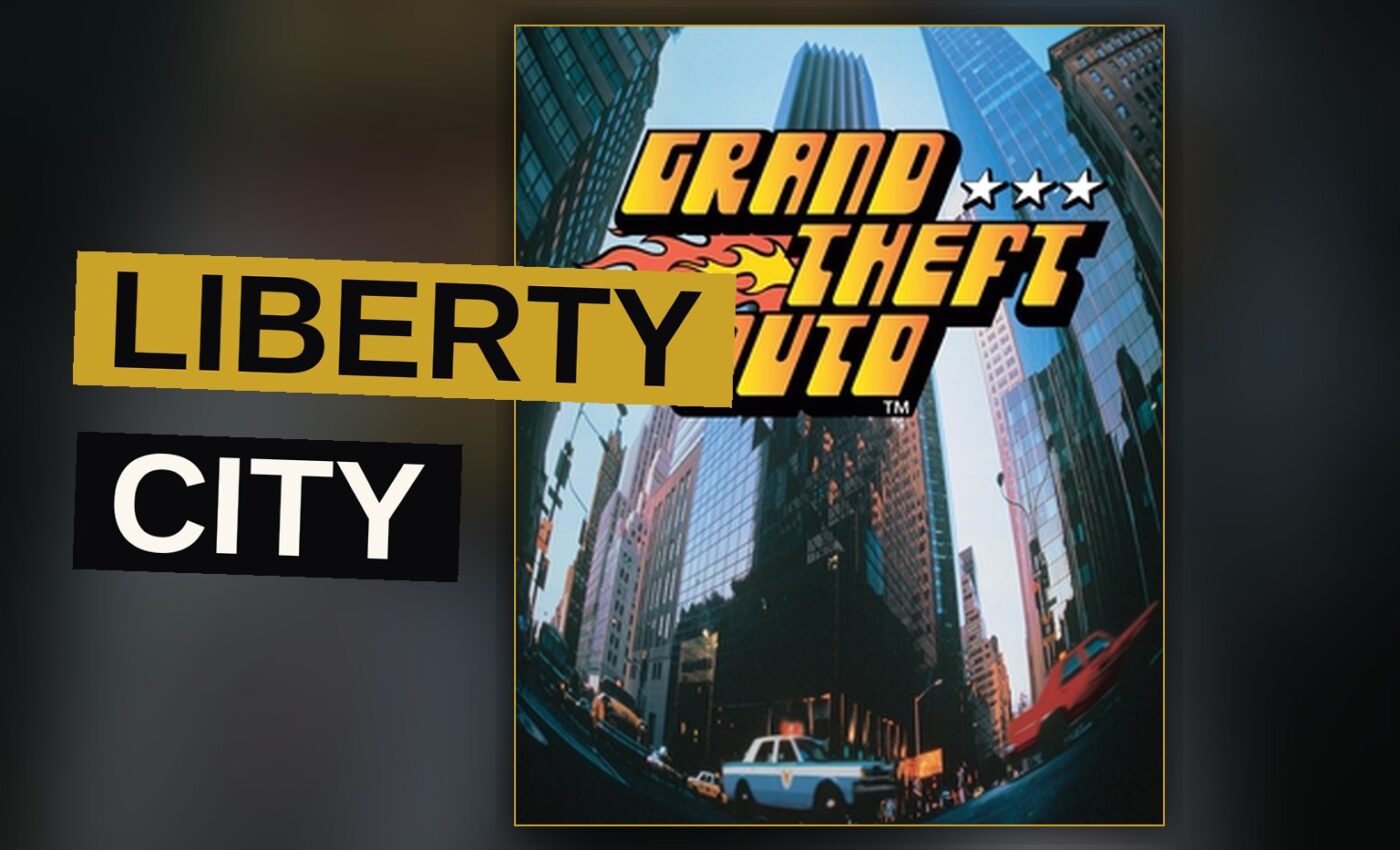
Grand Theft Auto arrived on the original PlayStation in December 1997, a top-down crime game from DMA Design published by BMG Interactive, and it is the rare debut that already knows what it wants to be. It hands you a city, a car and a body count, then gets out of the way.
Liberty City, San Andreas and Vice City
The game is built from three cities and six levels. Liberty City stands in for New York City, San Andreas for San Francisco, Vice City for Miami. Each level hands you one objective: reach a target number of points, starting at $1,000,000 and climbing in the later stages, then hit the level’s goal to close the chapter out.
Progression is linear. Finish a level and the next one opens. That is the whole structure, and it is sturdier than it sounds.
Points come from anywhere. You can cause death and destruction in traffic, finish special challenges, or steal cars and sell them for profit. The usual route is to take jobs from whatever crime syndicate runs the level. A ringing telephone box starts a job. Touch it and you are working.
Eight Faces, One Criminal
Before any of that, you pick a character from eight options — four on the PlayStation version — and name them. The choice is purely aesthetic. It does not change the gameplay or the story.
That is worth stating plainly, because it is the game’s one real misstep. A roster of eight protagonists sounds like a promise of eight different games. It is not. It is a costume.
The named criminals you actually deal with are a better lot. Robert “Bubby” Seragliano runs the Vercotti crime family and wants his father’s death answered for. Uncle Fu leads a Chinese gang at war with a Latino crew under El Burro. Samuel Deever is a corrupt Vice City cop with a blackmail habit. Brother Marcus heads the Brotherhood of Jah Army of Love and moves the most drugs in Vice City.
Jobs, Multipliers and a Short Leash
Each level’s jobs are unique to it, and you can complete them in any order. Each job has some freedom in how you pull it off, though every location is fixed. Finish one and you get points, harder missions with bigger rewards, and a multiplier that raises what later jobs and actions are worth.
Fail and you get nothing. Missing objectives, getting arrested or dying all secure zero points, and a failure can seal off other tasks entirely. You also have limited lives.
Equipment scattered across each map — weapons, body armour — helps you close the gap. It is a lean system, and the multiplier is the smartest part of it. It rewards a player who keeps a run alive instead of one who reloads a checkpoint.
The Story Runs Through Three Cities
The protagonist starts in Liberty City working for Seragliano’s gang. A rival crew warns them that the work is hurting their boss, Sonetti. The protagonist keeps working for Seragliano anyway and kills Sonetti.
Bubby then praises the effort but warns that police are closing around the gang, and suggests it might be time to leave town. In San Andreas, Uncle Fu’s gang makes contact and puts the protagonist to work. After several jobs, Fu meets them in person, thanks them, and says their actions have brought honour to the family.
Then El Burro. Same pattern, several jobs, then a grateful boss in person who sends them to Vice City. There, corrupt officer Samuel Deever claims to hold evidence that could put the protagonist away for life and blackmails them into service. Deever warns them to be careful with what they do.
The last stretch runs through the Rastafarians to Brother Marcus, who commends the work, offers a large payout, and tells the protagonist they will never see each other again. The player collects the retirement money. The game ends.
What the Controversy Was Worth
Grand Theft Auto drew heavy controversy before it even launched. Its violent content prompted talk of banning its sale. Publicist Max Clifford ran a marketing campaign that used the outrage as free promotion.
That is the part of this game’s history people still repeat, and it is the least interesting thing about it. The outrage was a business strategy, and it worked. The design underneath is what kept the series alive.
Reviews at the time were mixed. Graphics and controls took the criticism. The game sold anyway.
Where It Stands Against What Came After
Rockstar North’s Grand Theft Auto V landed in 2013 for PlayStation 3 and Xbox 360, then PlayStation 4 and Xbox One, then PC, and then PlayStation 5 and Xbox Series X|S. It moved the series into a sun-soaked Los Santos and let players jump between three leads — Franklin, Michael and Trevor — inside one interwoven story.
The distance between the two games is enormous, and the table below is the shortest way to say it.
| Grand Theft Auto (1997) | Grand Theft Auto V (2013) | |
|---|---|---|
| Developer | DMA Design | Rockstar North |
| Publisher | BMG Interactive | Rockstar Games, Take-Two Interactive |
| Perspective | Top-down | First person, third person |
| Leads | Eight selectable characters, purely aesthetic | Franklin, Michael, Trevor |
| Setting | Liberty City, San Andreas, Vice City | Los Santos |
| Structure | Six linear levels, points target | Open world, interwoven story |
| Modes | Single player | Single player, multiplayer, co-operative |
The 1997 game has no multiplayer and no co-operative play. It has no first-person view. What it has is a top-down city you can read at a glance, and a scoring rule that makes every block you drive through a decision.
Here is what actually matters, ranked:
- The multiplier. It ties every job to every other job and turns the whole level into one long risk.
- The telephone boxes. A single fixed point for every job keeps the map legible and the planning honest.
- The points target. It gives a sandbox a spine, which most sandboxes never get.
- The eight protagonists. A promise the game does not keep.
- The graphics and controls. Dated at launch, worse now.
Why the Points System Still Holds Up
Grand Theft Auto is a commercial success that earned its sales on design, not on shock. The controversy was noise. The points system was the signal.
The eight-character roster is the flaw worth naming. It offers choice and delivers none, and the game would be cleaner without the pretense. But the job structure, the fixed locations, the multiplier and the limited lives add up to something tighter than the open-world label suggests. This is not a game about wandering. It is a game about deciding which block to risk.
The controls and the top-down graphics have not aged well. That is a real cost, and a modern player will feel it. But the underlying idea — that a crime game can be scored, ranked and failed — is the idea the whole series was built on, and it is fully formed here in 1997.
Grand Theft Auto is rough, smart and correct about what it is. Eight point eight.
Get the Notebook.
The day's best stories and every fresh verdict, in plain English, in your inbox by seven. One email a day, no more.