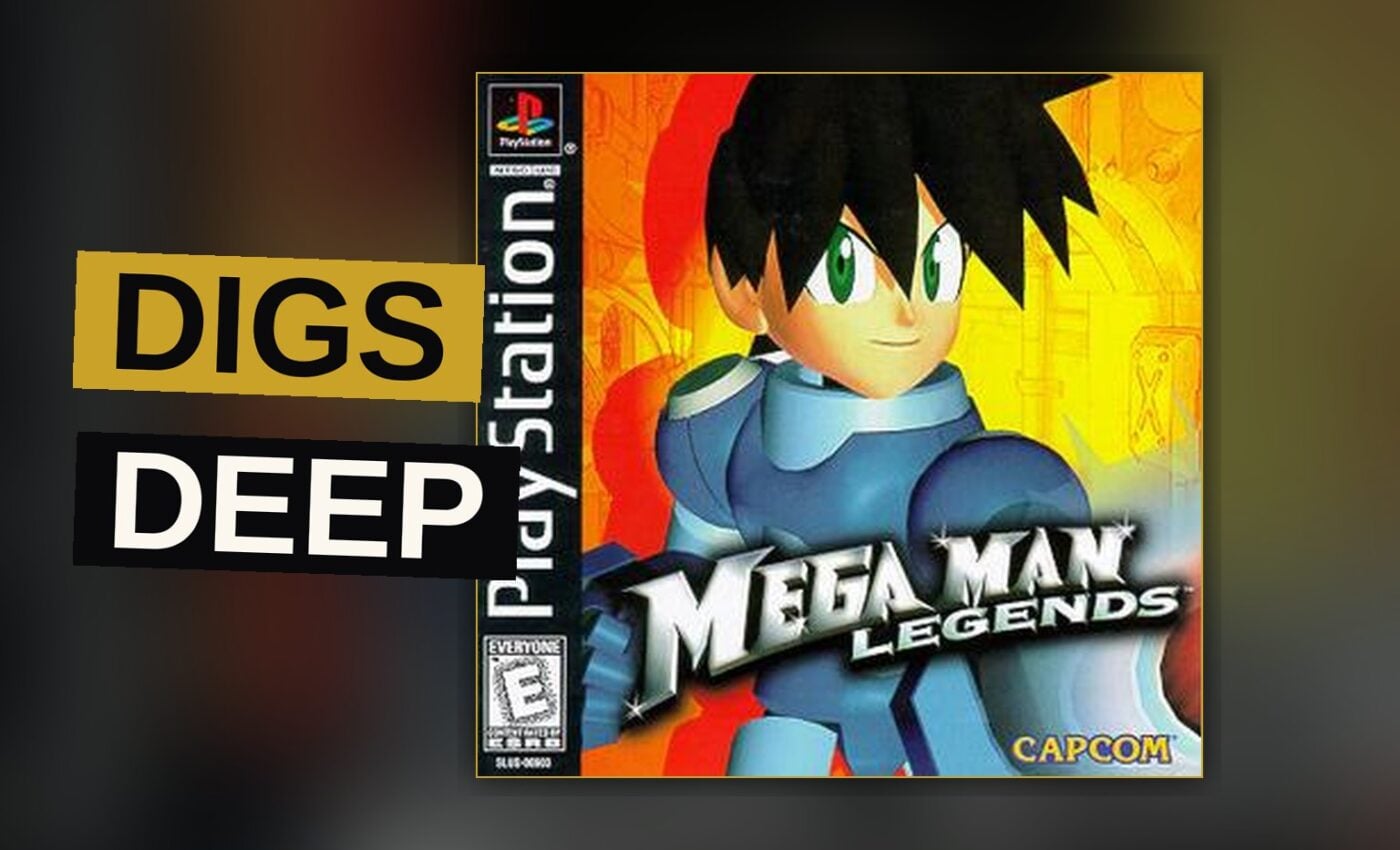
Mega Man Legends came out on the original PlayStation in Japan in 1997 and in North America in 1998. Capcom built it as the first entry in the Mega Man Legends sub-series and the second major polygonal Mega Man game, after Mega Man: Battle & Chase.
The risk paid off. The game drew positive critical reception for moving the franchise from 2D graphics into 3D. That shift is the reason it still gets talked about, and it is the reason this review exists.
Mega Man Volnutt and the Diggers
Legends introduces a new version of the hero: Mega Man Volnutt, a “Digger” whose job is investigating ruins on a flooded Earth. The player controls Volnutt for the whole game.
This is not the platforming Mega Man. Legends is an action-adventure game, and its mechanics sit close to Tomb Raider. Volnutt grabs and climbs ledges. He dives left and right. The player controls the camera by hand and locks onto targets in combat.
The world is large. It holds several dungeons that must be explored in a set order, plus a town full of non-player characters to talk to. Cutscenes carry the story. Volnutt travels on foot until Roll Caskett repairs a support car, which lets her move him to specific locations.
A Crash Landing on Kattelox Island
The game opens on a tower ruin in the middle of the ocean. Mega Man pulls a sizable blue refractor from it and fights past the Reaverbots guarding his way out. He reaches the Flutter, and the ship leaves — then its engines fail and it crashlands on Kattelox Island.
The Casketts look for a way to fix the ship. Before they find one, pirates hit the city with giant mechanical weapons. Mega Man decides to stop them.
He takes down the armored robots patrolling Downtown, led by Tron Bonne, and the ones besieging City Hall, led by Bon Bonne. Their leader, Teisel, strikes the Clozer Woods ruins next. Mega Man beats him as well.
Mayor Amelia then tells Mega Man that the Bonnes are hunting the island’s secret treasure. Legend holds that whoever obtains it will bring a great disaster down on the island. Amelia asks him to investigate the ruins.
Refractors, the Flutter, and the Bonnes
Refractors — large gems — are the primary power source in this world. In the Forest Ruins, Mega Man finds a large yellow one. It powers a boat in Uptown, which gets him to the Lake Ruins and past the Bonnes, who had stolen the other boats and rebuilt them as robotic weapons.
The Lake Ruins hold a huge red refractor. Mega Man and Roll use it to repair the Flutter, and the ship carries them to the entrance of the Clozer Woods ruins. Inside, Mega Man unlocks the island’s largest ruin, the Main Gate, hoping to learn why the island’s Reaverbots are waking up.
On the return trip, the Bonnes meet the Flutter with their mothership. Mega Man beats them again and destroys the Gesellschaft.
That is a heavy plot, and the game carries it lightly. The Bonnes read as comic villains rather than real threats, and the game seems to know it.
Mega Man Juno and the Main Gate
Exploring the Main Gate’s depths unlocks Sub-Cities across the island. Mega Man finds the Bonnes in the Old City while working through the three of them, and destroys their newest robot — a colossal monster called Bruno. The Bonnes accept the loss and leave, though they intend to grab the Main Gate’s treasure once Mega Man gets it.
Three keys from the Sub-Cities open the Main Gate’s depths. There, Mega Man finds a stasis chamber holding the ancient robot Mega Man Juno, a 3rd class bureaucratic unit from Eden, a space station orbiting above the planet.
Mega Man wakes Juno by accident. Juno calls him “Mega Man Trigger” and works out that Mega Man has lost his memory. Juno says the island’s population must be purged to make it more controllable, then leaves Mega Man in a trap and engages the program in the deepest depths of the ruin.
Tron and Teisel help Mega Man escape. He confronts Juno, and Juno upgrades to a giant form. Mega Man wins anyway. Juno’s body is gone, but his final words push his backup data into Eden’s systems and confirm the Carbon Purification Process.
Data issues new commands to the system, halting the Purification and wiping Juno’s backup data from Eden. Data then tells Mega Man that he carries all of his memories from his time as Mega Man Trigger. Mega Man had stored those memories in Data so Eden could never tamper with them. Data promises to restore them when the time comes.
The residents call Mega Man a hero. The Casketts fly off in the repaired Flutter to continue their journey. The Bonnes sail away on a small boat Tron built from the scraps of their other robots, towing the colossal refractor from the Main Gate.
The Ports That Did Not Help
A Nintendo 64 port landed in 2000 under the same title, renamed Mega Man 64 for its North American release in 2001. Windows got a version in 2001. The PlayStation Portable version arrived in 2005, only in Japan. The most recent release was a PS one Classic on the North American PlayStation Network in 2015.
The Nintendo 64 and Windows ports took criticism for adding nothing over the PlayStation version. Their graphics were already dated when they shipped. That read is correct. A port that changes nothing but the box is not a port. It is a reprint.
What Actually Holds Up
The 3D transition is why Legends earned its reception. It is not why you should play it now. Plenty of 1997 games went polygonal and aged into rubble.
The structure is what survives. Legends gives you a large world, dungeons that must be explored in a set order, and a town full of characters. That order is not a flaw. It is the design. The game wants you to learn Kattelox Island the way a Digger would — one ruin at a time, one Refractor at a time.
The Tomb Raider comparisons are fair, and they are not an insult. Grabbing ledges, diving, controlling the camera by hand, locking on — these are the moves of a game working out how a 2D hero behaves in three dimensions. Some of it is clumsy. All of it is readable.
The story is where Legends pulls away from the rest of the franchise. Mega Man Juno is not a themed boss at the end of a themed stage. He is a 3rd class bureaucratic unit from Eden with a purification protocol and a plan to purge an island. The reveal that Mega Man is Mega Man Trigger, that he hid his own memories inside Data to keep Eden from touching them, hits harder than any fight in the game.
It also sets up a promise this installment does not keep. Data will restore Mega Man’s memory when the time comes. That time is not now.
The Verdict on Mega Man Legends
Against the Mega Man games that came before it, Legends is the boldest thing Capcom did with the character in the 1990s. Against action-adventure games of its era, it is a solid, sometimes clumsy, genuinely ambitious game that understood what its ports did not: the value was never the polygons. It was the world.
The reasons to play it, in order:
- The 3D transition itself — the second major polygonal Mega Man title, and the one that launched a new sub-series.
- Kattelox Island as a place, with a town, characters to meet, and dungeons that must be explored in a set order.
- The Bonnes, a villain family that loses repeatedly and keeps returning, including the mothership fight and the colossal Bruno.
- Mega Man Juno and the Eden reveal, which reframes the hero as Mega Man Trigger and hands the series its strangest, best storyline.
- The Refractor system, which makes large gems the primary power source and gives every ruin a reason to exist.
The Nintendo 64 and Windows ports are not on that list. Skip them. Play the PlayStation version, or the 2015 PS one Classic release if that is what you have.
Mega Man Legends is not the best game in the franchise. It is the most important one for anyone who wants to know how Mega Man survived the jump to 3D, and it is still worth the crash landing.
Get the Notebook.
The day's best stories and every fresh verdict, in plain English, in your inbox by seven. One email a day, no more.