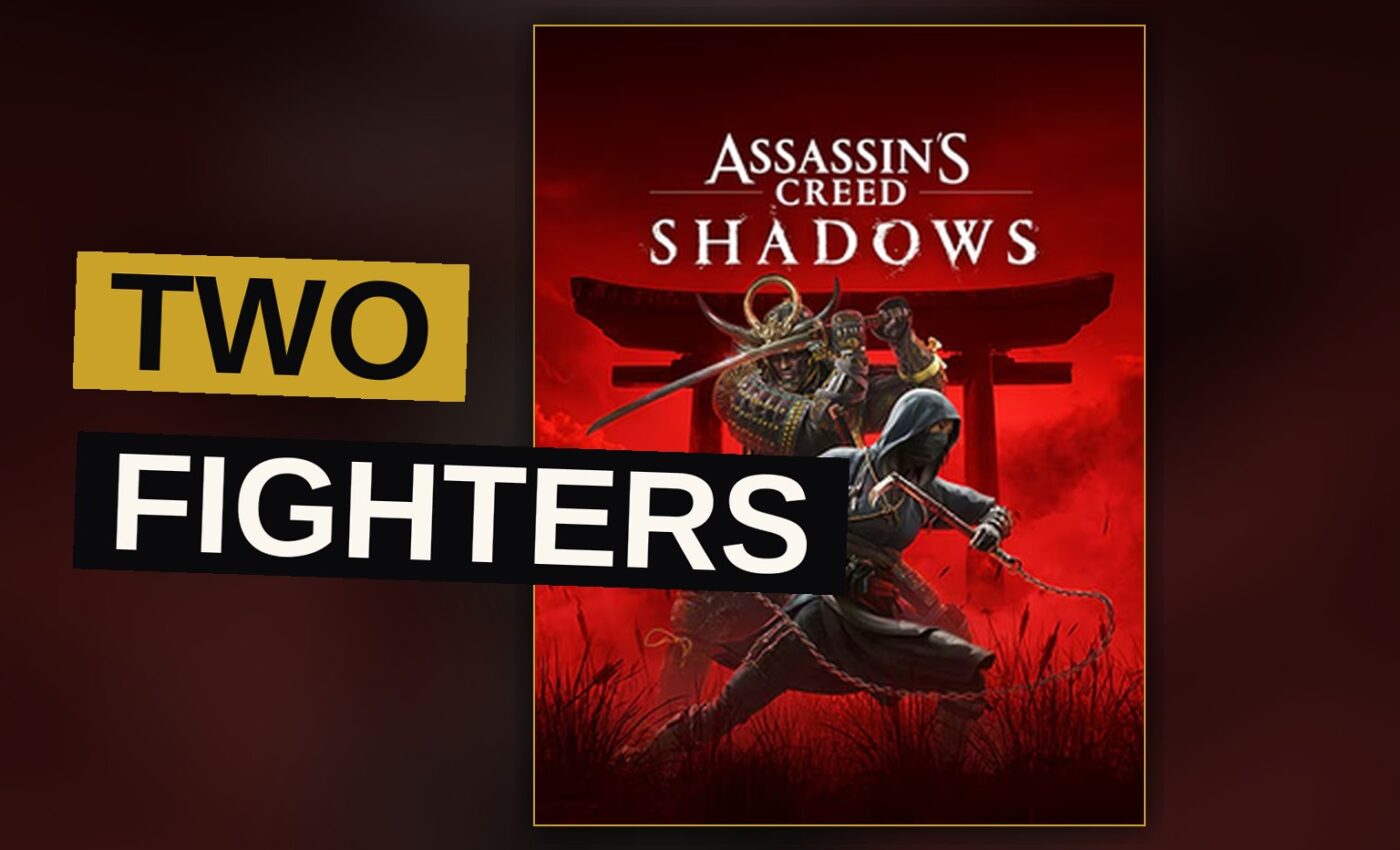
Assassin’s Creed Shadows puts two blades in your hands and makes you choose which one the series has been missing. Ubisoft Quebec’s 2025 release lands on PlayStation 5, Xbox Series X/S, and PC, with a Nintendo Switch 2 version following on December 2, 2025 and an iPadOS version still to come. It is the fourteenth main entry in the series and the successor to Assassin’s Creed Mirage. It is also the best the franchise has been in years, though not without a few seams showing.
Trailer, via Assassin’s Creed.
Naoe and Yasuke in 16th-Century Japan
The setup is the strongest the series has had since it traded pirates for revolutionaries. Set in feudal Japan starting in 1579, during the Azuchi-Momoyama period and the final stage of the Sengoku period, Assassin’s Creed Shadows follows two protagonists with almost nothing in common. Fujibayashi Naoe is a kunoichi from Iga Province, trained in ninjutsu, quick and quiet. Yasuke is an African samurai inspired by the historical figure of the same name, a former slave who arrives in Kyoto with a Jesuit delegation and is transferred into Oda Nobunaga’s service.
Their stories intertwine against a backdrop of civil war. Nobunaga sits at the height of his power after defeating the Takeda clan with arquebus firearms. His 1581 assault on Iga Province drives the plot: Naoe’s father Nagato gives her his Hidden Blade and sends her to recover a box from a nearby kofun, a masked samurai ambushes her and takes it, and Nagato dies telling her to “follow the blade.” That instruction carries the game.
The historical cast is deep. Luís Fróis and Alessandro Valignano appear as missionaries. Hattori Hanzo, Akechi Mitsuhide, Ise Sadaoki, the sōhei Kyōnyo, merchants Imai Sōkun and Imai Sōkyū, and tea master Sen no Rikyū all show up. The world covers the Kansai region, including Kyoto, Kobe, Osaka, and Iga, with castles like Takeda and Fukuchiyama built as intricate dungeons. Portuguese traders and Jesuit missionaries shape the environment, bringing Christianity, cannons, and long guns into a country already tearing itself apart.
Two Playstyles That Actually Differ
Most dual-protagonist games give you the same character in two costumes. Assassin’s Creed Shadows does not. Naoe and Yasuke play differently enough that quests can be approached in multiple ways, and the game leans into that instead of hiding it.
Naoe gets traditional Eagle Vision back, letting her spot enemies and useful elements. She can hide in shadows, indoors and outdoors, becoming invisible to enemies, and she can destroy lit lanterns with shuriken to create that darkness. She can go prone and crawl along the ground to avoid detection and squeeze through small openings. She can submerge herself in shallow water and breathe through a bamboo stick. She is the stealth half of the game, and the tools fit her.
Yasuke is the power half. The game describes him as a legendary samurai, and the combat reflects it. Where Naoe picks her moments, Yasuke meets problems head-on.
Both characters can enter a mode called “Observe,” a fast way to gather information about targets, available while crouching on high vantage points to examine newly discovered places. It is a small addition that quietly fixes a problem the series has had for years: too much time spent staring at a minimap instead of the world.
Seasons, Scouts, and a World That Fights Back
The open world is comparable in size to Assassin’s Creed Origins, and it progresses through seasons that change how you play. Ponds and shallow bodies of water that Naoe uses to hide freeze over in winter. That is not decoration. It is a mechanic that closes a door you were relying on and forces you to rethink an approach.
Missions are non-linear, encouraging players to track and eliminate targets freely. Vantage points now help you look for points of interest rather than marking objectives, a change from previous games. By default, Assassin’s Creed Shadows does not reveal the exact locations of targets or key NPCs. You recruit and deploy scouts to narrow down their location based on clues. It is a slower, more deliberate loop, and it is the right one.
The game runs on an upgraded version of Anvil, with dynamic lighting and environmental interactions. Breakable objects are in. You can manipulate shadows and use a grappling hook for parkour. The setting reflects the urbanization of Japan at the time, with bustling ports, samurai districts, and ornate architecture that gives the traversal something to do.
Where Assassin’s Creed Shadows Stumbles
The game is not flawless, and the flaws are worth naming plainly.
- The scout system can stall momentum when clues are thin and you are left circling a region with nothing to go on.
- Seasonal shifts are a genuine mechanical change, but winter’s frozen water cuts down Naoe’s options more than it adds new ones.
- The historical cast is large enough that some figures, including Sen no Rikyū and the merchants Imai Sōkun and Imai Sōkyū, register as set dressing rather than characters.
- Two protagonists means two upgrade paths, and the game does not always pace the split evenly.
None of these break the game. They are the kind of friction that separates a very good Assassin’s Creed from a great one.
What Assassin’s Creed Shadows Gets Right
Here is what matters. Assassin’s Creed Shadows solves the series’ oldest problem by refusing to pick a lane. Naoe and Yasuke are not two skins on one assassin. They are two arguments about how to play, and the game lets both arguments win. The Observe mode, the scout deployment, the removal of objective markers by default, the seasons that freeze your hiding spots — these are not features bolted on for a bullet list. They are a coherent design that trusts the player to find their own way.
The setting does real work too. Feudal Japan has been requested for so long that it risked arriving as fan service. Instead, Ubisoft Quebec builds around the Sengoku period’s actual fractures: Nobunaga’s rise, the Iga ikki and their ninjutsu, the Portuguese and Jesuit presence, the castles and ports. The result feels researched rather than decorative.
The game received generally positive reviews from critics upon release, and that tracks with what is here. It is not a reinvention. It is a correction, and a confident one. The series has spent years drifting toward bigger maps and thinner identities. Assassin’s Creed Shadows is the first entry in a while that knows what it wants to be and commits to it.
It is not perfect. The pacing sags in the middle, and some of the historical figures deserve more room than they get. But the core loop — switch between two unlikely allies, master complementary playstyles, build a shinobi league, customize a hideout, usher in a new era for Japan — holds together from the first hour to the last.
The detail worth holding onto is the one the game never announces. Naoe’s whole arc begins with a box she was told to protect at all costs, and she loses it twice before she is strong enough to keep it. Yasuke’s begins with a name he did not choose. Both characters spend the game earning a version of themselves that someone else handed them first, and Ubisoft Quebec lets that theme sit quietly under the assassinations rather than stating it out loud. That restraint is why the ending lands harder than the set pieces do.
Assassin’s Creed Shadows is available now on PlayStation 5, Xbox Series X/S, and PC, with the Nintendo Switch 2 version out December 2, 2025 and an iPadOS release still to come.
The Numbers Behind Assassin’s Creed Shadows
- Release date: March 20, 2025 (macOS, PlayStation 5, Windows, Xbox Series X/S)
- Nintendo Switch 2 version: December 2, 2025
- iPadOS version: to be released at a later date
- Developer: Ubisoft Quebec
- Publisher: Ubisoft
- Series position: fourteenth main installment, successor to Assassin’s Creed Mirage (2023)
- Setting: feudal Japan, starting 1579, Azuchi-Momoyama period
- Protagonists: Fujibayashi Naoe and Yasuke
- Score: 8.2/10
Get the Notebook.
The day's best stories and every fresh verdict, in plain English, in your inbox by seven. One email a day, no more.