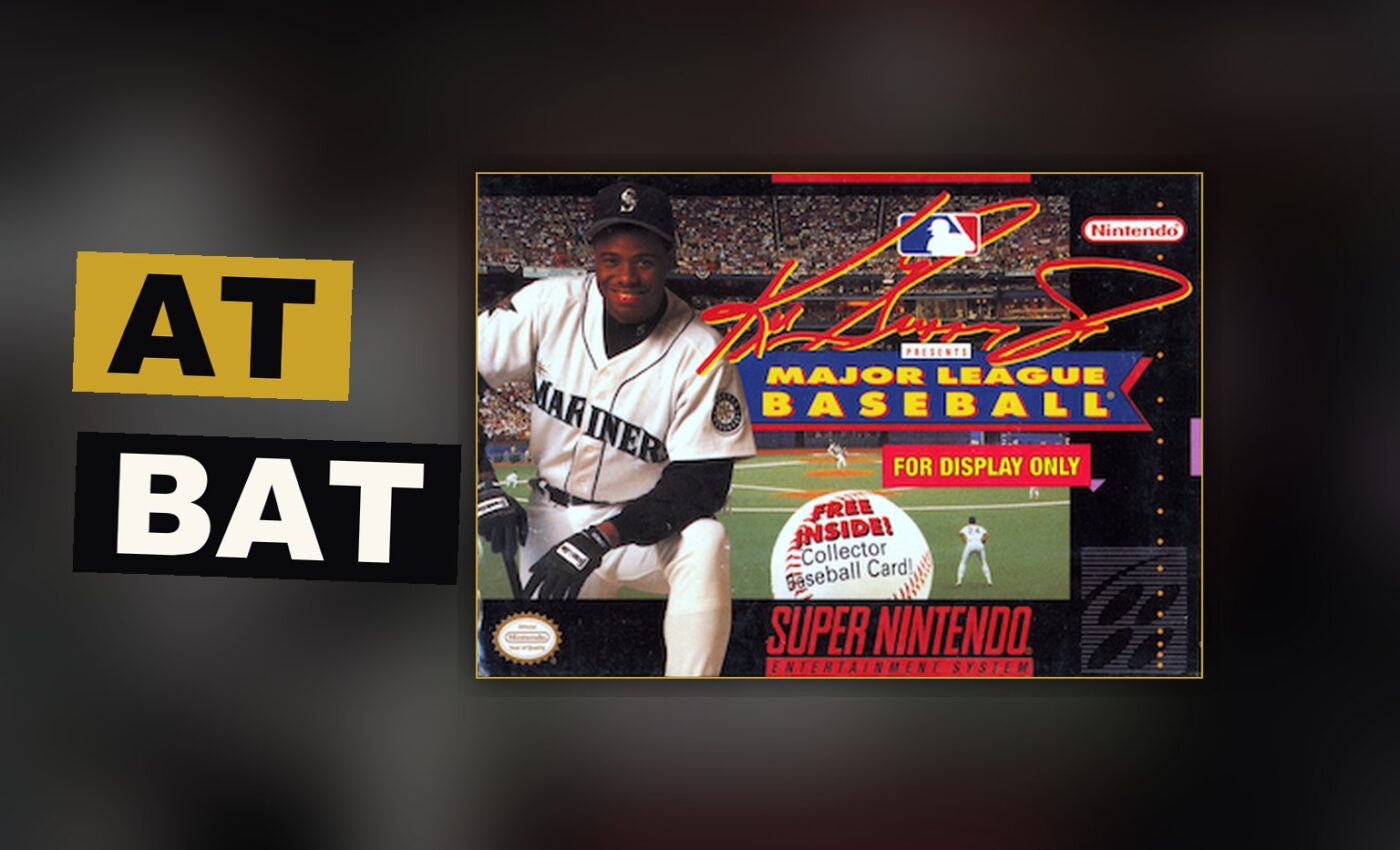
Ken Griffey Jr. Presents Major League Baseball hit the Super Nintendo in 1994 with a licensing problem baked into its title. The game had a Major League Baseball license but not a Major League Baseball Players Association license. Real stadiums and real teams, no real players — except Griffey.
Software Creations developed it. Nintendo published it. The fix was odd and, in hindsight, smart: fictitious athletes carried the exact statistics of their real-world counterparts, and a name-changing feature let players restore the names themselves.
A Name-Changing Feature and the 1993 Season
That one decision explains the whole game. It is a baseball simulation that trusts its audience to know the sport, and it builds authenticity from numbers rather than likenesses.
Rosters are based on the 1993 MLB season, with stats included. The game tracked statistics for the team the user controlled across a full season. CPU-controlled teams did not update — their numbers stayed frozen at 1993 values. That is a real gap in the design, and it shows.
For its time, the feature list was long. This was a game that wanted to be a season, not an afternoon.
Fenway’s Green Monster and Camden Yards’ Warehouse
Nearly every team got its own venue. Some are unusually specific.
Fenway Park’s Green Monster is in the game. Joe Robbie Stadium’s teal wall is in the game. Oriole Park at Camden Yards has its trademark warehouse in right field. Kauffman Stadium has its outfield waterfalls and its center field scoreboard. Toronto’s SkyDome hotel and restaurant are visible when a home run heads to center.
Dodger Stadium has the outfield “roof” and its slants by the crowd. Shea Stadium has its minuscule center field crowd. Comiskey Park has the large scoreboard in right field.
The Cincinnati Reds’ Blue Wall
Cartridge space had limits, and the failures are honest ones. Some stadiums could not be included, so those teams played in a generic park with green or blue walls. That layout went mostly to the concrete donuts — Riverfront Stadium and Three Rivers Stadium among them, themselves already noted for being generic.
Small details stick. The Cincinnati Reds have a blue outfield wall here instead of their signature green wall at Riverfront Stadium. That is wrong, and it is the kind of wrong a certain fan never stops noticing.
The Kansas City Royals and Chicago White Sox are the only two teams that play night games at their respective ballparks.
Yankee Stadium and Tiger Stadium are almost identical, with one difference: Yankee Stadium has shorter right field bleachers and the ball can be hit out of the park, while Tiger Stadium has an upper deck all the way around.
A 1997 Game Boy Version With 1996 Stats
Nintendo released a portable version in 1997 for the Game Boy. It came with real players and real stats from the 1996 season — a different licensing arrangement, and a different game in practice.
The SNES version shipped with a promotional Griffey collector’s card packed inside the box. That is a marketing artifact now, and it dates a release more precisely than any stat line.
Gameplay That Sometimes Sluggish
The gameplay is similar to its predecessors. It is also, at times, sluggish because of hardware restrictions. That is the tradeoff: the game spent its cartridge on ballparks and statistics, and the play on the field paid for it.
The perspective is a bird’s-eye and isometric view. Modes are single player and multiplayer. The genre is sport.
Why the Ballparks Carry It
Here is what matters. Ken Griffey Jr. Presents Major League Baseball is often rated by the public as one of the best baseball games of all time, and the reason is not the name on the cover. It is the stadiums.
The Green Monster, the Camden Yards warehouse, the Kauffman waterfalls, the SkyDome hotel visible on a long ball to center — these separate a licensed product from a game that actually watched baseball. The name-changing feature is the tell. Software Creations could not use the players, so it used the numbers and let the player finish the job.
The frozen CPU statistics are a genuine flaw. The sluggish play is a genuine flaw. The Reds’ blue wall is a genuine flaw. None of them undo the ballparks.
This game understood that a baseball sim lives in its places. Anyone can render a diamond. Rendering the warehouse in right field at Camden Yards is a decision made by people who cared, and it is why this one is still talked about.
Score: 8.2 of 10.
The Numbers
- Title: Ken Griffey Jr. Presents Major League Baseball
- Developer: Software Creations
- Publisher: Nintendo
- SNES release: 1994
- Game Boy release: 1997
- SNES stats season: 1993
- Game Boy stats season: 1996
- Genre: Sport
- Modes: Single player, Multiplayer
- Perspective: Bird view / Isometric
- Critical score: 8.2/10 (IMDb)
What the Ballparks Got Right, and Wrong
- Fenway Park — Green Monster present
- Oriole Park at Camden Yards — warehouse in right field
- Kauffman Stadium — outfield waterfalls and center field scoreboard
- Joe Robbie Stadium — teal wall
- Toronto SkyDome — hotel and restaurant visible on homers to center
- Dodger Stadium — outfield roof and crowd slants
- Shea Stadium — minuscule center field crowd
- Comiskey Park — large right field scoreboard
- Riverfront Stadium and Three Rivers Stadium — generic park with green or blue walls
- Cincinnati Reds — blue outfield wall instead of the signature green
Get the Notebook.
The day's best stories and every fresh verdict, in plain English, in your inbox by seven. One email a day, no more.