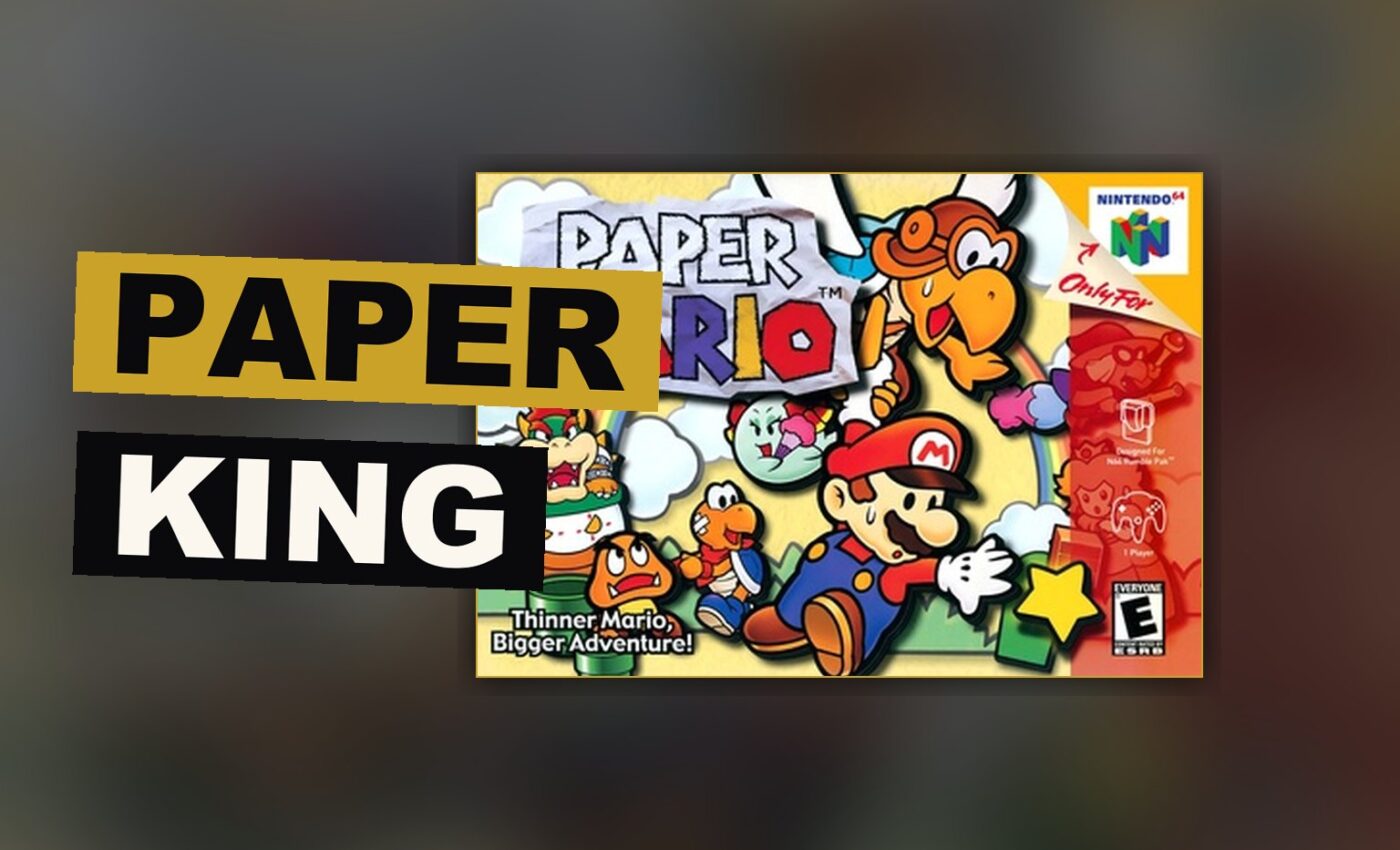
Paper Mario arrived in 2000 as something of a gamble. Nintendo had planned to hand the project to Square, the studio behind Final Fantasy, but Square was busy with Final Fantasy VII for the PlayStation. Intelligent Systems built the game instead. The result is a role-playing game that folds the Mario series’ platforming instincts into a turn-based battle system, wraps the whole thing in a paper-thin aesthetic, and sends Mario across the Mushroom Kingdom to rescue Princess Peach from Bowser. It is the first game in the Paper Mario series, and it holds up as one of the Nintendo 64’s sharpest pieces of design.
Bowser Steals the Star Rod and Lifts the Castle
The story opens at Peach’s castle. Mario and Luigi arrive for a party. When Mario and Peach are alone, Bowser lifts the entire castle into the sky, overpowers Mario with an invincibility he gained by stealing the Star Rod from Star Haven, and imprisons the seven Star Spirits in playing cards. Mario is thrown from the floating castle and lands in Goomba Village.
That opening sets the stakes cleanly. Bowser is not just a boss waiting at the end. He has removed the one thing that could stop him. The Star Spirits, once rescued, can negate the Star Rod’s effects, which is the only reason Mario has a path forward at all. The game never lets you forget it.
Goombario, Kooper, and Eight Partners Who Do Real Work
Mario recruits eight partners over the course of the journey, and each one represents a different type of enemy from the Mario franchise. Goombario, a Goomba, can tell the player about any character, environment, or enemy. Kooper, a Koopa Troopa, throws his shell at objects Mario cannot reach. Bombette, a Bob-omb, blows up weak parts of walls. Parakarry, a Paratroopa, helps Mario cross gaps that are too large to jump.
Only one partner can travel with Mario in the overworld, but the player can swap them at any time. The puzzles and boundaries are built around what each partner can do, which means the roster is not decoration. It is the game’s vocabulary. You meet a gap, you check who can cross it. You meet a cracked wall, you call Bombette. That structure keeps the exploration from feeling like filler between battles.
Action Commands Turn Turn-Based Combat Into a Test
Battles are turn-based, but Paper Mario adds a wrinkle. The player can influence the power of an attack or a defense by pressing a button at the right moment or performing some other input. The game calls these action commands. A jump that would do modest damage does more when timed correctly. A block that would let damage through can be reduced.
This is the mechanic that separates Paper Mario from the RPGs it borrows from. You are never just selecting a menu option and waiting. The controller stays in your hands during the enemy’s turn. Mario and his partners have a finite capacity for special moves, and each one costs flower points, or FP. Star Points earned in combat work as experience points and let you level up. An on-screen gauge tracks Star Energy, which powers another class of move and grows as you advance.
The game also hides battle upgrades in the overworld. Finding one promotes a single partner to a new rank. That is a quiet reward for players who poke at corners instead of beelining through chapters.
Seven Star Spirits, Four Koopa Bros., and a Murder Mystery
The structure is presented as a novel, with each rescue of a Star Spirit treated as a single chapter. Mario and Goombario reach Shooting Star Summit, where the weakened Star Spirits ask Mario to find them. From there the game moves through distinct locales.
The first Star Spirit, Eldstar, is held in the four Koopa Bros.’ fortress. The second, Mamar, is found in the Dry, Dry Desert inside a secret fortress ruled by Tutankoopa. The third, Skolar, is kept by Tubba Blubba, who terrorizes the Boos and eats them when he believes he is invincible. His heart is his true weak point. The fourth, Muskular, is held by General Guy and his minions in the Toy Box.
Then Mario travels to Lavalava Island, where inhabitants face an impending volcanic eruption, and saves the fifth Spirit, Misstar. He retrieves the sixth, Klevar, in Flower Fields. In Shiver City, Mario becomes a suspect in a murder when he finds the mayor unconscious. The mystery turns out to be the mayor’s own accident. That cleared, Mario reaches the Crystal Palace and saves the last Star Spirit, Kalmar, from the Crystal King.
Peach is playable between chapters. She works with a star kid named Twink inside the castle, attempting escapes and relaying information to Mario. Those interludes break up the pacing and give Peach something to do besides wait.
A Paper Aesthetic That Earns Its Place
The paper look is not a gimmick bolted onto a standard RPG. It shapes how the world reads. Characters are flat, the camera sits in a third-person side view, and the game leans into a storybook framing. The novel structure and the paper visuals reinforce each other. You are playing through a book about Mario, and the game is honest about that.
The Mushroom Kingdom’s locales are varied enough that the chapters do not blur together. A desert fortress, a haunted village, a toy box, a volcano island, a flower field, a snowbound city, a crystal palace. Each one has its own problem and its own partner to find or use. The game keeps moving.
What Paper Mario Gets Right and Where It Slows
The battle system is the strongest argument for Paper Mario. Action commands give every encounter a small physical demand, and the partner system gives every encounter a small tactical one. You are choosing who fights and timing how they strike. That combination is rare in 2000 and still feels deliberate.
The pacing has soft spots. The chapter structure is rigid, and the game commits to it. If a chapter’s locale does not land for you, you are in it for a while. The murder mystery in Shiver City is a detour that resolves as an accident, which is a thin payoff for the setup. These are minor complaints against a game that otherwise knows exactly what it is doing.
The partner paralysis rule is a smart touch. Partners do not have individual HP statistics, so damage against them results in temporary paralysis instead of a knockout. You are never punished with a permanent loss mid-battle, but you are inconvenienced. It keeps the partner system from becoming a management chore.
A Nintendo 64 RPG That Still Holds Its Ground
Paper Mario was first released in Japan in 2000 and internationally in 2001. It was re-released on the Wii Virtual Console in July 2007, the Wii U Virtual Console in April 2015, and the Nintendo Classics service on December 10, 2021. The game received acclaim at release, and the years since have not dulled its case.
What matters here is that Paper Mario solves a problem most RPGs of its era did not try to solve. It makes the player’s hands part of the strategy without abandoning the strategy. The Star Spirits, the Star Rod, the eight partners, the flower points, the action commands — all of it serves one loop. Explore, recruit, fight, time it right, move on.
The paper aesthetic could have been a coat of paint. Instead it is the frame the whole story hangs on. That is the difference between a game that looks distinctive and one that is built distinctively.
Key Facts
- Title: Paper Mario
- Developer: Intelligent Systems
- Publisher: Nintendo, Gradiente, iQue
- Platforms: Nintendo 64, Wii, Wii U
- Release: Japan 2000; international 2001
- Re-releases: Wii Virtual Console July 2007; Wii U Virtual Console April 2015; Nintendo Classics December 10, 2021
- Genre: Role-playing (RPG), Adventure
- Modes: Single player
- Perspective: Third person, side view
- Score: 9.3/10
Release Schedule
| Date | Platform / Service |
|---|---|
| 2000 | Nintendo 64 (Japan) |
| 2001 | Nintendo 64 (international) |
| July 2007 | Wii Virtual Console |
| April 2015 | Wii U Virtual Console |
| December 10, 2021 | Nintendo Classics |
Paper Mario earns its score on the strength of one idea executed without compromise. The action command is not a novelty. It is the spine of the combat, and the partner roster is the spine of the exploration. Intelligent Systems took a project Square could not take and built something that belongs to the Mario series without borrowing its momentum. The game is a novel you play, a paper world with real weight, and it remains the standard the later Paper Mario games are measured against. 9.3 of 10.
Get the Notebook.
The day's best stories and every fresh verdict, in plain English, in your inbox by seven. One email a day, no more.