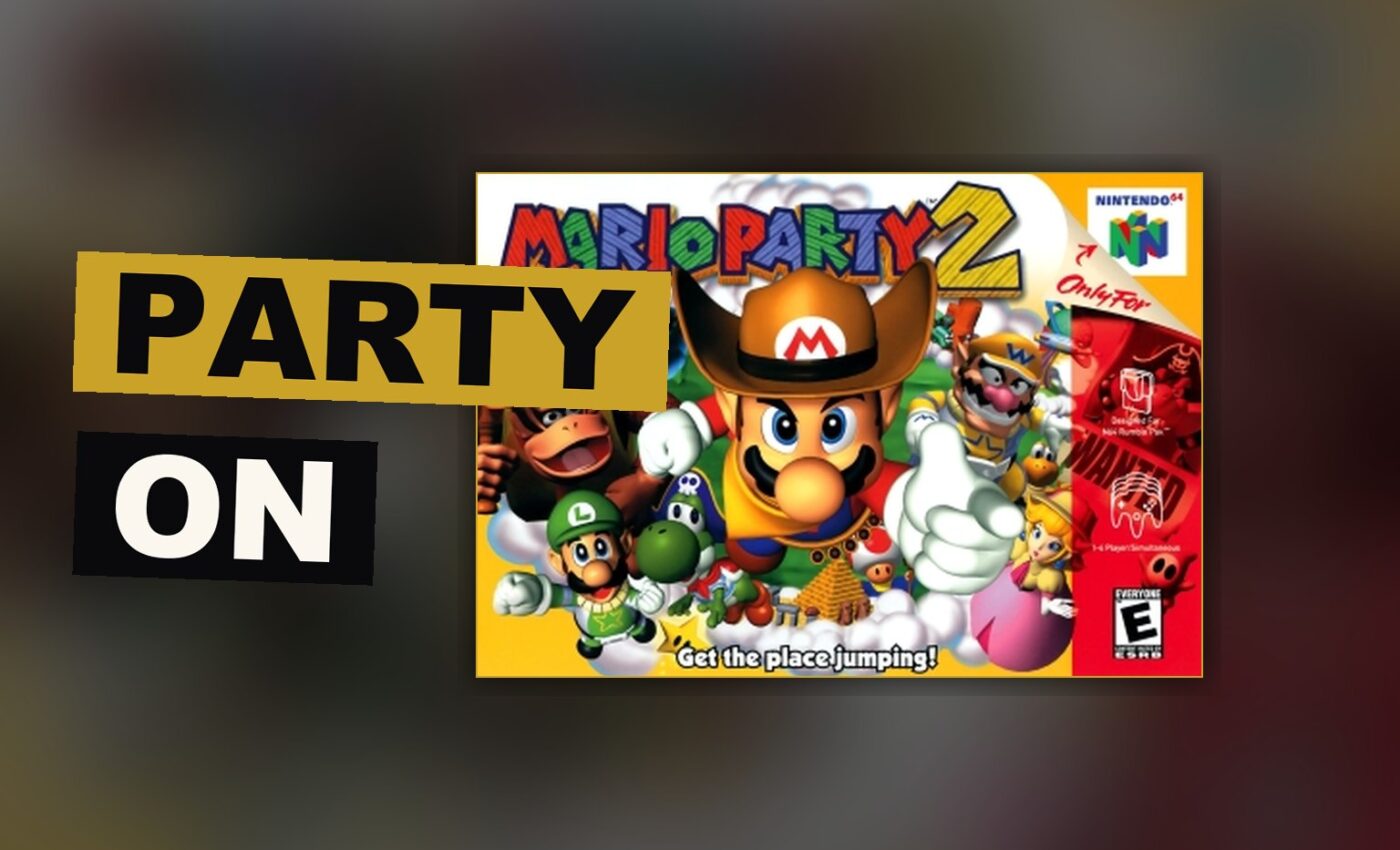
Mario Party 2 landed on the Nintendo 64 in 1999, and it arrived with a simple promise: more boards, more minigames, more reasons to shout at your friends over a dice roll. Hudson Soft developed it, Nintendo published it, and the game was released in Japan on December 17, 1999, in North America on January 24, 2000, and in PAL regions on October 13, 2000. The source also credits CAProductions as a developer and Gradiente as a publisher.
It is the second game in the Mario Party series. It is also the one critics said improved on the original.
Six Characters, Five Boards, One Bowser Problem
Mario Party 2 puts six characters on the board: Mario, Luigi, Princess Peach, Yoshi, Wario, and Donkey Kong. All six carried over from the Mario series and the original Mario Party. Each one can be directed around themed game boards in a bird’s-eye or isometric view.
The setup is a board game, not a platformer. Four players take a board at a time. At least one has to be human, and up to four can be. Anyone not controlled by a person gets run by the computer, and the skill level for those characters can be set individually to “Easy”, “Medium”, or “Hard”.
That last detail matters more than it sounds. A board game lives or dies on whether the other players are worth competing against. Mario Party 2 lets you tune that.
The Frame Story Is Nonsense, and That Is Fine
The game opens with a frame story. Mario and his friends build a world out of their dreams, then get into a debate over whose name the new world should carry. Bowser shows up and invades the land. Toad suggests naming it after the “Super Star” who defeats Bowser.
It is thin. It is also enough. The story exists to justify five themed boards and a sixth that unlocks later in the game, and it does that job without getting in the way of the dice.
A slew of new tricks and devices bring new levels of challenge and excitement to board game play.
Turns, Stars, and 65 Minigames
The goal of Mario Party 2 is to collect the most Stars within the allotted number of turns. Stars are not found. They are bought from Toad with coins, and Toad only sells from a single predefined space on the board. Buy one, and Toad moves somewhere else.
Coins come from minigames. There are 65 of them, and one plays at the end of every turn. Coins also buy items.
Turn order gets set before the board starts. Each player hits a dice block, highest number goes first, lowest goes last. From there, a turn is a roll: the dice block decides how many spaces a character advances.
Length is a choice, not a default. “Lite Play” runs 20 turns, “Standard Play” runs 35, and “Full Play” runs 50. Twenty turns is a party. Fifty turns is a commitment.
| Mode | Turns | What it asks of you |
|---|---|---|
| Lite Play | 20 | A quick round, low stakes |
| Standard Play | 35 | The default party length |
| Full Play | 50 | A full evening on one board |
The Improvements Over the Original Are the Story
Mario Party 2 received mostly positive reviews from critics. The praise went to the improvements over the original, the multiplayer, and the minigames. The criticism went to a lack of originality. Graphics got a mixed to positive response.
That split is fair, and it is also the whole review in miniature. Mario Party 2 does not reinvent anything. It takes the first game’s frame and adds boards, minigames, items, and costumes. Each character gets different duds for each of the five Adventure Boards. New tricks and devices raise the challenge.
None of that is a new idea. All of it is a better version of an old one.
Where the Game Actually Lives
The single-player mode exists. It is not the point. Mario Party 2 supports multiplayer, co-operative play, and split screen, and the game is built around a table of people, not a couch of one.
That is why the computer skill settings matter, and why the turn length options matter, and why 65 minigames matter. A board game with four humans is a social contract. A board game with three computers is a test of whether the AI is worth beating.
What Came After
Mario Party 2 was followed by Mario Party 3 in 2000, which is a fast turnaround and says something about how Nintendo viewed the series. The game was re-released on the Wii Virtual Console in 2010, on the Wii U Virtual Console in North America in 2016, and on the Nintendo Classics service in 2022.
Content from Mario Party 2 was remastered for Mario Party: The Top 100 on the Nintendo 3DS, and for Mario Party Superstars and Super Mario Party. A 1999 board game keeps getting pulled forward. That is not nostalgia alone. It is a game that still works.
The Dice Block Still Holds Up
Mario Party 2 is not original, and it does not need to be. It arrived with five themed boards, a sixth that unlocks later, 65 minigames, adjustable computer skill, and three turn lengths that let a group decide how much of the night this is going to take.
The lack of originality is a real criticism. It is also the least interesting thing about the game. What matters is that Hudson Soft took a rough first draft and made the turns, the boards, and the minigames carry their weight. The frame story about naming a dream world after whoever beats Bowser is forgettable. The dice block is not.
Everything after it — Mario Party 3, the Virtual Console re-releases, the remastered content in later collections — sits on top of what this game got right.
Get the Notebook.
The day's best stories and every fresh verdict, in plain English, in your inbox by seven. One email a day, no more.