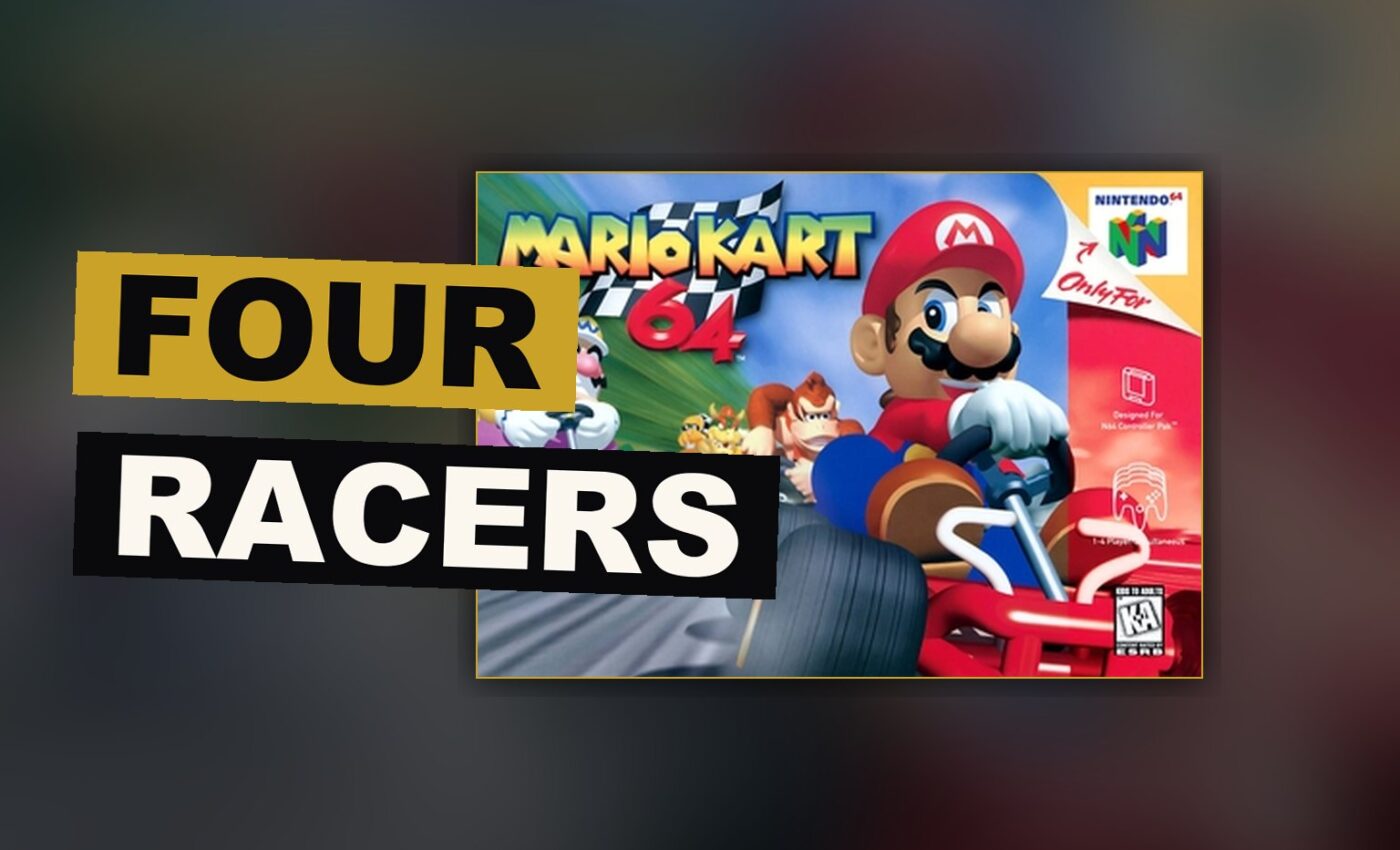
Mario Kart 64 arrived months after the Nintendo 64 itself, in late 1996 in Japan and 1997 worldwide, and it did not try to reinvent the series. Nintendo’s Entertainment Analysis & Development team built it as a sequel to 1992’s Super Mario Kart with one clear goal: make the racing smooth. That restraint is the whole story of the game, and it is why it still holds up.
Eight Characters, Three Weight Classes
The roster is eight Mario franchise regulars, split into three weight classes that decide how a kart handles. Lightweights are Princess Peach, Toad and Yoshi. Mario and Luigi carry middleweight. Bowser, Donkey Kong and Wario are heavyweights.
Speed, acceleration and handling shift with the class, so picking a racer is picking a driving style before the first race starts. The karts themselves have distinctive handling and top speed, and the game offers two camera angles on top of that.
It shipped on the Nintendo 64, Wii and Wii U.
Sixteen Tracks and Question Mark Boxes
Mario Kart 64 runs 16 courses built from locales in the Super Mario platform games. Each one carries obstacles that slow you down, shortcuts that let you skip a section, and question mark boxes that hand out a random item.
Those items split into two jobs. Some are power-ups, like a speed boost. Others are offensive, like a shell that sends an opponent spinning out. Bananas make rivals skid. Lightning Bolts shrink them and leave them crawling.
You can also drift around corners or tuck into an opponent’s slipstream for a boost, two small skills that separate a clean lap from a messy one.
Grand Prix, Time Trials, and Battle Mode
There are two single-player modes and a local multiplayer suite. Time Trials is solo only. Grand Prix can be played alone or with two players.
In Grand Prix, the main mode, you race seven computer opponents — six in two-player — across four cups of four tracks each, chasing the highest points over three-lap races.
- Battle mode is last man standing
- Split screen covers the multiplayer racing
- Drifting and slipstream boosts reward clean lines
Ranking the Three Engine Classes
The engine classes are the smartest piece of design here. They let one game serve a child and a veteran without a menu of options.
- 50cc — the gentlest maximum speed and the loosest control demands
- 100cc — a middle setting with more speed and sharper handling
- 150cc — the highest top speed and the hardest control
Higher classes mean higher top speeds and harder control. That single dial does more work than any other choice in the game.
Where the Game Shows Its Age
Mario Kart 64 was the first game in the series to use three-dimensional graphics, but the characters and items are still two-dimensional pre-rendered sprites. That mix is visible now in a way it was not in 1996.
The developers were bounded by the N64’s processing power and leaned on rendering techniques to save memory. They used car physics simulations to shape how the karts drive. The result is a game that moves well and looks dated.
Technical Issues and Difficulty
Criticism at the time landed on technical issues and difficulty, and both complaints still make sense. The presentation and track designs earned praise. So did the multiplayer, which is the reason many owners kept the cartridge in the slot.
9.87 Million Copies
Mario Kart 64 sold 9.87 million copies worldwide, the second-bestselling game on the N64. It was nominated for awards following release.
That number is not nostalgia. It is the record of a game that found a wide audience exactly as its developers intended, by polishing a formula instead of rebuilding it and aiming to appeal to a wide audience.
What the Multiplayer Still Proves
The case against Mario Kart 64 is real: the sprites, the technical issues, the difficulty. None of it touches the core.
What matters is the drift, the slipstream, the shell fired at the right moment, and three friends on one screen. Nintendo spent its effort on smooth gameplay rather than innovation, and that bet paid off in the only currency that counts for a party racer — whether people keep playing.
Eight characters, 16 tracks, three engine classes, one screen. That is a lean package, and it is still the right one.
Get the Notebook.
The day's best stories and every fresh verdict, in plain English, in your inbox by seven. One email a day, no more.