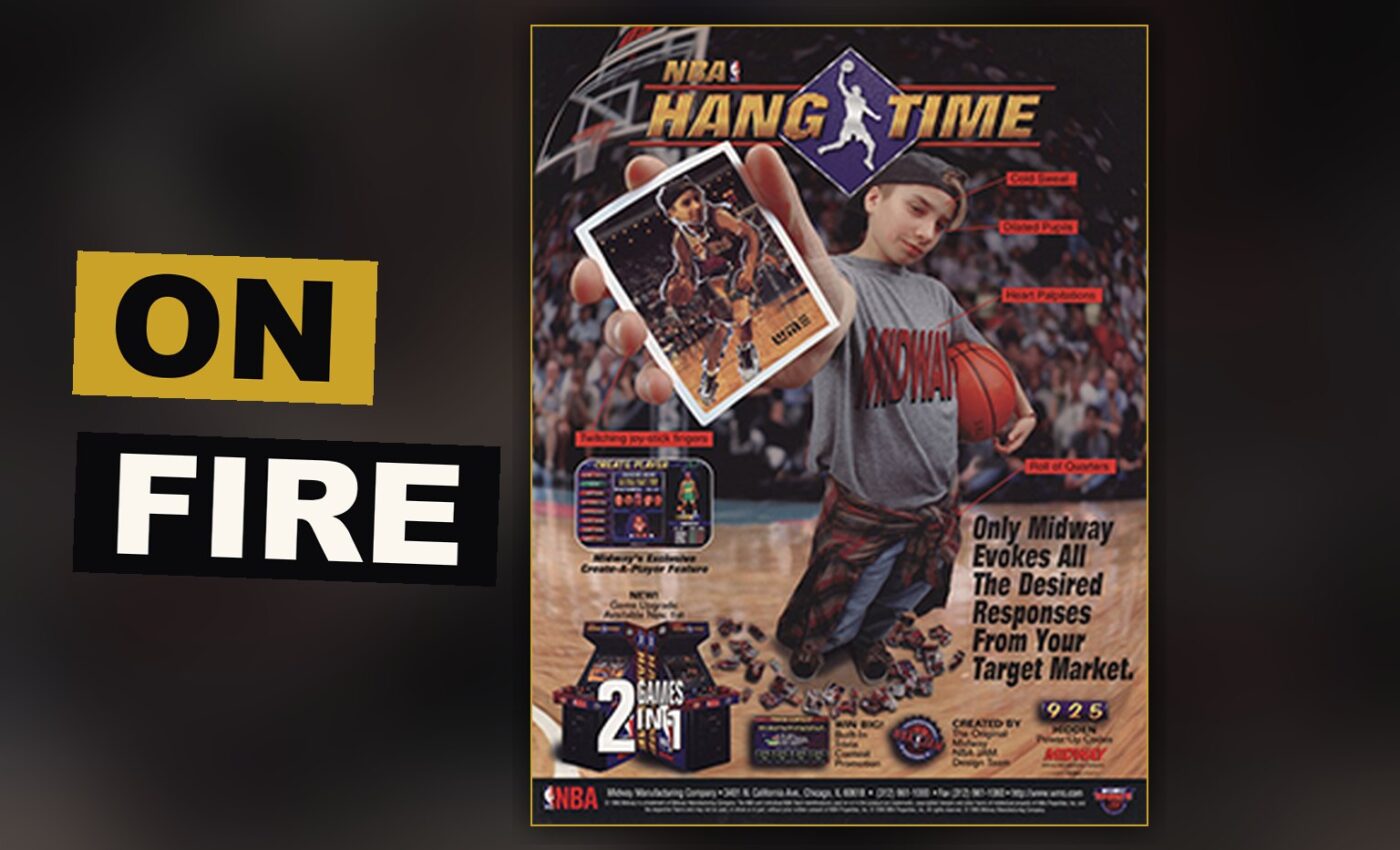
NBA Hangtime arrived in 1996 as the third basketball game from the same Midway team that built the NBA Jam series, and it carries that lineage on its sleeve. The name changed for a blunt reason: Acclaim Entertainment had acquired the NBA Jam name, so Midway’s arcade original shipped as Hangtime while Acclaim pushed NBA Jam Extreme the same year. On the Nintendo 64, that history is both the game’s strength and its ceiling.
Two-on-Two, Five Deep, and a Create Player Mode
The core is unchanged from NBA Jam: Tournament Edition. Two-on-two matchups, stat tracking, legal pushing, and “on fire” mode all return. You pick from any of the 29 NBA teams, play four quarters of three minutes each, and settle ties with three-minute overtimes. Each team now offers five roster members to choose from.
The headline addition is “Create Player.” You build a custom baller by spending a limited pool of attribute points across height, weight, power, shooting, and defensive skill. Win games and you earn more points, so the character grows with you. It is a simple hook, but it gives the home console versions a reason to exist beyond a roster update.
Alley-Oops, Double Dunks, and Team Fire
Hangtime’s other new mechanics are all about the two-man unit. Spin moves join the move set. Alley-oops let one player lob to the other mid-air. Double slam dunks let a player in the middle of a dunk pass to a teammate, who finishes it.
Those two plays can trigger “team fire,” a new mode where both teammates catch fire at once. That is the smartest thing in the game. In NBA Jam, fire was a solo reward. Here it rewards the pass, which nudges a series built on selfish highlight play toward something closer to actual teamwork.
Rosters, IDs, and the Chicago Bulls Problem
The home console versions carry rosters accurate to the 1996–97 NBA season, while the arcade original used 1995–96. That is a meaningful difference for a sports game sold on authenticity.
The game tracks the teams you beat using a player ID and PIN, and you can load your created player into that run. Your ID takes you through a ladder of NBA teams, starting with the Vancouver Grizzlies and ending with the Chicago Bulls. The Bulls were on their way to the championship when Hangtime shipped. Michael Jordan had returned from his sabbatical around that time, and he is not in the game. Midway chose not to include him. That is a hole a 1996 basketball game cannot fully paper over, and no amount of team fire fills it.
What the Home Versions Inherit
The gameplay is largely the same as Midway’s NBA Jam games, with some additions. That is the honest description, and it cuts both ways. The engine is proven. The two-on-two rhythm, the shoving, the stat lines — all of it still works. But Hangtime is not a reinvention. It is an iteration with a new name.
A software update called NBA Maximum Hangtime later hit arcades. Home players never got it. The sequel, NBA Showtime: NBA on NBC, would not arrive until 1999.
The Verdict on NBA Hangtime
Here is what actually matters. The Create Player mode and team fire are real additions, not marketing. They change how a match flows, and they give the two-on-two format a second layer that NBA Jam never had. The 1996–97 rosters on the home versions are the right call, and the ID-and-PIN progression gives solo play a spine.
What does not matter as much as the box wants you to think: the name change. Hangtime versus NBA Jam is a legal footnote, not a design one. The game plays like the series it came from because it is the series it came from, made by the same team.
The thing worth watching is the Jordan absence. It is not a bug or an oversight — Midway made a choice, and the choice leaves the game’s final boss, the Chicago Bulls, without the player everyone wanted to use. In a sports game, that is the kind of gap that ages badly.
Ranking what Hangtime gets right, in order of how much it changes the experience:
- Team fire, which turns the alley-oop and double dunk into a real strategic option.
- Create Player, which gives the home versions long-term solo appeal.
- The 1996–97 rosters, which keep the home versions current.
- The ID and PIN tracking, which gives that solo run a finish line.
- Spin moves, a fine addition that no one will remember.
The gameplay is largely the same as Midway’s NBA Jam games, with some additions.
That line is the whole review in miniature. Hangtime is a good basketball game with a legal problem for a title and one glaring roster hole. It earns its place next to the NBA Jam games, but it does not surpass them. It is the third entry from a team that knew exactly what it was doing, and it plays like it.
Get the Notebook.
The day's best stories and every fresh verdict, in plain English, in your inbox by seven. One email a day, no more.