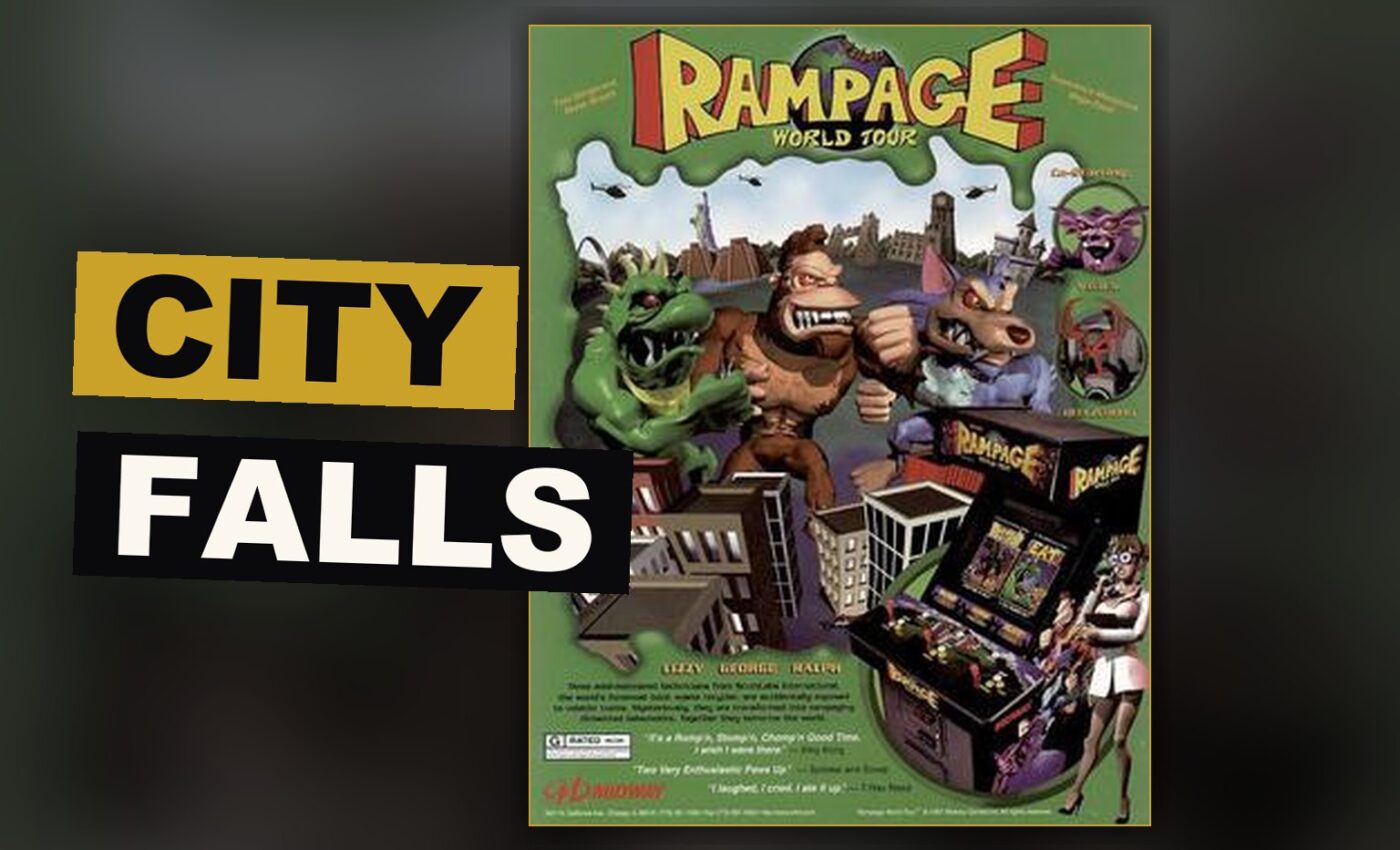
The Nintendo 64 version of Rampage World Tour does something the other home ports could not manage: it lets three people wreck a city at the same time. That alone makes it the version worth owning.
Three Monsters on One Cartridge
Rampage World Tour is a 1997 action game developed by Game Refuge and published by Midway Games for arcades. It is the sequel to 1986’s Rampage, and Brian Colin and Jeff Nauman designed it — the same pair behind the original. Ports followed for the PlayStation, Sega Saturn, Nintendo 64, Game Boy Color, and Microsoft Windows. The game was later re-released on Midway Arcade Treasures 2 and included in Rampage: Total Destruction.
The arcade cabinet supported up to three players at once. That feature did not survive the trip to every console. Though Midway announced the PlayStation version would also support three players, both the PlayStation and Saturn versions allow only two. Three-player support was apparently programmed into the port at one point and pulled at the last minute — a review of the PlayStation version in Electronic Gaming Monthly describes three-player gameplay, which tells you the feature existed and then vanished.
The Nintendo 64 conversion includes full three-player functionality. No asterisk, no caveat. If you want the couch version that matches the arcade original, this is it.
George, Lizzie, and Ralph Against Scumlabs
The plot is thin and knows it. The evil and corrupt Scumlabs causes an accident that unleashes three giant monsters named George, Lizzie, and Ralph. The trio set out to destroy every Scumlabs base scattered across the world and kill its employees.
In the last levels, Scumlabs CEO Eustace DeMonic turns himself into a monster to fight them. He is defeated during a battle on a lunar base. After that, the only surviving Scumlabs employee, Dr. Elizabeth Veronica, tries to disintegrate the monsters with a ray gun on her spaceship. It shrinks them to miniature size instead, and they wind up inside her ship. George and Ralph pose on the shelves. Lizzie bounces atop Veronica’s breasts — a moment censored on home ports.
That is the whole story, and it is enough. Rampage World Tour is not reaching for anything grander than a reason to knock buildings down.
The Stage Is the City
The goal of every stage is the same as the first game: destroy all the buildings in each city while avoiding or destroying the military forces. If you take too long, jets fly in and bomb the remaining buildings, ending the stage with a lower score. The game punishes dawdling, which is a sound way to keep a demolition game moving.
In the first level, Peoria, a tourism billboard cycles through different regions of the country — Northeast, Southwest, and so on. Destroy the billboard while it shows a region and you are sent in that direction. Players can also choose to eat or ignore the “World Tour” power-ups and control which country they visit. After grabbing a World Tour power-up, the next few levels take place in a foreign location until a Scumlabs plant is destroyed.
The structure has a cost. The game will not end until every Scumlabs city has been destroyed. That can cause erratic traveling toward the end, including multiple world tour trips if players missed flags or deliberately skipped them. The freedom to steer your own route cuts both ways: it keeps a long arcade game from feeling like a corridor, and it lets a careless run drag.
V.E.R.N. and the Long Haul
Purple radioactive waste temporarily transforms the player into a super monster known as V.E.R.N. It is a temporary buff, not a permanent upgrade, and it fits the game’s rhythm — brief bursts of overwhelming power between stretches of ordinary smashing.
The arcade version supports up to three players simultaneously. The Nintendo 64 version carries that through. Three monsters on screen at once changes the feel of a stage. Buildings come down faster, the military response gets messier, and the score chase becomes a competition between people in the same room rather than a solo grind.
The arcade version supports up to three players simultaneously.
That sentence is the whole case for this port. Everything else about Rampage World Tour — the Scumlabs plot, the world tour flags, the shrinking ray — is the same material on every platform. The player count is what separates them.
What the Port Gets Right
Digital Eclipse handled the Nintendo 64 conversion, and the result is the most complete home version of the game. The PlayStation and Saturn releases cap out at two players. The Game Boy Color release is a different proposition entirely, built for a handheld that cannot host a party. The Nintendo 64 sits in the middle: a console built for four controllers, running a game that only needs three.
The tradeoff is that Rampage World Tour was never a looker. It was an arcade game from 1997, and the Nintendo 64 conversion does not reinvent it. What it does is preserve the thing that mattered. Three players, one screen, a city to flatten.
The erratic late-game travel is a real flaw. A run can wander if flags are missed, and the requirement to destroy every Scumlabs city means the finish line keeps moving. Players who want a tight, predictable campaign will find the back half loose. Players who want an excuse to keep smashing will not mind.
The Verdict on Rampage World Tour
Rampage World Tour is a sequel that understands its own assignment. Brian Colin and Jeff Nauman built the original, and they built this one the same way: give the player a monster, a city, and a reason to keep going. The Scumlabs framing is nonsense in the best sense — Eustace DeMonic turning himself into a monster on a lunar base is exactly the kind of escalation a game about giant animals should reach.
The Nintendo 64 version is the one to play. Full three-player support, the complete arcade structure, and no compromises on the core loop. The PlayStation and Saturn versions are fine, but they are two-player games wearing a three-player game’s clothes. The Game Boy Color version is a curiosity. This is the real thing.
The score reflects a game that is very good at one specific pleasure and does not pretend to be anything else. The demolition holds up. The world tour mechanic gives the campaign a shape without overcomplicating it. The late-game wandering is a genuine annoyance, and the visuals will not impress anyone who did not grow up on arcade cabinets. But the three-player mode is not a bullet point — it is the reason the game exists, and the Nintendo 64 version is the only home release that delivers it.
The Numbers
- Title: Rampage World Tour
- Release year: 1997 (arcade)
- Developer: Game Refuge
- Publisher: Midway Games
- Nintendo 64 port: Digital Eclipse
- Platforms: PlayStation, Sega Saturn, Nintendo 64, Game Boy Color, Microsoft Windows
- Players (arcade): up to 3
- Players (PlayStation, Saturn): 2
- Players (Nintendo 64): 3
- First level: Peoria
- Monsters: George, Lizzie, Ralph
- Super form: V.E.R.N.
- Published critical score: 7.2/10 (IMDb)
Get the Notebook.
The day's best stories and every fresh verdict, in plain English, in your inbox by seven. One email a day, no more.