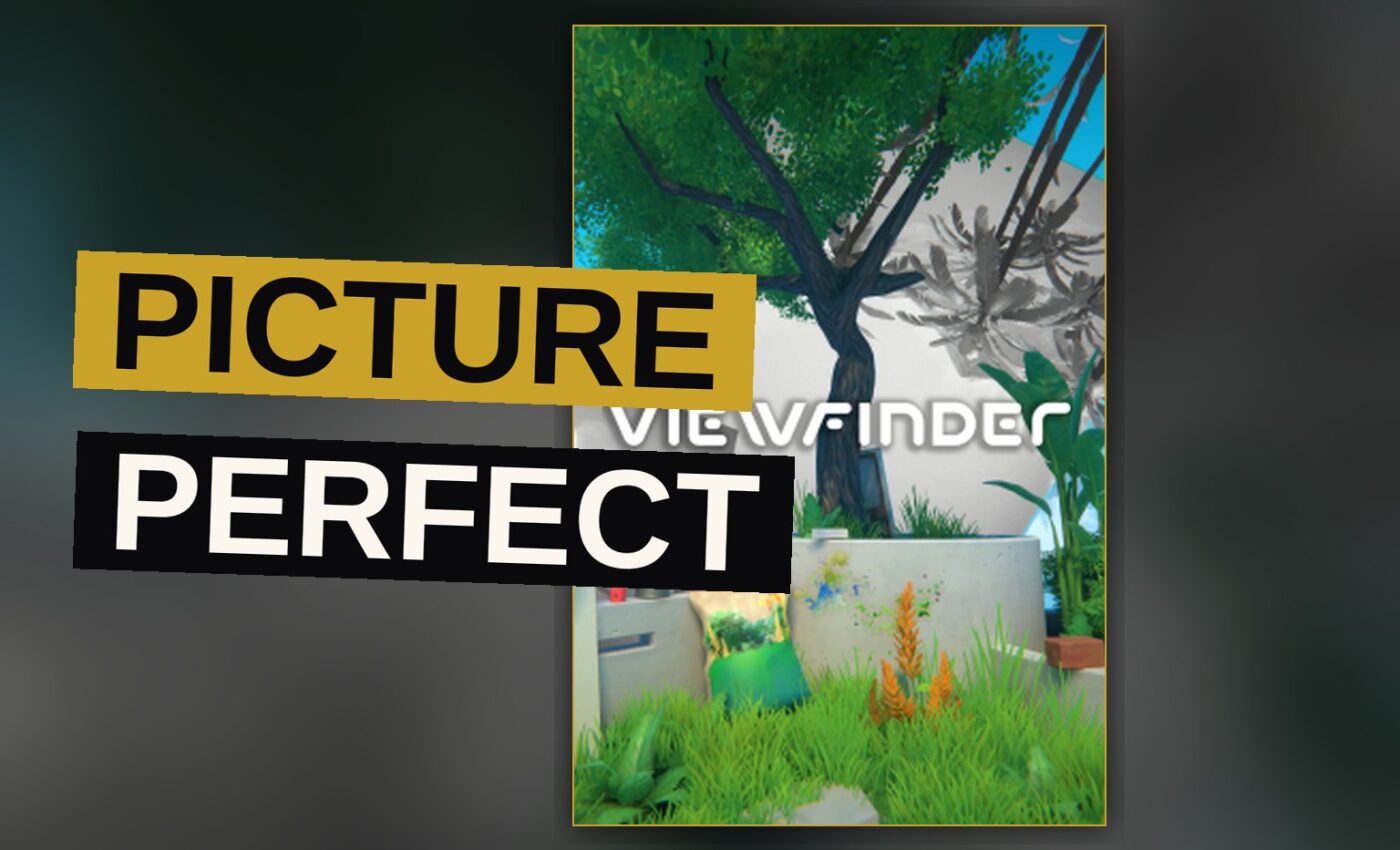
Viewfinder is a first-person puzzle game from Sad Owl Studios, published by Thunderful, and it does one thing better than almost anything else released in its year: it lets you take a photograph and walk into it. That is the whole pitch, and the game spends its entire run finding new ways to make it feel strange. Viewfinder earns an 8.4 out of 10.
Trailer, via Matt Stark.
A Camera That Turns Pictures Into Rooms
The core mechanic is mapping the images inside photographs and other two-dimensional works onto the three-dimensional space of the game’s world. Doing so creates new geometries and layouts. A picture of a hallway becomes a hallway. A picture of a ledge becomes a ledge. The player uses these mapped images to solve puzzles and reach teleporter devices at the end of each level.
Reaching a teleporter is not always the end of the work. The player may have to power it first, using batteries or other power devices, before the teleport will fire. That extra step keeps levels from collapsing into a straight line from picture to exit.
Later in the game, the player gains a Polaroid-style camera. Images taken with it work the same way as any other photograph.
The toolset grows without the rules changing, which is the right call. Viewfinder trusts its own idea enough to keep finding new angles on it rather than stacking new systems on top.
Cait, the Cheshire Cat Who Talks
The player is not alone inside the simulation. A witty artificial intelligence named Cait, in the form of a cheshire cat, guides the way. Cait is the voice in the player’s ear, and the game leans on that voice to keep the tone from sinking under the weight of its own premise.
That premise is heavy. Viewfinder is set inside a simulation built by a handful of researchers. In the real world, all plant life on Earth has been wiped out, leaving humanity without a viable source of oxygen. The simulation was their attempt to find a way to bring flora back. The player character enters the digital space to retrace their steps.
The player works with a partner in the real world. That detail matters more than it first appears. It establishes that there is an outside, that someone is waiting, and that the simulation is a tool rather than a refuge. The game does not treat the digital space as a place to hide. It treats it as a place to work.
A Failed Experiment and One Seedling
The story does not resolve the way a player might expect. The player-character finds that the scientists failed in their grand experiment. To leave the simulation, the player must force the simulated world to shut down, destroying the past work in the process. That is a real cost, and the game does not wave it away.
Then comes the turn. As the player leaves, they encounter a seedling. They still possess it when they exit the simulation. It is a small thing, and the game treats it as a small thing, which is exactly why it lands. Hope for Earth’s future arrives as a single object in the player’s hands rather than a speech.
The player-character finds that the scientists had failed in their grand experiment, and must force the simulated world to shutdown in order to leave the simulation, destroying the past work.
That structure — failure, destruction, a seedling — is the smartest thing in Viewfinder. The game earns its ending by making the player complicit in the loss first.
Batteries, Teleporters and the Puzzle Loop
Each level ends at a teleporter. Getting there means reading the space, finding the images that will reshape it, and placing them where they will open a path. The batteries and power devices add a second layer of problem-solving on top of the spatial one.
This is where Viewfinder could have gone wrong. Puzzle games built on a single strong idea often front-load the best material and then repeat themselves. Viewfinder avoids that by varying what the player is asked to do with the images, not just where they are placed. The introduction of the Polaroid camera late in the run is the clearest example. It changes what the player can bring to a puzzle without changing what a puzzle is.
The first-person perspective does quiet work here. The player is standing inside the geometry they created. When a photograph becomes a room, the player is in the room. That is a different feeling from watching a shape resolve on a screen from a distance, and the game knows it.
What the Simulation Was Built For
The researchers built the simulation to solve an existential crisis. All flora gone, no viable source of oxygen, humanity running out of time. That is the backdrop, and Viewfinder never lets the player forget it, but it also never turns the game into a lecture about it.
The player character is retracing the scientists’ steps. That framing turns the levels into a kind of archaeology. Every puzzle solved is a clue recovered. Every teleporter reached is a step deeper into the experiment. The game is about piecing together what happened to people who are not in the room anymore.
Cait is the only continuous presence in that space. A cheshire cat as a guide is a loaded image, and the game uses it lightly. Cait is witty, which keeps the tone from flattening into dread, but the cat is also the thing that knows more than it says. That is the right amount of ambiguity for a story about a failed experiment.
Five Platforms Across Three Years
Viewfinder released for PlayStation 5 and Windows in July 2023. The PlayStation 4 version followed in December 2023. The Xbox Series X/S version arrived in August 2025, and the Nintendo Switch version in December 2025. Five platforms, and the game is now 3 years old.
That is a long tail for an indie puzzle game, and it suggests the audience kept finding it. The 8.4 out of 10 on Metacritic puts Viewfinder in strong company. That score reflects a game that does one thing exceptionally well and builds a whole experience around it without padding. The puzzle design is the engine. The story is the reason to keep going. Cait is the reason it does not feel lonely.
There are limits. Viewfinder is a single-player experience, and its pleasures are solitary ones. The reality-bending mechanic is the entire show, and a player who does not click with it will not find a second hook waiting behind it. Viewfinder is not trying to be everything. It is trying to be one thing done right.
Why the Seedling Matters
Viewfinder is a puzzle game that understands its own idea. Mapping two-dimensional images onto three-dimensional space could have been a demo, a proof of concept, a thing you show someone for five minutes and then put down. Sad Owl Studios built a full game around it, gave it a story worth caring about, and stuck the landing with a seedling.
The 8.4 out of 10 is the right number. Viewfinder is not a perfect game, and it does not need to be. It is a game with a clear identity, a mechanic that holds up from the first level to the last, and an ending that respects what it cost the player to get there. That is more than most puzzle games manage.
The part worth watching is not the camera. It is what the camera is for. Viewfinder uses a reality-bending tool to tell a story about people who tried to save the world and failed, and then hands the player a reason to think it might still work. That is a harder trick than any of the puzzles.
Key facts:
– Developed by Sad Owl Studios
– Published by Thunderful Publishing
– Released for PlayStation 5 and Windows, July 2023
– Released for PlayStation 4, December 2023
– Released for Xbox Series X/S, August 2025
– Released for Nintendo Switch, December 2025
– Platforms: Xbox Series X|S, PlayStation 4, PC (Microsoft Windows), PlayStation 5, Nintendo Switch
– Genres: platform, puzzle, adventure, indie
– Theme: science fiction
– Mode: single player
– Perspective: first person
– Metacritic: 8.4/10
Get the Notebook.
The day's best stories and every fresh verdict, in plain English, in your inbox by seven. One email a day, no more.