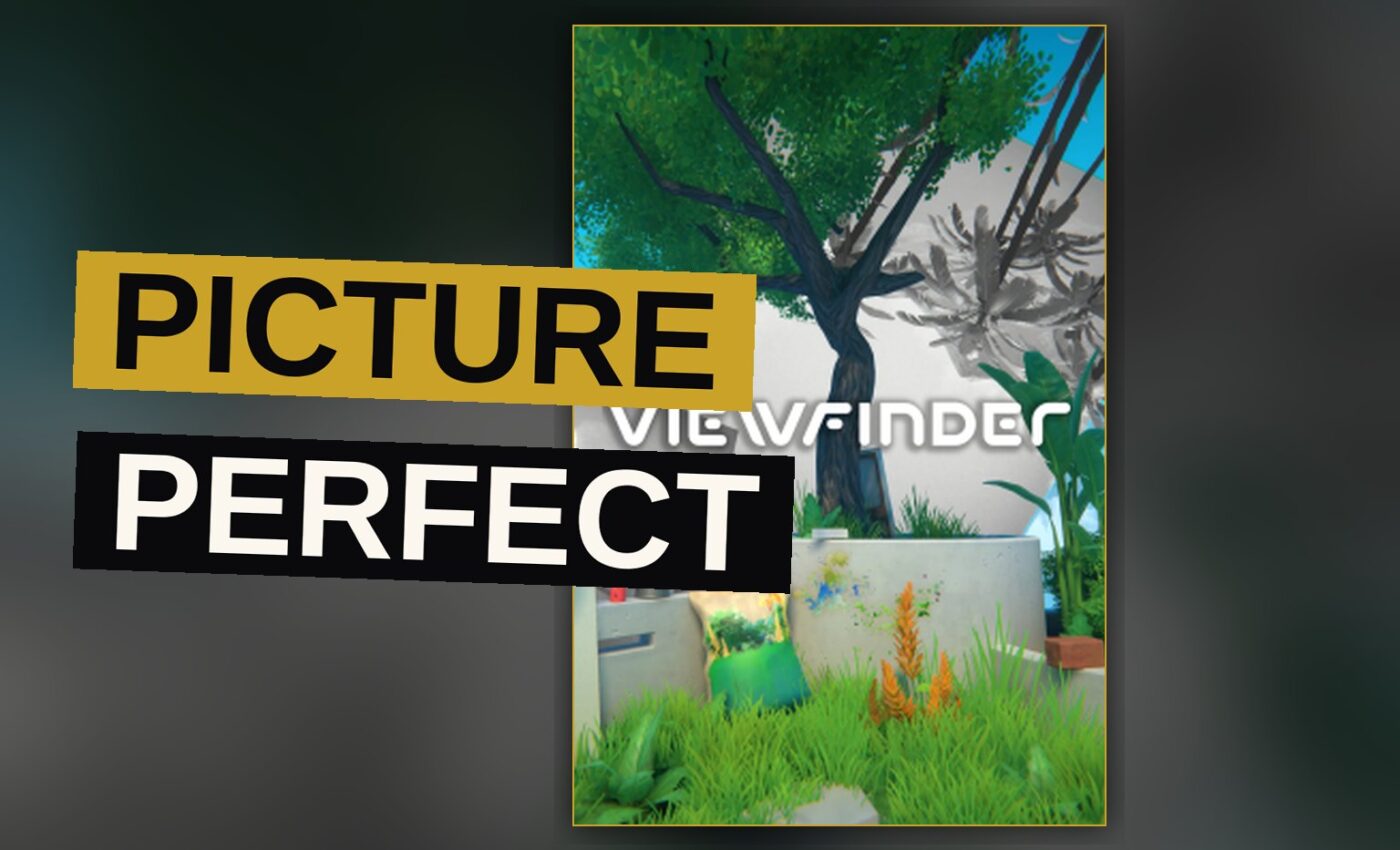
Viewfinder asks players to solve puzzles by placing pictures into the world and walking straight into them. Drop a picture of a bridge in front of a gap, and the bridge becomes real. Step through, and the picture changes the space around you. It’s a strange idea, and it works.
Trailer, via Matt Stark.
The Camera as Tool
The core idea never really changes across the campaign, but the puzzles built on top of it keep shifting the rules. Early rooms teach simple picture setting. Later ones hand you a working camera, let you take a picture of the surroundings, and then ask you to fold that new picture back into the scene to create an object, a staircase, or an exit that wasn’t there before.
The game leans on light narration between puzzle chambers, voiced by characters who show up mostly as recordings and notes. The story stays thin. It never gets in the way, but it never becomes the reason to keep playing either.
Here’s the short version: Viewfinder is a puzzle game first, and everything else is support.
Working Through the Rooms
The pacing holds up because the difficulty curve is honest. New tools arrive before old ones get stale, and the game rarely repeats an idea once it has made its point. A rough sense of how tools are introduced across the run:
| Stage | New Tool Introduced | Puzzle Focus |
|---|---|---|
| Opening | Still pictures | Simple setting and perspective |
| Early-mid | Handheld camera | Player-made picture objects |
| Mid | Copying pictures | Layered objects built one atop another |
| Late | Time-based picture triggers | Timing and order puzzles |
That structure keeps the back half of the game from feeling like a repeat of the front half, which is where a lot of perspective-puzzle games start to weaken.
Viewfinder draws comparison to other reality-bending puzzle titles, and it mostly earns the company it’s likely to be judged against.
| Comparison Point | Common Approach in the Genre | Where Viewfinder Differs |
|---|---|---|
| Core trick | Linking spaces or bending perspective | Viewfinder uses pictures as the linking object instead |
| Puzzle objects | Often temporary or one-use | Viewfinder’s picture objects last and can be built upon |
| Player logic | Often abstract symbol reading | Viewfinder favors hands-on picture handling over symbols |
The comparison isn’t a knock. Viewfinder borrows the general feeling of those games — that quiet satisfaction of a rule finally falling into place — while building its own grammar around pictures rather than portals or symbols.
Rough Edges
Not every puzzle lands. A handful of rooms in the middle stretch rely on awkward camera angles that make solutions feel more like trial and error than real insight. When a puzzle in Viewfinder works, it feels like a trick explained to you in real time. When it doesn’t, it feels like fighting the camera controls instead of the puzzle.
Performance on PS5 stays steady through the puzzle rooms, without slowing during the more object-heavy late-game chambers. On PC, the game scales cleanly across a range of hardware, and load times between puzzle rooms are short enough that failure never feels like a real loss.
There’s an undo feature that removes a placed picture instantly.
That small mercy matters more than it should. Puzzle games live or die on how forgiving they are when a player’s first idea doesn’t pan out, and Viewfinder never punishes trying new things. Players are encouraged to try the wrong picture, watch it fail, and pull it back without penalty.
Where It Lands
Viewfinder doesn’t stay too long. The campaign wraps before the central idea gets thin, and the late puzzles ask real questions of the core trick rather than just repeating earlier answers with new dressing. The narrative framing is the weakest part of the package, present mostly to give the puzzle rooms a reason to exist rather than to build toward anything memorable on its own.
What Viewfinder gets right is the feeling of a truly new idea handled with care. It doesn’t lean on shock value from the twist alone. It builds an actual puzzle language out of pictures and perspective, then spends the rest of the game teaching players to speak it well.
For players who liked how other perspective-driven puzzle games turned a single trick into a full experience, Viewfinder belongs on the same shelf. It has some awkward moments and a story that mostly stays out of its own way, but the core idea carries the whole thing.
Get the Notebook.
The day's best stories and every fresh verdict, in plain English, in your inbox by seven. One email a day, no more.