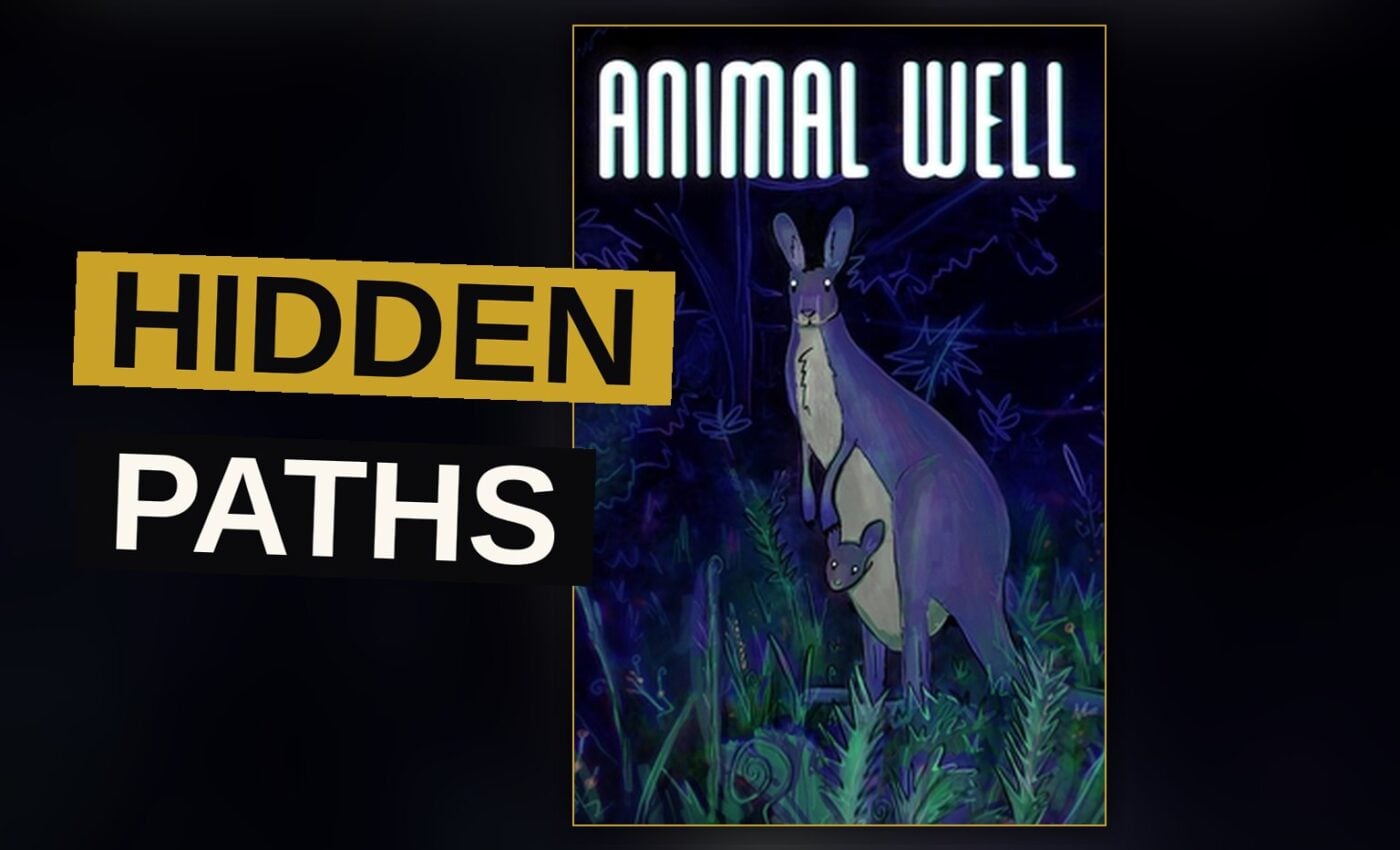
Animal Well is a strange, exact game that builds a single sprawling world out of small rooms and simple rules. It asks players to find every hidden path inside it. The result earns a 9.1 out of 10. The game came out in 2024 on PC, PS5, Xbox Series X/S and Switch, and it still stands as one of the strangest games of that year.
Trailer, via Billy Basso.
A World Without Words
There is no dialogue in Animal Well. No text boxes explain what a switch does or where a locked door leads.
Instead the game teaches through repetition and trial. A player picks up an item, tests it against a wall, a switch, an animal, and slowly learns the shape of the world through use. That approach could feel cold. Here it feels generous, because every room holds a clue if a player looks closely enough.
The Tools Players Find
Progress in Animal Well comes from a small set of tools, each one plain on its own but powerful in combination.
- A ring that can be thrown and bounced off surfaces
- A rope tool used to reach ledges and strike switches
- A small bell that startles animals and opens paths
- Bubbles that can be ridden or used as platforms
None of these tools is explained in detail. Players work out their limits by using them, then find new uses for them hours later in rooms that once seemed empty.
The Animals Themselves
The creatures that give the game its title are not simple enemies. Some block a path until scared off. Some carry a player across water. Some exist only to be watched, not touched.
Each animal behaves by a fixed set of rules, and learning those rules is often the true puzzle, more than any switch or door.
Design That Rewards Patience
Animal Well is built as one continuous map, and it rarely tells a player where to go next.
That structure asks for patience. A locked door met early in the game might not open until many hours later, after a tool or a piece of knowledge gained somewhere else makes the answer clear. When that moment arrives, it lands with real force, because the game never points at it directly.
The game’s hardest secrets are not marked as secrets at all. They sit in plain sight, disguised as background detail, until a player notices a pattern repeating across rooms far apart from each other. Finding one of these threads and following it to its end is the closest this game comes to a plot, and it is more satisfying than most games manage with pages of written story.
Visual Style
The pixel art in Animal Well is small and precise, built from a limited range of colors that still finds room for real beauty. Water ripples, lights flicker, and shades shift softly as a player moves between rooms.
None of it is loud. The game trusts quiet color and simple movement to do the work, and that restraint fits the mood of the whole project.
Sound Design
The audio in Animal Well matters as much as the visuals. A low hum runs under most rooms, broken by chimes, splashes, and distant animal calls that hint at what waits ahead.
Music arrives rarely, and only at moments that have earned it.
Where It Falls Short
The game’s refusal to explain itself will frustrate some players. Without any hints, guidance, or map markers, certain puzzles depend on noticing a single visual detail in a room visited many hours earlier. Missing that detail can mean wandering the map without a clear next step.
The controls are precise but demanding. A handful of late-game trials require exact timing across the ring, rope, and bell at once, and the game does not soften that difficulty.
What Stays With You
Long after the credits, the shape of a certain hidden path or a single strange animal call tends to linger in memory more than any single puzzle solved. That lingering feeling is rare, and it is the clearest sign of how much care went into building this small, dense world.
The game’s final secret, buried deep in its map, asks players to trust the patterns they have seen all along. That trust is the whole point of Animal Well, and it pays off in a way few games attempt.