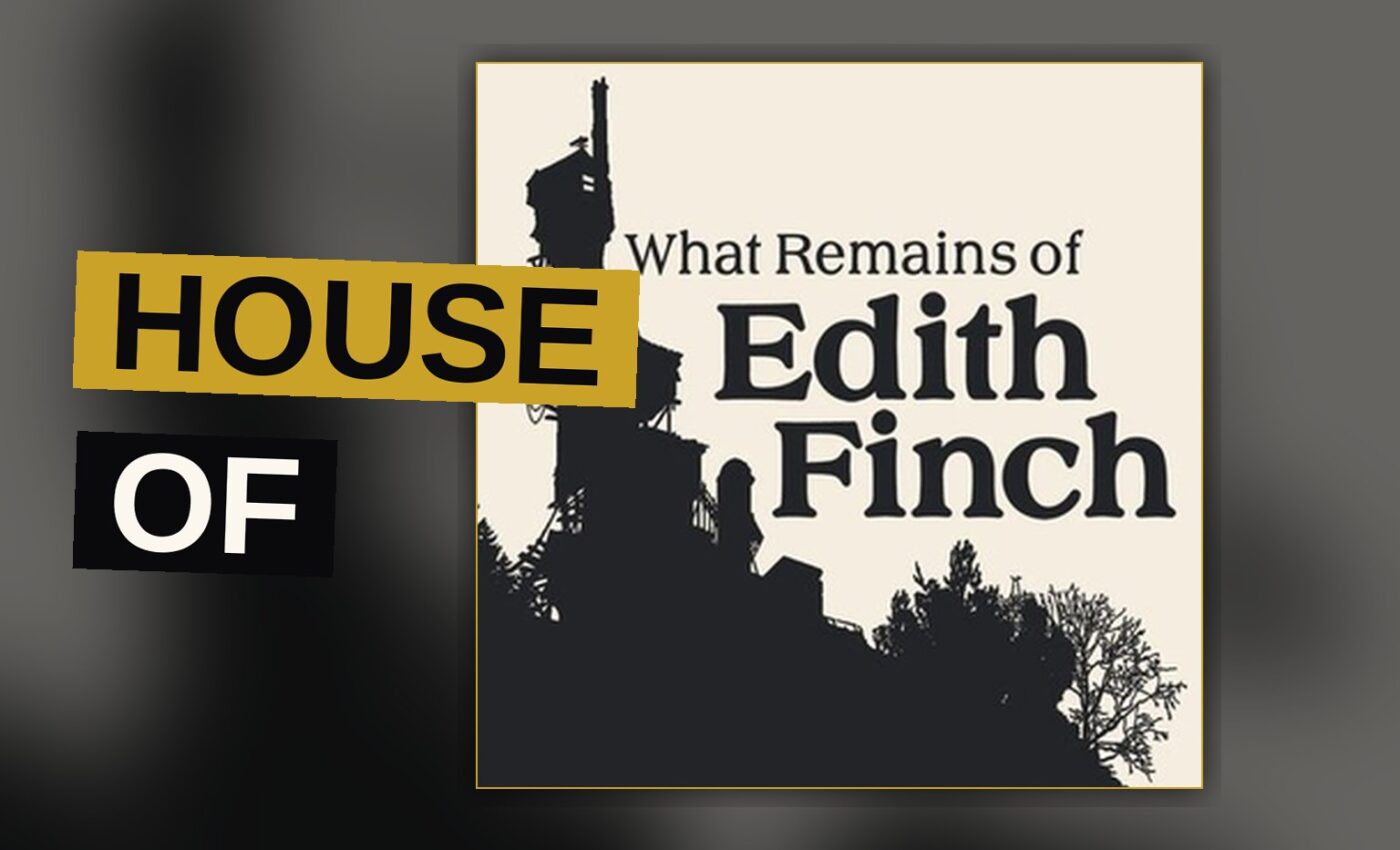
What Remains of Edith Finch opens with a ferry ride to Orcas Island, Washington, and a journal. The player character carries Edith’s writing ashore. That small displacement — reader first, character second — is the whole game in miniature.
Giant Sparrow developed it. Annapurna Interactive published it. It arrived in 2017 for PlayStation 4, Windows and Xbox One, then on Nintendo Switch in 2019, iOS in 2021, and PlayStation 5 and Xbox Series X/S in 2022. The critical consensus settled at 8.8 out of 10 on OpenCritic. That number holds up.
Trailer, via PlayStation.
The Finch House on Orcas Island
Edith is seventeen. She is the last surviving Finch, and she has come back to her ancestral home for the first time in seven years. The house is the game’s true subject — a semi-linear maze of rooms, footpaths, crawlspaces and secret passages that the player moves through in first person.
Each dead relative’s bedroom has been preserved and memorialized since the day that person died. Edith interacts with objects at these shrines. Each object triggers a vignette. Each vignette ends with a death.
The structure is an anthology, and the game means it. Genre, medium, perspective, stylization and mechanics shift from story to story. Some sequences are realistic. Some are not. The player is made to doubt how much of any account is true.
Molly, Barbara, Calvin, Walter
The family believes it is cursed. In 1937, after the deaths of his wife Ingeborg and newborn son Johann, Edith’s great-great-grandfather Odin Finch emigrates from Norway to the United States. He ferries the family house across the water with his daughter Edie, her husband Sven, and their newborn daughter Molly aboard. Waves off Orcas Island capsize the house. Odin drowns.
The survivors build a new home and a graveyard beside it. Edie gives birth to Barbara, twins Calvin and Sam, and Walter. For a while she thinks the curse is behind them. Then the tragedies start again.
Molly dies at ten after ingesting fluoridated toothpaste and holly berries, a death the game attributes to her mother’s neglect. Barbara is murdered at sixteen after a heated argument with her boyfriend Rick. Calvin, eleven, falls to his death swinging off the edge of a cliff. Sven dies at forty-nine in a construction accident at the house. Walter spends thirty years in a bunker beneath the house, decides at fifty-three to leave, and dies immediately.
Doubt Is the Point
The game hands the player a stack of stories and then undermines every one of them. The vignettes vary in intent and veracity as much as in style. Edith’s narration, drawn from her journal, provides the exposition and the nuance, but it is her account, told through the sources she collected.
This is where What Remains of Edith Finch does something few games attempt. It builds its emotional force on uncertainty rather than revelation. The magical realist touches — the themes of free will, fate, memory and death — are not decoration. They are the mechanism.
A Game That Earned Its Awards
The recognition was immediate and specific. What Remains of Edith Finch won the British Academy Games Award for Best Game in 2017. It won Best Narrative at The Game Awards 2017 and again at the 2018 Game Developers Choice Awards. It is regularly cited as an example of video games as an art form.
The praise focused on three things: immersive storytelling, characters, and presentation. That is an accurate accounting. The presentation carries the anthology format, because a game that changes its own visual language every twenty minutes should fall apart, and this one does not.
What the Game Gets Right
The first-person constraint is the smartest decision here. Every story is played from that perspective, and every story ends in a death the player cannot prevent. You are not solving the Finch curse. You are attending it.
The pacing is the weaker element. Some vignettes land harder than others, and the semi-linear house means the player’s investment rises and falls with whichever room they open next. The game also asks a lot of patience from anyone who wants answers rather than atmosphere. It never confirms the curse. It never explains the deaths beyond what the family believed.
That refusal is the point, and it is also the limitation. What Remains of Edith Finch is about being humbled and astonished by a vast and unknowable world. It delivers that feeling. It does not deliver closure, and it does not pretend to.
The Verdict
Nine years on, What Remains of Edith Finch remains the cleanest argument that a game can be a short story collection and still be a game. The anthology structure is not a gimmick. It is the only way to tell this particular story about this particular family, where every branch ends the same way and the only thing that changes is how you get there.
The doubt the game plants in every account is not a flaw to be resolved. It is the honest position. Families tell themselves stories about why they suffer, and those stories are never fully true.
What Remains of Edith Finch is worth playing for the Molly sequence alone, and it is worth finishing for what Edith finds at the end of her journal. It is a rare thing: a game that trusts the player to sit with not knowing.
Key facts
- Title: What Remains of Edith Finch
- Developer: Giant Sparrow
- Publisher: Annapurna Interactive
- Release: 2017 (PlayStation 4, Windows, Xbox One); 2019 (Nintendo Switch); 2021 (iOS); 2022 (PlayStation 5, Xbox Series X/S)
- Genre: Puzzle, Adventure, Indie
- Perspective: First person, single player
- Critical score: 8.8/10 (OpenCritic)
- Key awards: British Academy Games Award for Best Game 2017; Best Narrative, The Game Awards 2017; Best Narrative, Game Developers Choice Awards 2018
Get the Notebook.
The day's best stories and every fresh verdict, in plain English, in your inbox by seven. One email a day, no more.