Arkane Austin built Prey as a spiritual successor to System Shock, then dressed it in the skin of a 2006 game it has almost nothing to do with. The result, released in 2017 for PlayStation 4, PC and Xbox One, is one of the smartest immersive sims of its decade — a station-sized puzzle box where the wrench in your hand matters as much as the shotgun you find later.
Trailer, via IGDBcom.
Talos I, Orbiting the Moon
You wake up in an apartment that is not an apartment. Prey opens in a simulated environment, and Morgan Yu — voiced by Tim Kang or Sumalee Montano depending on the gender the player picks — discovers they have already spent three years aboard Talos I, a TranStar Corporation research station in orbit around the Moon. Three years of memories are gone.
The station has been overrun by the Typhon, a hostile alien species with physical and psychic powers. Most of the crew is dead. Morgan is hunted.
The setup is a haunted house in orbit, and Arkane knows it. Every corridor has a story about what went wrong, and none of the survivors agree on the details.
A Wrench, a Gloo Cannon, and Scarcity
Combat in Prey is a negotiation. You start with a basic wrench. Eventually you unlock the Gloo Cannon, which fires a foam-like substance that freezes enemies in place. Firearms exist — a silenced pistol, a shotgun, a boltcaster — but ammo is scarce, and the game wants you to feel that.
Sprinting and swinging a melee weapon burn stamina, which regenerates only when you rest. Stealth is a real option, not a token one. You can slip past enemies or chart alternate routes entirely. Environmental hazards like oil spills and explosive canisters, plus station defenses such as turrets, do work for you if you plan.
This is the part of Prey that has aged best. The station is a toolbox, and the game trusts you to open it.
The Typhon Have Subspecies
The alien roster is built around distinct attack patterns. Cystoids rush and explode. Mimics shapeshift into common items, which turns every coffee mug into a threat. Poltergeists turn invisible. Telepaths throw psychic energy. Phantoms are human corpses taken over by the Typhon, and their power is randomly generated, so no two fights read the same.
Then there is the Nightmare, a singular enemy that constantly hunts and stalks the player. Its psionic attacks can be nullified with throwables, which renders it vulnerable. The Nightmare is the game’s best argument for its own pacing: a threat you cannot out-level, only out-think.
Alien attacks deplete Morgan’s health and suit integrity. Food and health kits restore both. A post-launch update added a “Survival” mode with additional systems.
An Alternate Space Race
Prey’s backstory is a full alternate timeline, and it is delivered with unusual discipline. In 1958, the Soviet Union encounters the Typhon aboard its satellite Vorona 1. The Soviets and the United States work together to capture the aliens, keeping the public in the dark. They build Kletka, a prison station in orbit around the Moon.
After a failed assassination attempt on President John F. Kennedy, the United States takes full control of Kletka. Research continues as “Project Axiom.” The 1980 “Pobeg Incident” ends with Typhon killing scientists aboard the station, and the American government shuts the project down while leaving the captive Typhon alive.
In 2025, the newly founded TranStar Corporation acquires Kletka. By 2030 it is Talos I, a working laboratory studying the Typhon and pushing neuroscience forward. The payoff is Neuromods, which harness Typhon physiology to restructure the human brain and grant new abilities, including superhuman ones. TranStar gets rich selling them on Earth.
By the time of the game, roughly 2035, staff spend up to two years on the station between shuttles home. That detail does more worldbuilding than any codex entry.
Morgan, Alex, and January
The cast is small and specific. Morgan is recruited in March 2032 by their brother Alex, voiced by Benedict Wong, to join TranStar’s research team. Before leaving for the station, Morgan takes a series of tests. One of the supervising doctors is attacked by a Typhon during testing, and Morgan is knocked out.
In 2035, Morgan wakes in the simulated apartment and is contacted by January, an Operator artificial intelligence that claims Morgan built it. January warns that the Typhon have broken containment and killed much of the crew.
Morgan’s job is to piece together the truth while deciding who and what to trust. Prey commits to that question instead of answering it early.
The Dishonored Team’s Second Act
Development began after Arkane Austin finished Dishonored in 2012. Raphaël Colantonio served as director. The studio built Prey as a spiritual successor to System Shock (1994), giving players multiple avenues through missions, and treated Talos I as a thematic reinterpretation of the underground dungeon from its debut game, Arx Fatalis (2002).
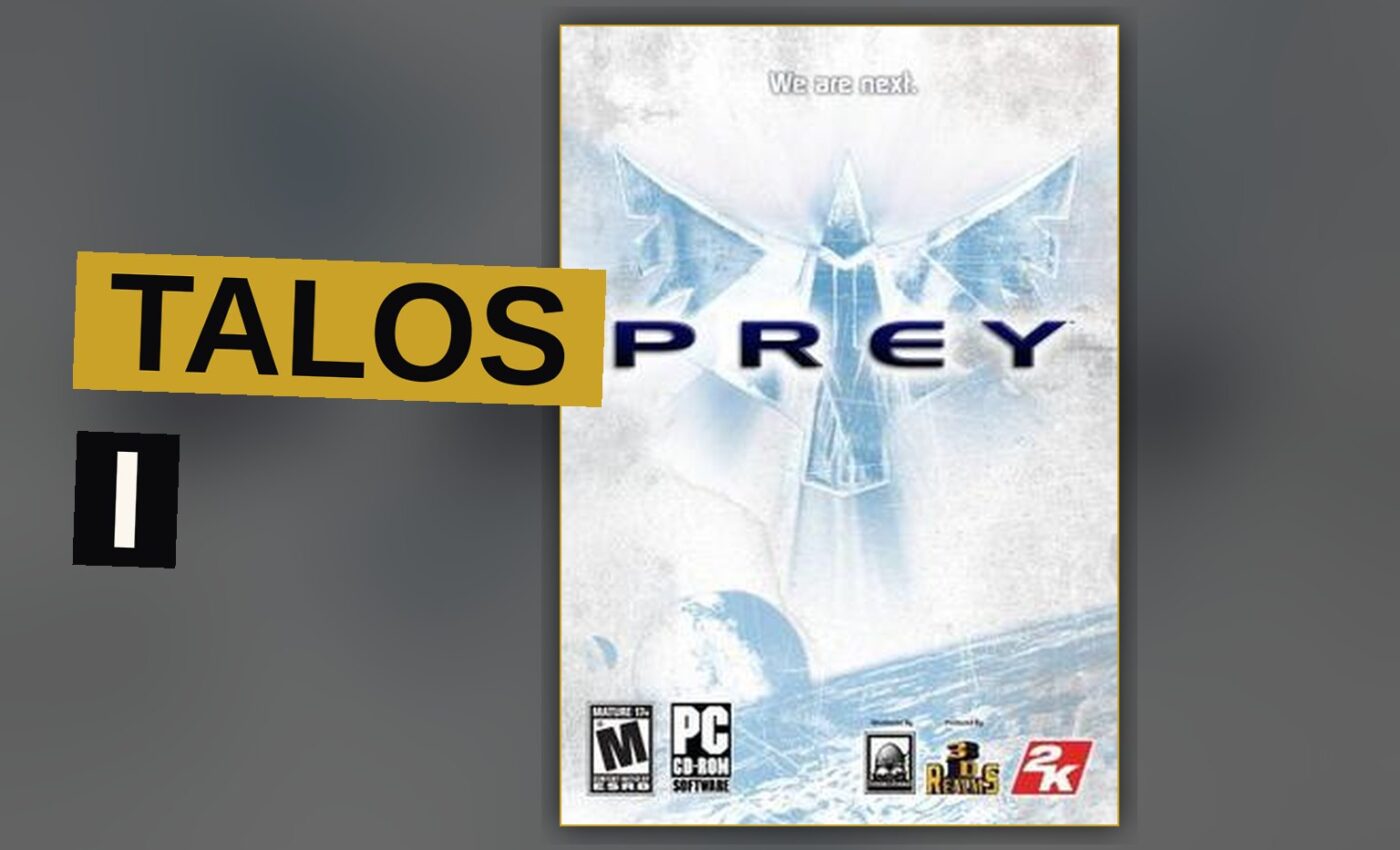
The naming is the strangest part of the story. Arkane’s Prey is largely unrelated to the 2006 game Prey or its cancelled sequel. It used none of the planned sequel’s assets and took only the previous game’s name and the broad theme of a protagonist hunted by aliens.
That decision cost the game a chunk of its audience before launch. It also freed Arkane to make the game it actually wanted.
A Station You Learn to Read
Progression through Talos I runs on linear missions until the player earns free exploration of the station, picking up key items and abilities along the way. The structure matters because Prey’s tension comes from knowledge, not from difficulty. A room is frightening until you know its exits.
| Phase | Location | What changes |
|---|---|---|
| Opening | Simulated apartment | Morgan learns three years are missing |
| Early station | Talos I corridors | Wrench, scarce ammo, stealth routes |
| Mid-game | Research labs | Gloo Cannon, firearms, Neuromods |
| Free exploration | Full station | Alternate paths, turrets, hazards |
| Late game | Talos I | The Nightmare hunts without pause |
Read that table as a difficulty curve made of information. The station does not get easier. You get better at reading it.
What Prey Gets Right, and What It Doesn’t
The strongest thing Prey does is refuse to separate its systems from its fiction. Neuromods are both a power-up and a moral problem. The Typhon are both enemies and the raw material for human enhancement. Talos I is both a workplace and a prison, and the crew’s two-year shifts make the station feel lived in rather than dressed.
The weaker stretch is the back half. Once free exploration opens up, the game’s dread thins. The Nightmare is a genuine pressure, but it is one enemy carrying a lot of weight. And the 2006 name remains a marketing decision that has never stopped looking like one.
Still, the pieces that matter hold. The Mimics turn ordinary objects into ambushes, which is the single best idea in the game and the one that most changes how you walk into a room. The Gloo Cannon gives you a non-lethal tool that stays useful for hours. Ammo scarcity forces decisions instead of reflexes.
Prey is not a shooter with puzzles bolted on. It is an immersive sim that treats the station as the main character and Morgan as the player’s instrument inside it. Arkane Austin’s decision to build a System Shock successor under a borrowed title was cynical on paper. The game itself is not cynical at all.
Get the Notebook.
The day's best stories and every fresh verdict, in plain English, in your inbox by seven. One email a day, no more.