
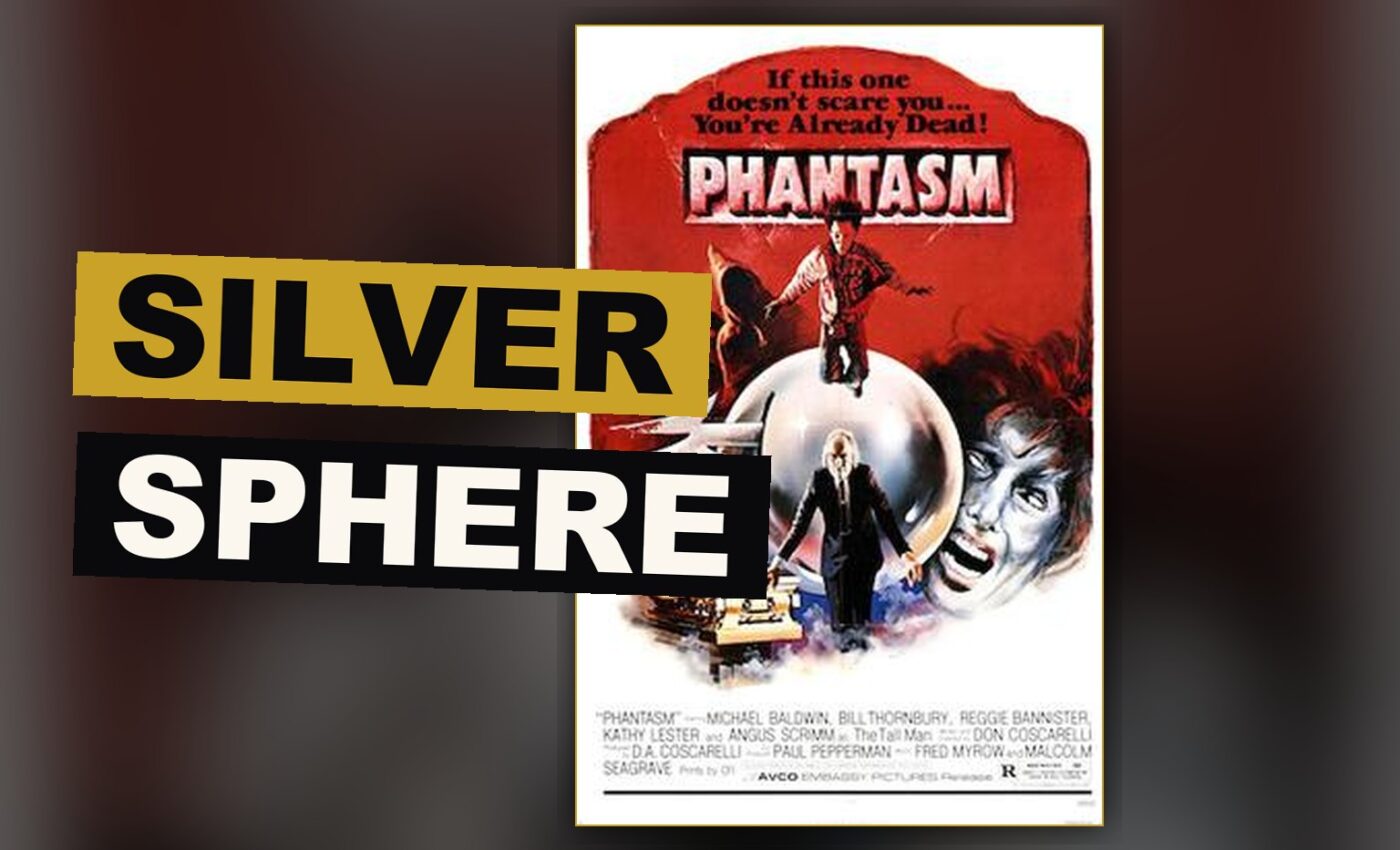
Don Coscarelli made Phantasm for almost nothing, shot it across a year in and around Chatsworth, California, and cast it with amateurs and friends. The story he tells is set in a small Oregon town. The result is one of the strangest American horror films of the 1970s, and one of the best. It runs 89 minutes. It never once behaves itself. Our score is 9.3/10.
A Coffin Lifted Like It Weighs Nothing
The premise is small and clean. Mike is 13. He lives in a small Oregon town with his older brother Jody. Their friend Tommy has died, and everyone has settled on suicide. Mike doesn’t buy it. He sneaks around the funeral and watches the mortician put Tommy’s heavy coffin back into the hearse by himself, without strain, instead of finishing the burial.
That single image is the whole engine of Phantasm. A man does something physically impossible in plain daylight, and a kid is the only one paying attention. Coscarelli wrote the film from a nightmare he had as a teenager and developed it into a rough screenplay, then kept rewriting it throughout the shoot. You can feel that restlessness. The movie keeps adding rooms instead of tidying the ones it has.
Mike takes his story to a local fortune teller. She has him put his hand in a box. Something seems to grab it. He pulls it out unharmed after she tells him not to be afraid. That is the film’s method in miniature: dread first, explanation never.
Angus Scrimm and the Lady in Lavender
The Tall Man is the reason people still talk about Phantasm. Coscarelli cast Angus Scrimm after being intimidated by him on the set of Jim the World’s Greatest in 1976, and decided on the spot that Scrimm would make a great villain. Scrimm was outfitted in lifts and a suit too small for him, so he would read as taller and skinnier than any man should be.
Coscarelli has been blunt about what he got.
I really didn’t have any idea that he would take it to the level that he did. … I could see it was going to be a very powerful character.
Scrimm initially had little input on the character. He began contributing once Coscarelli started trusting his instincts, and the performance that came out of that trust is mostly stillness and posture. The Tall Man doesn’t lunge. He looms, and the film treats his height as a fact of nature.
He also appears as the Lady in Lavender, a female form he takes to seduce and kill. Kathy Lester plays her, with Laura Mann as her double, credited as Double Lavender. The Lady in Lavender kills Tommy in Morningside Cemetery while they are having sex. It is the film’s first scene and it sets the terms: sex, death and the mortician are the same figure.
The rest of the cast is thin on paper and effective on screen. Mike was written specifically for A. Michael Baldwin after he appeared in a minor role in Coscarelli’s Kenny & Company in 1976. Bill Thornbury is Jody. Reggie Bannister plays Reggie, a character Coscarelli based on his friend of the same name and wrote for him directly — an everyman, a loyal friend, and the comic relief. The supporting players are a list of small, specific faces:
- Kathy Lester as Lady in Lavender
- Terrie Kalbus as Fortuneteller’s Granddaughter
- Kenneth V. Jones as Caretaker
- Susan Harper as Girlfriend
- Lynn Eastman-Rossi as Sally
- David Arntzen as Toby
- Ralph Richmond as Bartender
- Bill Cone as Tommy
Spheres, Fingers, and a Driverless Hearse
Phantasm’s weapons are its reputation, and they hold up. The flying silver sphere that chases Mike through the mausoleum is the film’s signature, and Coscarelli stages it as a chase rather than a set piece. A caretaker accosts Mike inside. The sphere kills the caretaker. Mike escapes.
Then there is the door. Mike flees the Tall Man and slams it, catching the Tall Man’s fingers. The fingers come off. They keep moving, dripping yellow ichor. Mike takes one with him.
That severed finger does more narrative work than most horror films manage in ninety minutes. It convinces Jody that Mike has been telling the truth. Before Jody can take it to the sheriff, it transforms into a flying insect. Reggie sees the insect attack them and joins the brothers. One piece of evidence becomes three problems, and the film never slows down to admire the trick.
Jody goes to the cemetery alone and gets chased off by dwarves and a hearse with no visible driver. Mike rescues him in Jody’s Plymouth Barracuda. The film’s geography is a funeral home, a mausoleum, a cemetery and a car, and Coscarelli shoots all of it like he has something to hide in the frame.
An Independent Production That Looks Like More
Phantasm was a fully independent production, financed by Coscarelli, his father, and local investors. Coscarelli directed, wrote, photographed and edited it. The shoot ran about a year. Post-production ran months longer, and the film underwent significant editing in that period.
That history explains the film’s texture. It does not look like a studio horror movie of 1979. It looks like a movie made by people who had one shot and used every corner of what they had. The mausoleum is a real space with real echo. The sphere works because the edit is fast and the sound is ugly.
Avco Embassy Pictures picked it up for theatrical distribution in the United States and premiered it in Los Angeles in the spring of 1979. The expanded release turned Phantasm into a box office hit, with an international gross of $22 million. Reviews at the time were mixed. Critics praised the visual elements and the screenplay’s strangeness even when they didn’t know what to do with the rest of it. That split has held for decades.
What Phantasm Gets Right
Here is the part worth arguing about. Phantasm is not a coherent movie in the way its imitators are coherent. It does not resolve. The plot moves by escalation rather than logic, and the fortune teller’s box, the finger, and the sphere are never explained on the film’s own terms. A viewer who needs the rules stated will bounce off it hard.
That refusal is the point, and it is why the film has outlasted tidier horror from the same year. Coscarelli built Phantasm out of a nightmare and then declined to translate the nightmare into a system. The Tall Man is not a villain with a motive. He is a mortician who does not want the dead to stay buried, and the film treats that as sufficient.
Coscarelli attributes the film’s enduring popularity to young audiences who responded to Mike and his adventures. That reading is correct, and it is also the most underrated thing about the movie. Mike is 13 and nobody believes him, and the film takes his side completely. When the finger proves him right, the relief is real. Phantasm is a horror film about being the only person in the room who saw what happened.
The Score
Phantasm earns 9.3/10. That is this paper’s own score, not an aggregate. The film’s flaws are genuine: the acting is uneven, the plotting is loose, and the ending refuses the closure a mainstream audience was trained to expect.
None of that matters against what Coscarelli actually pulled off — a self-financed, largely amateur production that invented a villain, a weapon and a tone that horror has been borrowing from ever since. Angus Scrimm’s Tall Man is the performance that carries it, and the sphere is the image that sells it, but the reason to watch Phantasm today is the same reason it worked in 1979. It is a nightmare that was never cleaned up for us.
Get the Notebook.
The day's best stories and every fresh verdict, in plain English, in your inbox by seven. One email a day, no more.


