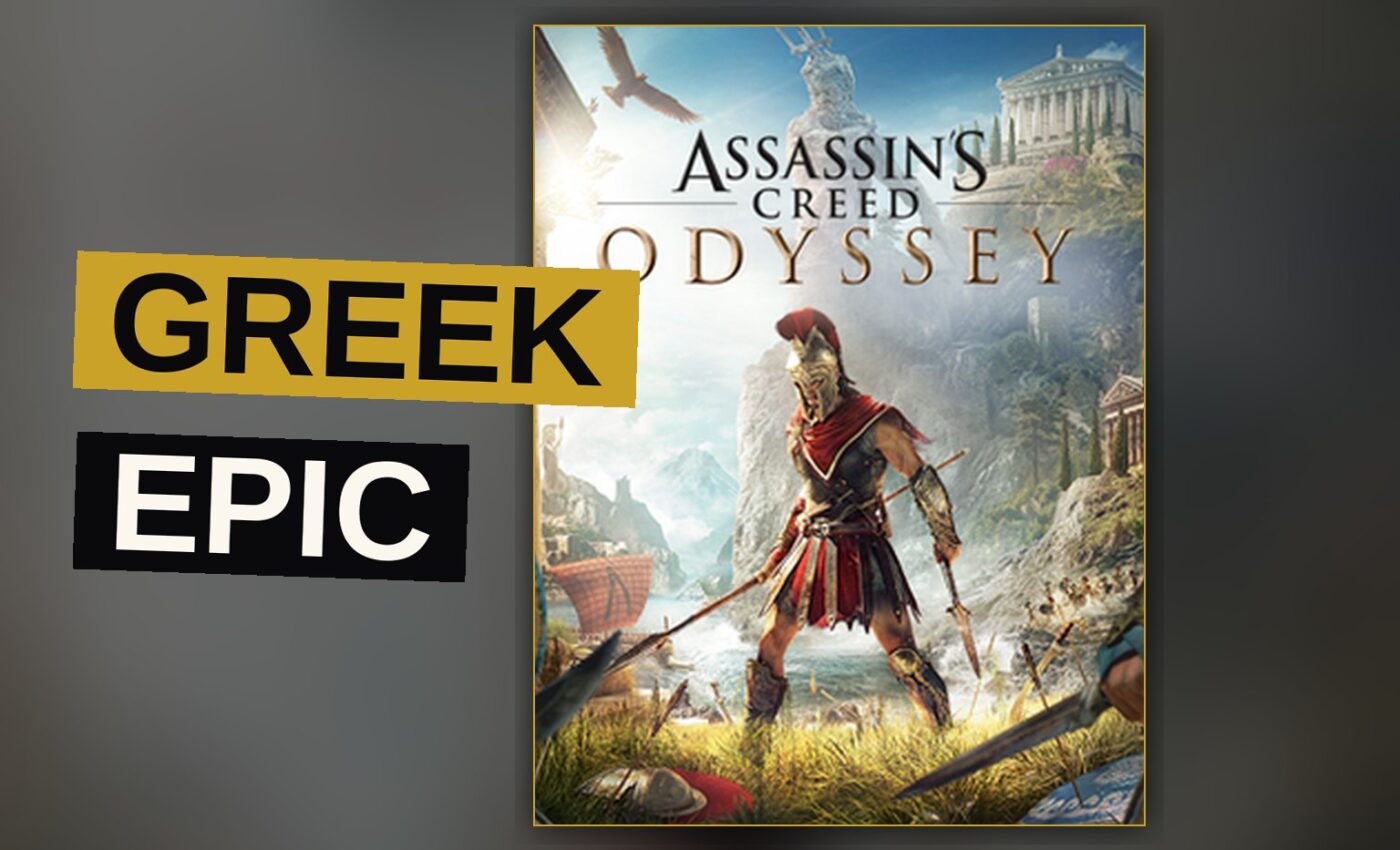
Assassin’s Creed Odyssey asks a lot of its player before it hands over anything. Pick Alexios or Kassandra. Pick a path through a war that has no clean side. Then live with it.
Ubisoft Quebec built that bargain into a game about ancient Greece, and the result is the most confident Assassin’s Creed has been in years — even when its ambition outruns its own machinery.
A Spartan Cast Out of Sparta
Odyssey opens in 480 BC at the Battle of Thermopylae, where King Leonidas holds a pass against a Persian charge. The Spartans win the skirmish. Then a captured enemy tells Leonidas the Persians have found the mountain path and will surround him by morning. Leonidas resolves to hold anyway.
That is the game’s frame, and it is a good one. The Peloponnesian War runs from 431 to 422 BCE, four centuries before Assassin’s Creed Origins and the founding of the Hidden Ones. Players control a Spartan mercenary, the elder of two siblings known as the Eagle Bearer, exiled as a child after a Spartan elder was killed trying to throw their infant sibling from Mount Taygetos.
Their father Nikolaos threw them off the mountain on the Spartan leadership’s orders. They survived, landed in the care of a con man named Markos on Kephallonia, and grew up working odd jobs. Now they fight as a misthios — for Athens, for Sparta, for whoever pays.
Two Names, One Mercenary
The choice between Alexios and Kassandra is the first decision Odyssey makes you own, and it is a real one. Both are Greek mercenaries and descendants of Leonidas I. Both carry the same story.
The game does not treat the swap as cosmetic. It treats it as a statement about what a role-playing game owes its player: a face, a voice, and a reason to care which one you picked.
Odyssey is played from a third-person perspective. It is an action role-playing game, the eleventh major installment in the series and the successor to Origins, and it leans harder into combat and exploration than stealth. Naval combat, a series staple, plays a prominent role again.
A Greece You Can Sail, Ride, or Walk
The open world here is the argument. Players cross Greece on foot, by boat, or on horseback. They meet non-playable characters who hand out side missions. They clear fortresses and camps, explore tombs and shipwrecks, and collect hidden treasures.
Synchronization points at landmarks unlock fast travel. Crafting resources — iron ore, wood, leather, metal, precious gems — come from exploration and hunting wildlife. There is a gladiatorial arena. There are time-limited bounties and contracts.
Odyssey also splits its own navigation in two. Guided mode shows objective locations immediately with waypoints. Exploration mode gives brief clues from other characters and makes you find the place yourself.
That second option is the one worth choosing. It turns Greece from a checklist into terrain.
The Cult of Kosmos and the Nation System
The main campaign follows the mercenary reuniting their family and stopping the Cult of Kosmos, the shadow cult the protagonist becomes entangled with. Separate questlines send players after mystical creatures from Atlantis and after cultists.
Because the war is the setting, Athens and Sparta control different parts of Greece. An area can be weakened if the player assassinates the nation leader or defeats members of their forces — which means the map is not scenery. It is a system you can push.
Layla Hassan returns from Origins. An Assassin and former Abstergo researcher, she works with Victoria Bibeau, Kiyoshi Takakura, and Alannah Ryan to find the Staff of Hermes Trismegistus and the lost city of Atlantis. Her portable Animus processes the data that becomes the Greek story.
Where the Two Modes Actually Differ
The guided-versus-exploration split is not a difficulty setting, and the table below shows why the distinction matters more than most menu options.
| Feature | Guided mode | Exploration mode |
|---|---|---|
| Objective locations | Shown immediately via waypoints | Not shown; found from NPC clues |
| Player’s job | Travel to the marker | Investigate, then travel |
| Effect on Greece | World reads as a checklist | World reads as terrain |
Neither mode changes the story. Both put you in the same war, with the same cult, the same family to find. What changes is how much of the game you are allowed to do yourself.
What Odyssey Gets Right
The mythological history is the boldest thing here. Odyssey tells the Peloponnesian War as myth, and it does so while cutting back the Assassins-versus-Templars conflict that anchors most games in the series. That is a risk. It pays off, because the Cult of Kosmos fills the vacuum with something the player can actually hunt.
The family thread gives the campaign a spine the side content cannot match. Reuniting the Eagle Bearer’s family and stopping the cult are the two goals that carry the whole map, and they are the two goals worth carrying.
And the setting earns its size. Greece in the fifth century BCE is not a backdrop Ubisoft Quebec had to invent from nothing. The war between Athens and Sparta supplies real stakes, real factions, and a real reason for a mercenary to sell their sword to both sides.
What Odyssey Gets Wrong
The game is too big for its own best ideas. Fortresses, camps, tombs, shipwrecks, treasures, bounties, contracts, an arena — the list of things to do is longer than the list of things that matter. Origins had the same problem, and Odyssey did not solve it.
The modern-day thread is the weakest link. Layla’s search for the Staff of Hermes Trismegistus and Atlantis is a fetch quest wrapped around the actual game, and it interrupts the Greek story rather than deepening it. The Animus framing has been load-bearing for the series since the beginning. Here it mostly feels like an obligation.
The choice mechanics are also narrower than the marketing implies. Odyssey lets you pick a mercenary, pick a side, and pick how you find your objectives. It does not let you pick a different war.
The Eagle Bearer’s Exile
Assassin’s Creed Odyssey is the moment the series stopped pretending to be a stealth game and admitted it wanted to be a role-playing game about a person in a place. The place is ancient Greece during the Peloponnesian War. The person is a Spartan exile with a spear, a sibling to find, and a cult to burn.
That is a strong foundation, and Ubisoft Quebec builds on it. The combat and exploration focus suits the scale. The naval combat returns without feeling bolted on. The Eagle Bearer’s exile, the fall from Mount Taygetos, the years under Markos on Kephallonia — these are specific, and specificity is what separates a setting from a backdrop.
The bloat is real, and the Layla Hassan material is the clearest evidence of it. But the core holds. This is a game that trusts its player to wander, and wandering through fifth-century Greece is the best thing Assassin’s Creed has offered in years.
Get the Notebook.
The day's best stories and every fresh verdict, in plain English, in your inbox by seven. One email a day, no more.