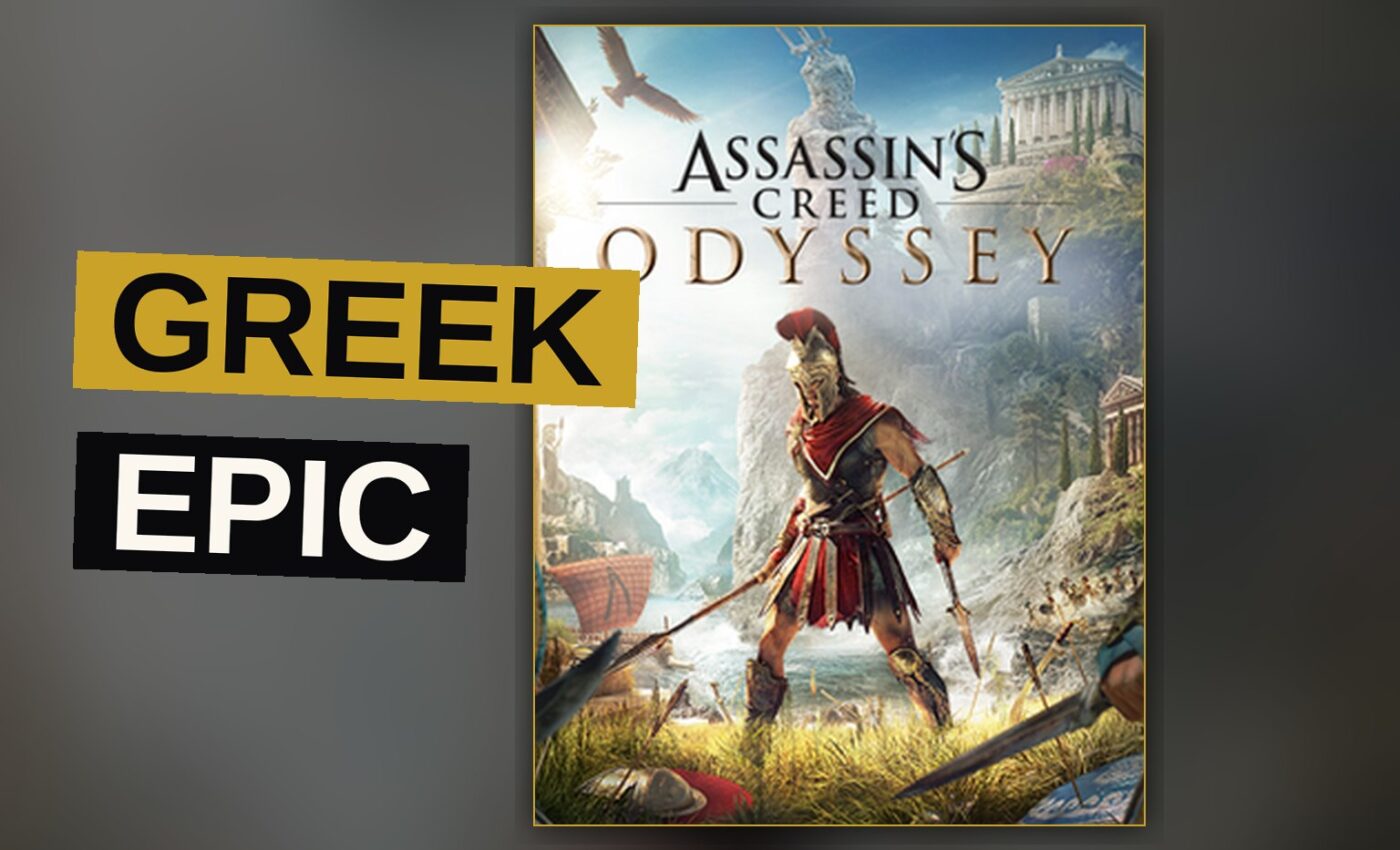
Assassin’s Creed Odyssey is a game that finally lets you be the hero of your own Greek epic — and it mostly earns that ambition. This is the largest, most flexible entry in the long-running series, trading the tight urban stealth of earlier games for a sprawling open world that spans the Aegean Sea and hundreds of islands. It is a game that asks you to make choices, pick sides, and steer your own story through the Peloponnesian War, and it succeeds more often than it stumbles.
Set in 431 BCE, Odyssey drops you into the war between Athens and Sparta, but it does not hold your hand. You play as Alexios or Kassandra, a mercenary descended from the legendary Spartan king Leonidas, and you are given a spear that carries his bloodline. From the opening hours, the game makes clear that this is not a story about a hidden order of assassins. It is a story about family, fate, and the choices you make along the way. The title is a fitting one: the journey is long, the seas are wide, and the path is rarely straight.
The World of Ancient Greece
The map is the star. Ubisoft Quebec has built a version of Greece that feels alive, from the sun-bleached marble of Athens to the rugged peaks of Mount Taygetos and the volcanic shores of the island of Thera. You can sail a ship called the Adrestia across the Aegean, recruit lieutenants, and engage in naval combat against rival fleets. The sea is not a loading screen; it is a destination in itself, full of hidden coves, sunken treasures, and pirate ships that will happily sink you if you are careless.
On land, the world is dense with activity. Every hilltop hides a ruin, every village has a quest, and every fort is a small puzzle of guards, alarms, and treasure. The game does not force you to clear these locations, but it rewards you for exploring. The sense of place is strong, and the developers have clearly studied the geography and architecture of the period. The Temple of Apollo at Delphi looms over the valley as it would have done, and the statue of Athena Promachos stands tall on the Acropolis.
The scale is staggering. The game world is vast, and it is packed with content. You will spend dozens of hours just sailing from one island to the next, and the game does not run out of things to show you. This is a world that respects your time, even if it asks for a lot of it.
Choices That Matter
Odyssey is the first game in the main Assassin’s Creed series to feature dialogue choices and branching narratives. You can talk your way out of a fight, or you can kill everyone in the room. You can side with Athens in one quest and Sparta in another, and the game tracks your reputation with both factions. This is not a superficial system; it changes the way quests play out and, in some cases, who lives and who dies.
The main story follows your character’s search for their family, a quest that takes you across the entire Greek world. Along the way, you meet a cast of characters that includes Socrates, Perikles, and Alkibiades, and the game does a good job of making these historical figures feel like real people with real agendas. The writing is sharp, and the voice acting is strong, particularly for Kassandra, who is widely considered the better of the two leads.
Your choices do not just affect the ending. They affect the relationships you build, the allies you gain, and the enemies you make. A decision made in hour ten can come back to haunt you in hour fifty. The game does not telegraph these consequences, which makes them feel more meaningful. It is a system that rewards careful thought, and it is one of the reasons the game feels so personal.
Combat and Stealth
The combat in Odyssey is a significant step up from its predecessor, Assassin’s Creed Origins. The game uses a light and heavy attack system, with dodges, parries, and a stamina bar that keeps you honest. You can specialize in three skill trees: Hunter, Warrior, and Assassin. Each tree offers a distinct playstyle, and you are free to mix and match as you see fit. The ability to respec your skills at any time for a small fee means you are never locked into a build you do not enjoy.
Stealth is still viable, but it is no longer the focus. You can take down enemies with the Spear of Leonidas, the weapon you carry from the start, but the game encourages you to think about positioning, distraction, and the environment. You can lure guards into tall grass, shoot arrows through oil jars to create explosions, and use your eagle, Ikaros, to scout ahead and mark enemies. The system works, but it is not as refined as the stealth in earlier games like Assassin’s Creed Unity. Enemies are often too alert, and the detection system can feel unfair when you are spotted through a wall.
Naval combat is a highlight. The Adrestia handles well, and the ship-to-ship battles are tense and exciting. You can fire arrows, javelins, and flaming projectiles, and you can board enemy ships to fight their crews in close combat. The naval mechanics are not as deep as those in Black Flag, but they are a welcome addition that breaks up the land-based action.
The Cult and the Grind
The game’s main antagonist is the Cult of Kosmos, a shadowy organization that pulls the strings of the war. You hunt them down by finding clues and eliminating their members, and this system works as a meta-quest that runs alongside the main story. Each kill brings you closer to the Cult’s leader, and the reveals are satisfying. The Cult members are scattered across the world, and finding them requires exploration and investigation.
The grind, however, is real. The game is level-gated, and you will frequently find yourself unable to progress in a main quest because you are not strong enough. This forces you to do side quests, clear forts, and hunt mercenaries to earn experience points. The side content is generally good, but there is a lot of it, and the pacing can drag. Some players will enjoy the extended stay in Greece; others will find it exhausting.
The game also includes a mercenary system, where you are hunted by bounty hunters who track you down if you commit crimes. These mercenaries are tough, and they add a constant sense of pressure. You can pay off your bounty, kill the mercenaries, or simply run. The system is well-implemented, and it adds a layer of unpredictability to the open world.
Graphics, Sound, and Technical Issues
The game is beautiful. The lighting is warm and natural, the water is stunning, and the draw distance is impressive. On a high-end PC, the game can run at 4K with a stable frame rate, and the world looks even better in motion. The character models are detailed, and the animations are smooth, though some facial expressions can feel stiff during dialogue scenes.
The soundtrack is a mix of traditional Greek instruments and modern orchestration, and it fits the setting perfectly. The music swells during combat and recedes during quiet exploration, and it never overpowers the action. The voice acting is strong across the board, with particular praise going to Kassandra’s performance, which is nuanced and emotive.
The game also features a Discovery Tour mode, which was added after launch. This mode strips out the combat and lets you explore the world as a museum piece, with guided tours explaining the history and culture of ancient Greece. It is a wonderful addition that shows the developers’ commitment to education as well as entertainment.
The game is not without its problems. On PC, the performance can be inconsistent, with frame rate drops in crowded cities and during naval battles. The game also suffers from occasional pop-in, where objects and textures appear suddenly as you move through the world. On PS4 and Xbox One, the game runs at a lower resolution and frame rate, and the load times can be long. There are also some bugs. I encountered a few quests that would not trigger, and one time I fell through the world during a naval battle. These issues are rare, and most of them have been patched since launch, but they are worth mentioning.
Verdict
Assassin’s Creed Odyssey is a sprawling, ambitious, and often brilliant game. It is not perfect, and the grind and technical issues hold it back from greatness, but it is one of the best entries in the series. The world is unforgettable, the choices are meaningful, and the combat is satisfying. If you have the time and the hardware, this is a journey worth taking.
The game is a clear evolution of the series, and it sets a high bar for future entries. It is a game that rewards patience and curiosity, and it is a game that you will remember long after you have finished it. A full playthrough of the main story takes around 45 hours, and a completionist run can easily double that. It is a lot of game, but it is rarely boring.
Key Facts Box
- Title: Assassin’s Creed Odyssey
- Release Year: 2018
- Platforms: PC, PS4, Xbox One
- Setting: Ancient Greece, 431 BCE
- Protagonists: Alexios or Kassandra
- Main Antagonist: The Cult of Kosmos
- Ship: The Adrestia
- Map Size: Vast; official figures were not independently verified for this review
- Skill Trees: Hunter, Warrior, Assassin
- Critical Score: 8.3/10
Comparison Table
| Feature | Assassin’s Creed Odyssey | Assassin’s Creed Origins |
|---|---|---|
| Setting | Ancient Greece | Ancient Egypt |
| Protagonist | Alexios or Kassandra | Bayek |
| Dialogue Choices | Yes | No |
| Naval Combat | Yes | Yes |
| Mercenary System | Yes | No |
| Discovery Tour Mode | Yes | Yes |
| Map Size | Vast (estimate) | Large (estimate) |
The game is long. A full playthrough of the main story takes around 45 hours, and a completionist run can easily double that.
It is a lot of game, but it is rarely boring.
Assassin’s Creed Odyssey is a triumph of scope and freedom, and it earns its score. An 8.3 out of 10.