
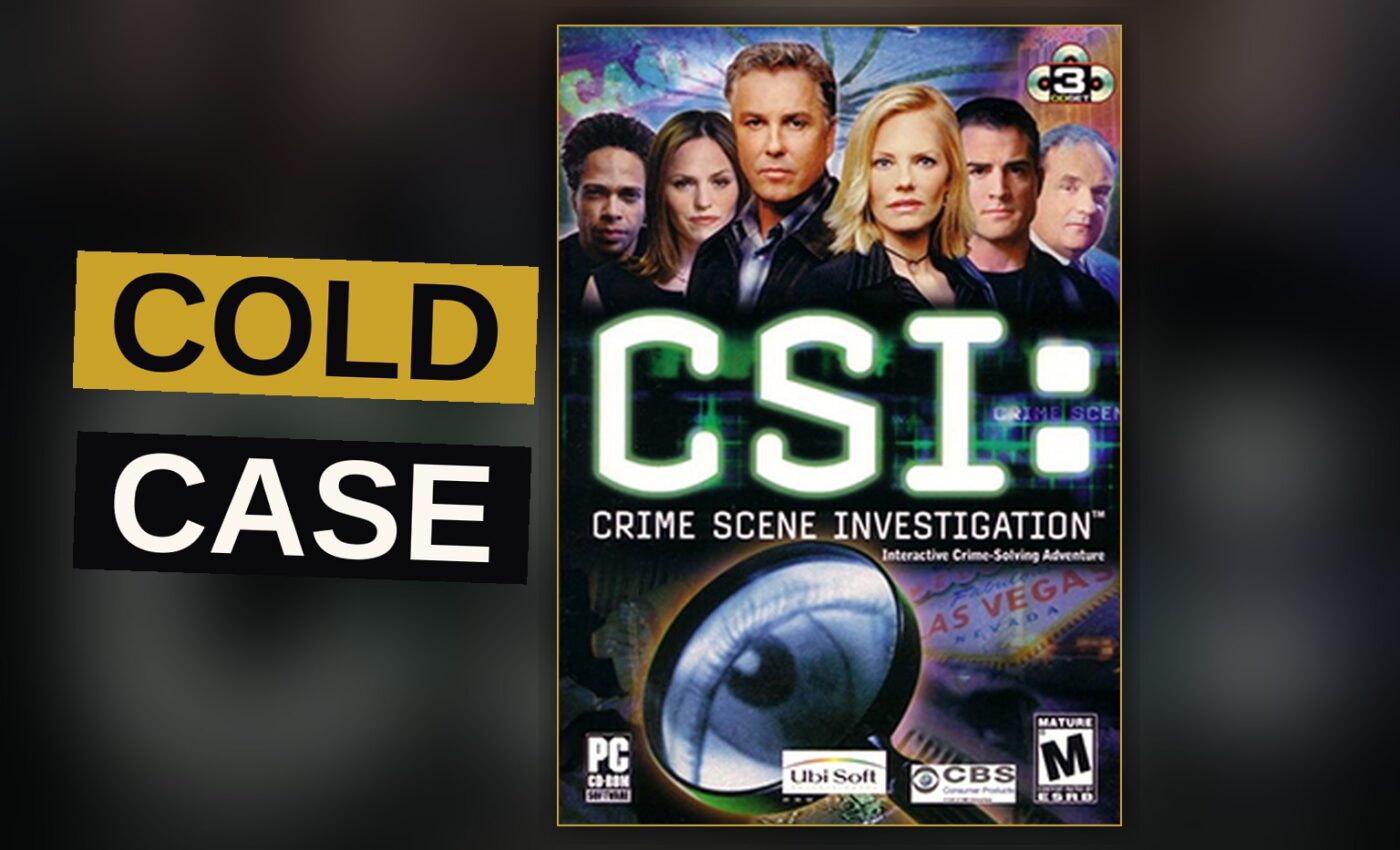
CBS had a hit on its hands the moment “CSI: Crime Scene Investigation” premiered on October 6, 2000. Created by Ann Donahue and Anthony E. Zuiker, the procedural drama ran for 15 seasons and 335 episodes before signing off on February 15, 2015. It did not just succeed. It became one of the biggest phenomena in television history, CBS’ most successful series at the time with the highest ratings, and the launchpad for an entire franchise.
The show built its case on a simple idea: the evidence never lies.
Trailer, via Classic TV Zone.
Gil Grissom and the Graveyard Shift
“CSI” follows a team of crime scene investigators employed by the Las Vegas Metropolitan Police Department. They work murders. They scour the scene, collect physical evidence, and find the missing pieces that close the case. The premise mixes deduction with character-driven drama, and for most of its run the balance held.
For its first nine seasons, the team belongs to Dr. Gil Grissom, played by William Petersen. Grissom is a forensic entomologist with a doctoral degree in biology from the University of California. He is socially awkward, a career criminalist, and very good at his job. He became a CSI around 1985 and took over the graveyard shift after a trainee investigator died.
He testifies in court as “Doctor Grissom.” He departs the Las Vegas Crime Lab in 2009.
Catherine Willows, Blood Spatter and the Strip
Marg Helgenberger plays Catherine Willows, Grissom’s second-in-command. She is a single mother with a cop’s instinct, born and raised in Las Vegas. Before law enforcement recruited her, she worked as a stripper. She trained as a blood-spatter specialist and joined the team as a lab technician, then worked her way up to assistant supervisor.
When Grissom leaves during the ninth season, Catherine is promoted to supervisor. She is later replaced by D.B. Russell and recruited to the FBI.
The show’s Las Vegas is not a postcard. It is a working city with a growing crime rate, and the team is on the job around the clock. That setting gave “CSI” its texture: casinos, motels, desert lots, and the fluorescent hum of the lab.
Warrick Brown and the Cost of the Job
Gary Dourdan plays Warrick Brown, a CSI level III. He is an audio-video analyst, a Las Vegas native, and a chemistry major from the University of Nevada, Las Vegas. He is also a recovering gambling addict, and he is skilled at the job anyway.
Warrick gets falsely accused of murder and acquitted. Then a corrupt high-ranking policeman, Undersheriff Jeffrey McKeen, assassinates him in his car. He dies in Grissom’s arms. It is the show’s hardest turn, and it lands because the series had spent years making him a person rather than a badge.
George Eads plays Nick Stokes, another CSI level III. Jorja Fox plays Sara Sidle. Eric Szmanda plays Greg Sanders. Robert David Hall plays Al Robbins. David Berman plays David Phillips. Wallace Langham plays David Hodges. Jon Wellner plays Henry Andrews.
Ted Danson, Elisabeth Shue and the Later Seasons
The cast turned over, as long-running shows do. Laurence Fishburne joined as Raymond Langston, a new investigator whose training Catherine oversaw. Then Ted Danson arrived as D.B. Russell, a family man, forensic botanist, and veteran of the Seattle Crime Lab. He replaces Catherine as supervisor, and she heads to the FBI shortly after.
In the 12th season, Russell reunites with his former partner Julie Finlay, played by Elisabeth Shue. Like Catherine, Finlay is a blood-spatter expert with deep knowledge of criminal psychology. The pairing gave the back half of the run a steadier center than it had any right to expect.
Elisabeth Harnois plays Morgan Brody. The ensemble is the point. “CSI” is a team show, and its cases move through many hands.
Mixing deduction and character-driven drama, CSI: Crime Scene Investigation follows a team of crime scene investigators (CSIs) employed by the Las Vegas Metropolitan Police Department (LVPD for short) as they use physical evidence to solve murders.
Six Emmys and a Lot of Complaints
The series won six Primetime Emmy Awards. It drew positive reviews from television critics. It also drew criticism from public officials and law enforcement over its depiction of crimes, its graphic content, and other mature content. That backlash was not a footnote. It was part of the show’s identity. “CSI” put bodies on screen in close-up and dared the audience to look.
The finale, “Immortality,” ran feature-length. It brought Grissom back. After a stint as a researcher, he becomes a sea-life advocate and reunites with his ex-wife Sara. The series ends with the two sailing off together from the Port of San Diego. Catherine, recently returned, is granted the directorship of the crime lab when Sara leaves Las Vegas.
That is a lot of closure for a show that spent 15 years insisting closure is what happens when the evidence finally lines up.
What “CSI” Actually Changed
“CSI” is the first series in the CSI franchise, and its influence is hard to overstate. It made forensic science a primetime subject. It made procedure itself dramatic, and it did so with a team the show presents as competent investigators rather than heroes. The team is tired and often wrong before it is right.
The criticisms were fair, too. The show’s crimes were graphic, and its portrait of law enforcement was flattering in ways that real investigators and public officials pushed back on. A procedural that treats evidence as irrefutable is making an argument, whether it admits it or not. “CSI” rarely admitted it.
In this paper’s view, the show stumbles in its long middle. Fifteen seasons is a long time, and the cast churn shows. Grissom leaves. Catherine leaves. Warrick dies. Langston arrives. Russell arrives and stays. Each transition costs the show something, and the later seasons never quite recover the specific chemistry of the early graveyard shift. The show’s formula is durable, but durability is not the same as freshness.
What holds up is the premise and the setting. Las Vegas is a city built on illusion, and “CSI” used it as a place where illusion gets stripped away by lab work. That is a good idea, and the show executed it with real craft for years.
The follow-up series, “CSI: Vegas,” premiered in 2021 and ended in 2024 after three seasons. It could not recapture what the original had, because what the original had was timing. In 2000, a show about evidence felt new. By 2021, it was the house style.
“CSI: Crime Scene Investigation” is not a perfect series. Its cast turnover is brutal, and its politics around policing deserve the scrutiny they got. But as a piece of television craft, it earns its place. It took a genre built on interrogation rooms and moved it to the lab. It made the swab and the microscope into instruments of suspense. And it gave CBS 15 seasons of its most successful series, the one with the highest ratings at the time.
That is a case worth closing.
Score: 7.6 of 10 (TMDB audience score, 1429 votes)
Get the Notebook.
The day's best stories and every fresh verdict, in plain English, in your inbox by seven. One email a day, no more.