
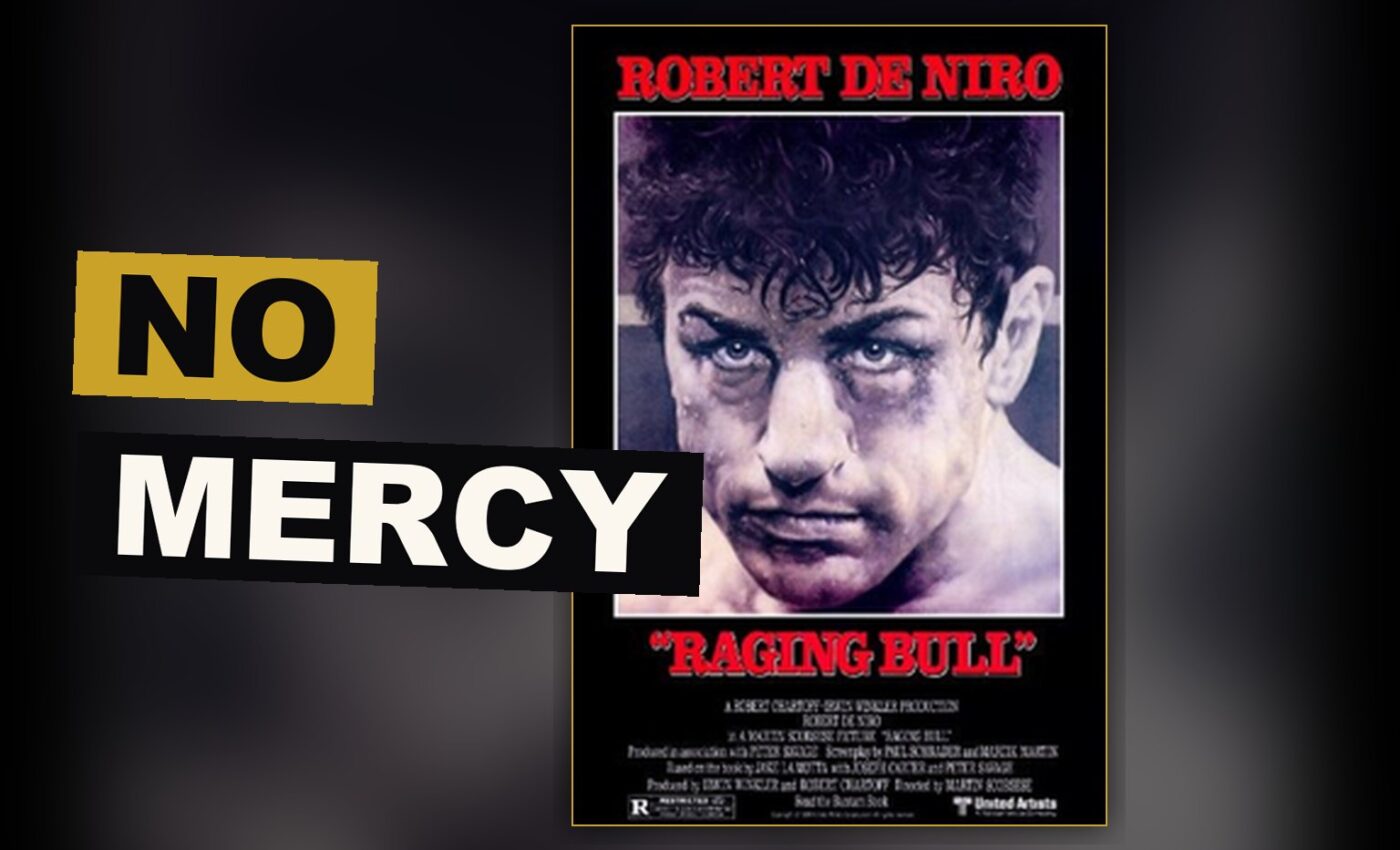
Martin Scorsese’s Raging Bull is a boxing film that spends most of its 129 minutes outside the ring, and that is the point. Robert De Niro plays Jake LaMotta, a middleweight who wins the title and loses everything else. The film premiered in New York City on November 14, 1980, and United Artists released it in theaters on December 19. It is a hard, exacting piece of work, and it holds up.
De Niro Gains 60 Pounds for Jake LaMotta
De Niro gained roughly 60 pounds (27 kg) to play LaMotta in his later years, and the change is not a stunt. It is the film’s argument. The young Jake who loses a controversial decision to Jimmy Reeves in 1941 and the bloated man telling jokes in a nightclub are the same person, and Raging Bull refuses to let the audience look away from the cost.
Scorsese directed from a screenplay by Paul Schrader and Mardik Martin, adapting LaMotta’s 1970 memoir Raging Bull: My Story. Schrader rewrote Martin’s first draft, and Scorsese and De Niro made uncredited contributions after that. The film is dedicated to Haig P. Manoogian, Scorsese’s Armenian-American film professor at NYU.
Joe Pesci and Cathy Moriarty, Found Not Cast
The supporting cast is the film’s other engine. Joe Pesci plays Joey LaMotta, and he had not worked in film for four years before this, working at an Italian restaurant in New Jersey. De Niro spotted him in the low-budget television film The Death Collector. Pesci recommended Cathy Moriarty for Vickie after seeing a picture of her at a New Jersey disco. She was 18. De Niro and Scorsese had to prove to the Screen Actors Guild that she was right for the role, and Cis Corman showed 10 comparing pictures of Moriarty and the real Vikki LaMotta.
The rest of the cast:
- Frank Vincent as Salvy Batts
- Nicholas Colasanto as Tommy Como, in his final film role
- Theresa Saldana as Lenore
A Marriage That Turns to Rage
The plot is a study in suspicion. Jake spots 15-year-old Vickie at a Bronx swimming pool while he is already married, pursues her anyway, and marries her by 1945. He is controlling and domineering, convinced she wants other men. When she says off-hand that his next opponent, Tony Janiro, is good-looking, Jake flies into a rage and asks what she meant by it. He then disfigures Janiro in the ring while Vickie watches in horror.
The mob thread runs underneath. Joey negotiates with Salvy Batts, Jake refuses the Mafia’s help, and local boss Tommy Como controls the championship. When Como orders it, Jake takes a dive against Billy Fox, cannot fake the defeat convincingly, and gets booed out of the building.
The Boxing Scenes Are Choreographed Like Music
Every boxing scene in Raging Bull was choreographed for a specific visual style. That is why the fights do not look like other fights. They are composed, cut and mixed with the same exactness Scorsese brought to the editing room, where he expected this to be his last major feature. The result is that the violence reads as character rather than spectacle.
The tagline is LaMotta’s own boast: “I don’t go down for nobody.” The film takes that line seriously and then shows the bill.
What Raging Bull Gets Right
The film opened to mixed reviews and a lukewarm box office: $23.4 million against an $18 million budget. That number is the least interesting thing about it. De Niro’s performance and the editing were singled out even then, and the years have settled much of the argument. Raging Bull is not a sports movie about redemption. It is a movie about a man who cannot stop swinging, and the ring is just where it shows.
Ranking what matters here:
- De Niro’s physical transformation and performance
- The choreographed boxing sequences and the editing
- Pesci and Moriarty, two unknowns who carry the domestic half
- The mob subplot, which is necessary but the least of it
The mob material is the part that creaks. Como and Salvy exist to explain why Jake throws the Fox fight, and the film needs them, but they are machinery. The marriage is the real subject. Every scene with Moriarty has more charge than any scene with Colasanto, and the film knows it.
The Case for Raging Bull
Raging Bull earns its reputation. It is a brutal, controlled film with a performance at its center that still stands as one of De Niro’s best, and a director working at the edge of what he thought he had left. The 60 pounds, the choreographed fights — none of it is decoration. All of it is the same idea: a man who destroys what he loves and calls it pride.
Get the Notebook.
The day's best stories and every fresh verdict, in plain English, in your inbox by seven. One email a day, no more.


