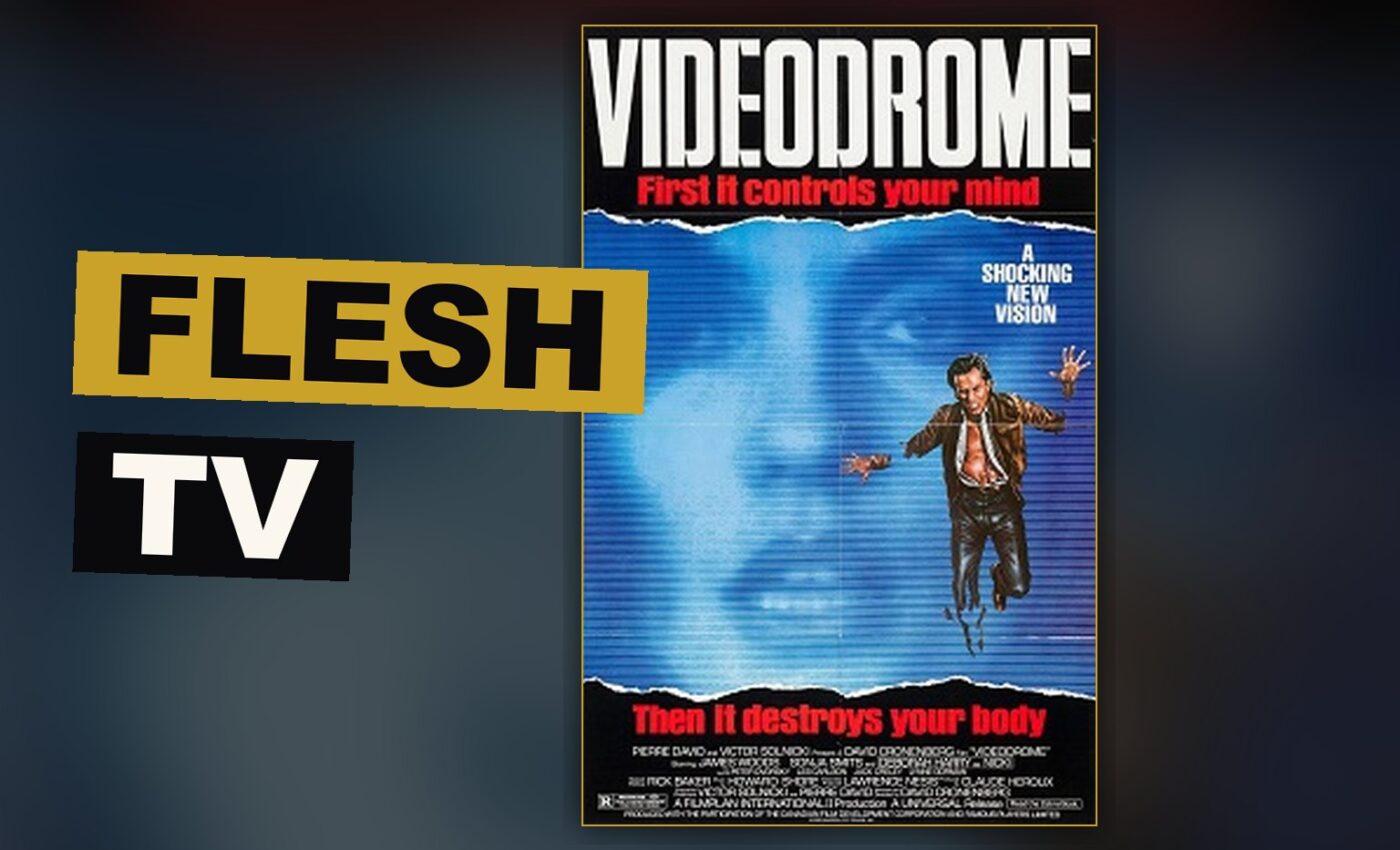
Videodrome turns a television broadcast into something that changes the body of every person who watches it. David Cronenberg’s 1983 film still gets under the skin, years after it first appeared, because it never explains itself away.
A Television Executive and a Broadcast
The lead character runs a small television station that trades in explicit content. He finds a secret broadcast that appears to show real suffering and killing, and he wants it for his channel. What he gets instead is a body that starts to change and a sense of what is real that starts to give way.
James Woods plays the part with a kind of uneasy calm that turns bitter as the film goes on. The woman he becomes involved with, a radio host, is drawn to the broadcast’s cruelty in a way that troubles even him. Their scenes together carry a charge that has little to do with romance and everything to do with appetite.
Effects Work Without Excuse
The body horror in Videodrome still holds up. The effects work gives the film its most famous images: a television set that breathes like something alive, an opening in the stomach that takes in a recording, flesh joined with machine parts. None of it uses digital tools built by computer. It is built by hand, with practical construction, and the physical quality of the work makes the changes land harder than most digitally made horror manages today.
- A breathing, organic television set
- A gun fused into human flesh
- An opening in the stomach that accepts a recording
- Visions that cannot be told apart from the film’s own reality
Each image does more than startle. These are steps in an argument about the way television enters the body, and Cronenberg builds that argument without stopping to explain it in speech.
The two parts of the film do not sit easily together, and that is the point.
The story keeps two worlds in play: the television business the lead character runs at the start, and the scheme he falls into once the broadcast takes hold of him.
| Television World | Broadcast World | |
|---|---|---|
| Tone | Detached, commercial | Uneasy, changing |
| Control | He runs the station | He is run by others |
| Body | Whole | Changed, joined with machine |
| Reality | Fixed | Coming apart |
That table is a plain outline. The whole point of the film is that these two worlds run into each other until the line between them no longer holds.
Where the Film Struggles
Videodrome is not an easy watch, and it does not try to be neat. The story, involving a shadowy figure who broadcasts sermons and a scheme behind the whole affair, gets harder to follow as vision and event run together. Some viewers will find the second part hard to track rather than troubling in a useful way. The film asks for patience and a willingness to sit without answers, and it does not give a clear ending.
The performance opposite Woods stands out but the character is thin; she exists mostly to draw him deeper into the broadcast’s hold rather than as a full person on her own. The low budget shows in a few scenes away from the effects work, where the pace loses its footing.
None of that changes what the film gets right. Its central idea, that watching something can change what you are, has only gained force as screens have multiplied in daily life. Cronenberg’s refusal to hold back on the body horror, and the effects work behind it, still mark this as one of the most striking body-horror films of its time.
Videodrome is not comfortable, and it never asks to be. It is a film about the body and the broadcast becoming the same thing, told with full effort and without apology. It has earned its place among horror’s most noted films, and it still has the power to disturb audiences who have seen far more graphic work since.