
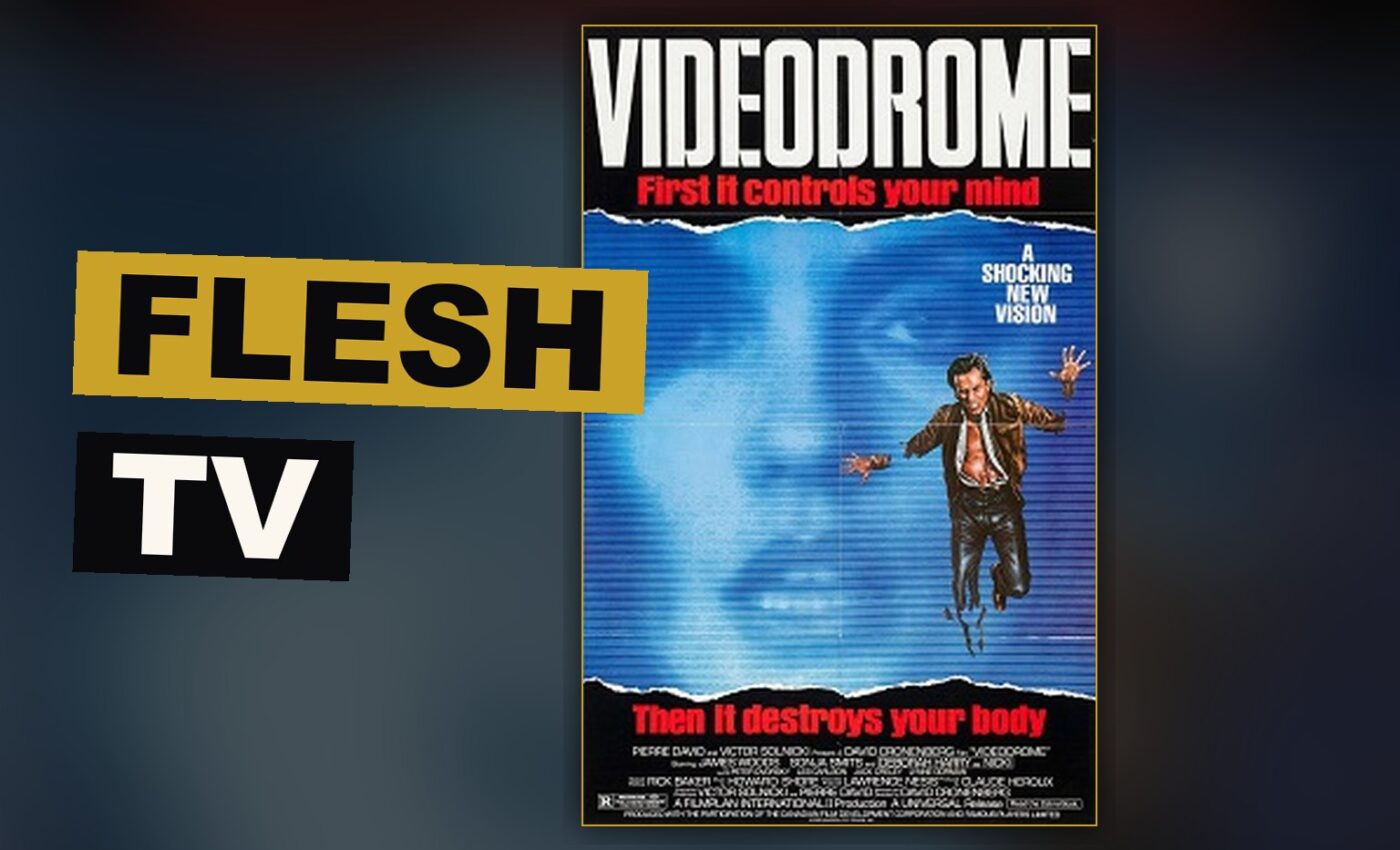
Videodrome is a 1983 Canadian science fiction body horror film written and directed by David Cronenberg. It runs 88 minutes and stars James Woods, Sonja Smits and Debbie Harry. Universal Pictures distributed it, making it the first Cronenberg film to get backing from a major Hollywood studio. It was a box-office failure, recouping $2.1 million from a $5.9 million budget.
Max Renn and the CIVIC-TV Signal
Woods plays Max Renn, president of CIVIC-TV, a Toronto UHF station that lives on sensationalist programming. Hungry for a hit, he takes a feed from Harlan, who runs the station’s unauthorized satellite dish. What Harlan finds is Videodrome: a plotless show, supposedly broadcast from Malaysia, in which victims are tortured and eventually murdered.
Max thinks he has found the future of television. He orders Harlan to record the broadcasts.
The tagline on the poster — “First it controls your mind. Then it destroys your body” — is not a bluff.
Nicki Brand Auditions, and Does Not Come Back
Debbie Harry plays Nicki Brand, a sadomasochistic radio host who starts a sexual relationship with Max. An episode of Videodrome arouses her. When she learns the signal is actually coming out of Pittsburgh, she goes to audition for the show. She never returns.
Max turns to Masha, a softcore pornographer, for help investigating. Masha tells him the footage is real and that Videodrome is itself a philosophical movement. She points him toward Brian O’Blivion, the media theorist who knows what Videodrome is.
Brian O’Blivion and the Homeless Shelter
Max finds O’Blivion at a homeless shelter where vagrants sit through marathon television sessions. O’Blivion’s daughter Bianca runs the mission and serves her father’s vision: a world in which television replaces everyday life.
On videotape, O’Blivion calls Videodrome a socio-political battleground, a war being fought to control the minds of the people of North America. Max then hallucinates Nicki speaking to him directly. His television undulates as he kisses the screen.
The Signal That Gives You Tumors
Bianca tells Max what Videodrome actually carries: a broadcast signal that gives malignant brain tumors. O’Blivion counts that as part of his vision. He believes hallucinations are a higher form of reality.
This is the film’s real subject. A television signal that grows a tumor in your head is Cronenberg’s argument about what mass media does to the people who watch it. The graphic violence is the delivery system. The tumor is the point.
Genie Awards and the Box Office Ledger
Cronenberg won Best Direction at the 5th Genie Awards and was nominated for seven other awards. The film drew praise for its special makeup effects, Cronenberg’s direction, the performances from Woods and Harry, its techno-surrealist aesthetic and its cryptic, psychosexual themes.
| Year | Event | Result |
|---|---|---|
| 1983 | Theatrical release | $2.1M gross against $5.9M budget |
| 5th Genie Awards | Best Direction | Won |
| 5th Genie Awards | Other categories | 7 nominations |
| Since release | Cult classic status | Recognized as a key body horror work |
Key facts
– Runtime: 88 minutes
– Budget: $5.9 million
– Box office: $2.1 million
– Genres: Horror, Science Fiction, Mystery
– Director and writer: David Cronenberg
– Distributor: Universal Pictures
– Cast: James Woods, Debbie Harry, Sonja Smits, Peter Dvorsky, Leslie Carlson, Jack Creley
Why Videodrome Still Holds
The box office number is the least interesting thing here. Videodrome lost money because it was sold as a horror film about torture footage and it is actually a film about the machinery that delivers torture footage into your living room. Audiences in 1983 were not given that film. They were given the tagline.
What has held up is the argument. Max Renn is not a victim of a conspiracy so much as a man who wanted a hit and got one. He chases the signal for ratings, then for answers, and by the end he cannot tell the difference between what he watched and what was done to him.
That is a sharper idea than most horror films of its decade attempted.
The makeup effects earn their reputation. The hallucinations do not read as decoration; they read as symptoms. Woods plays Max with a nervous appetite that curdles as the film goes, and Harry’s Nicki is the film’s best trick: she is gone for most of the running time and never really leaves the movie.
The flaws are real. The plot’s layers of deception and mind-control conspiracy get tangled, and the film’s grip on reality loosens faster than the audience’s ability to follow it. But the ending is earned, and the central image — a man kissing a television that is kissing him back — has not aged out of relevance. If anything, the decades since made it plainer.
Videodrome is a cult classic now, and it is recognized as a significant work in Cronenberg’s filmography and an influential example of body horror and science fiction horror. The Genie Awards saw the direction. The box office saw a flop. This paper’s score is 7 out of 10.
Get the Notebook.
The day's best stories and every fresh verdict, in plain English, in your inbox by seven. One email a day, no more.


