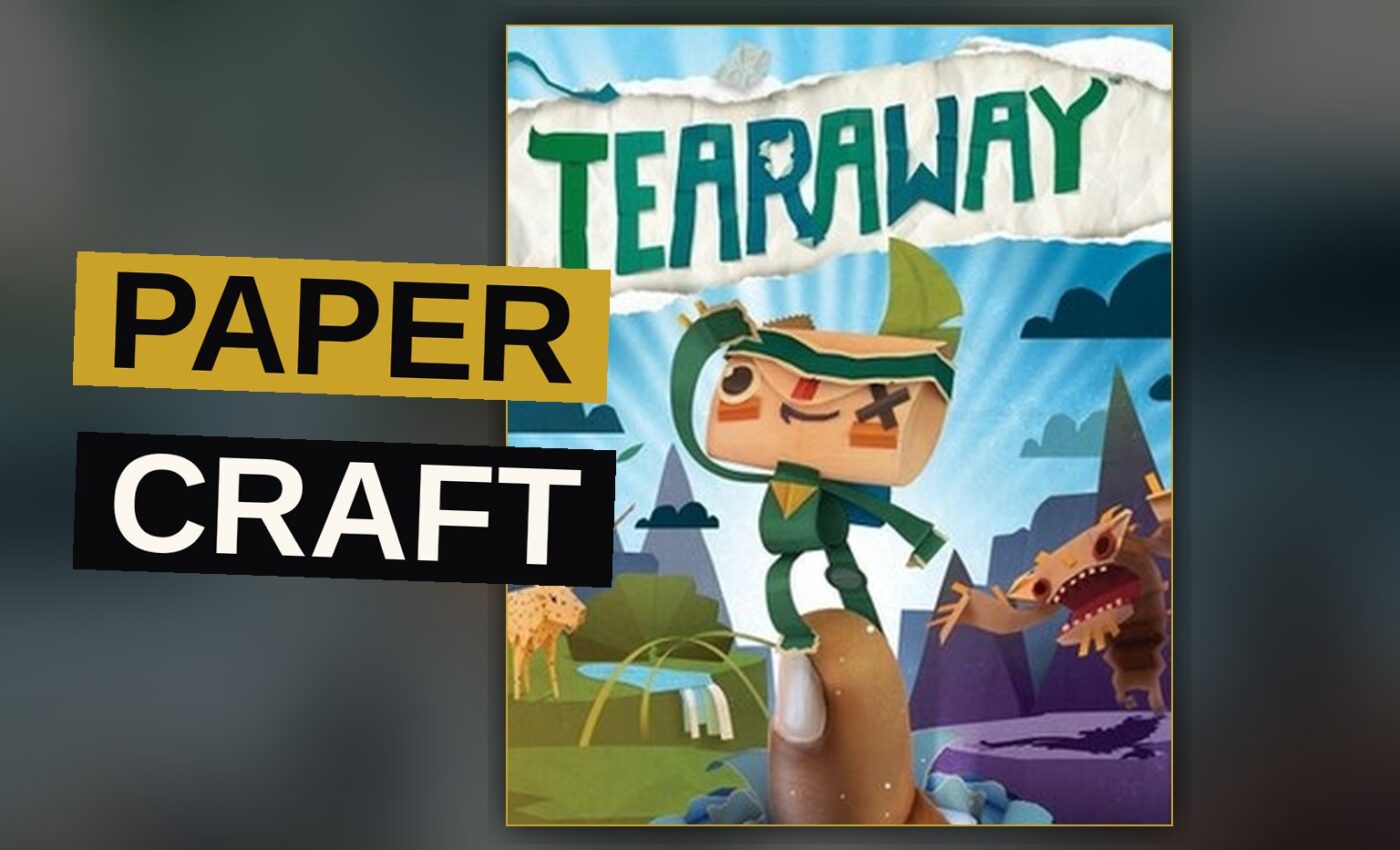
Tearaway is a game about paper, but it is not a fragile thing. It is a small, sturdy miracle from Media Molecule, the studio behind LittleBigPlanet, and it remains one of the best reasons to own a PlayStation Vita. The game puts you in a world folded from construction paper, cardboard, and old envelopes, and asks you to reach into that world to help a tiny messenger named Iota deliver a message.
It is a game about creation, about the joy of making things, and about the strange, warm relationship between a player and the character on the screen. The story is simple. Iota is a messenger made of paper, living in a world that is also made of paper. The sun is a paper circle, the trees are folded cones, and the wind is a series of cut-out ribbons.
Iota has a message to deliver, and you, the player, are the only one who can help. The game speaks to you directly, through the Vita’s speakers and through the on-screen actions of the Narrator, a character who appears as a floating, bearded face made of crumpled paper. The Narrator asks you to help Iota, to guide him through the world, and to use the Vita’s unique features to interact with the environment. It is a rare game that makes you feel like a participant in the story, not just an observer.
Trailer, via PlayStation.
A World Built from Scraps
The first thing you notice about Tearaway is how it looks. Every surface is textured with the grain of paper, and every object looks like it was cut from a sheet and glued into place. The grass is a fringe of green strips. The clouds are puffy cotton balls. The mountains are jagged paper cutouts against a sky that looks like a painted backdrop. This is not a realistic world, and it is not trying to be. It is a world that celebrates its own construction, and it is beautiful because of it.
The art direction is the star. Media Molecule has taken the idea of a papercraft world and run with it, creating environments that are dense with detail and charm. You will see a town made of shoeboxes, a forest of folded trees, and a cave carved from a paper-mache mountain. The color palette is bright and warm, with a lot of yellows, oranges, and soft greens. It is a pleasing world to look at, and it is a world that rewards attention. Look closely, and you will see the glue marks, the tape, and the pencil lines that hold it together.
The sound design matches the visual style. The music is a cheerful, folksy score that uses acoustic instruments and vocal chants. The sound effects are crisp and tactile, like the rustle of paper when Iota rolls or the snap of a fold when he jumps. The Narrator’s voice is warm and friendly, and it never gets annoying, even when it is guiding you through a puzzle.
Making the Vita Feel Essential
Tearaway was designed for the Vita, and it uses every feature the handheld has. The rear touch pad is used to push up through the ground, creating hills and bumps that Iota can climb or use as cover. The front touch screen is used to interact with objects directly, like tapping a button or dragging a piece of scenery. The camera is used to project your face onto the sun or the moon, and your image appears in the game world as a glowing, god-like presence. The microphone is used to blow wind, which can spin windmills or push Iota across gaps.
These controls are not gimmicks, even though they could have been. They are integrated into the gameplay in a way that feels natural and necessary. When you push up through the ground with the rear pad, you feel like you are physically shaping the world. When you tap the screen to flick a squirrel at an enemy, you feel like you are directly helping Iota.
The camera feature is the most memorable. When your face appears in the sky, the characters in the game look up and react to you. They wave, they cheer, and they sometimes ask you to do things. It is a simple trick, but it creates a powerful connection between you and the game.
The game is also generous with its use of the Vita’s features. It does not just use them once and then forget them. It builds puzzles around them, and it keeps introducing new ways to use them.
Platforming and Puzzles
At its core, Tearaway is a 3D platformer. Iota can run, jump, roll, and ground-pound. He can also pick up objects and throw them. The levels are linear, but they are wide enough to allow for exploration. You will collect confetti, which serves as the game’s currency, and you will find hidden presents that unlock new outfits and customization options. The main goal of each level is to reach the end, but there are plenty of side objectives to keep you busy.
The platforming is solid. The controls are responsive, and Iota is a joy to move. He has a weight to him, but he is also nimble. Jumping feels precise, and the game’s camera is generally well-behaved. There are a few moments where the camera gets caught on a wall, but they are rare and brief. The game is not particularly difficult, but it is not a walk in the park either. It offers a gentle challenge that is appropriate for its tone. It is a game for all ages, and it is not afraid to be easy.
The puzzles are the highlight. They are not brain-busters, but they are creative. You might have to use the rear pad to create a ramp, then use the front screen to launch Iota over a gap. You might have to blow wind to clear a path, then tap the screen to move a platform. The puzzles are always tied to the environment, and they always make sense within the world of paper.
Collecting and Crafting
Tearaway is not a long game. The main story can be finished in about six to eight hours, depending on how much you explore. But the game is dense with content. There are dozens of hidden presents to find, and each one unlocks a new piece of paper, a new color, or a new decoration for Iota. You can customize Iota’s head, his body, and his accessories, and you can share your creations with other players online.
The game also has a crafting system. You can collect scraps of paper and use them to create new items, like hats, crowns, and even musical instruments. These items can be used in the game, or they can be sent to friends through the Vita’s near functionality. The crafting is simple, but it is a nice way to extend the game’s life. It encourages you to look at the world differently, to see the potential in every piece of paper.
There is also a photo mode. You can take pictures of Iota in the game world, and you can decorate those pictures with stickers and frames. The pictures can be saved to your Vita’s memory card, and they can be shared online. This is a small feature, but it fits the game’s theme of creation. It is another way to make the game your own.
The Message and the Narrator
The story of Tearaway is simple, but it is told with heart. Iota is on a mission to deliver a message, and the message is not what you expect. Without spoiling it, the message is about you, the player. The game is aware that you are there, and it makes you part of the story. The final level is a culmination of everything you have done, and it is a moment that is genuinely moving.
The Narrator is a key part of the story. He is not just a guide; he is a character with his own motivations. He speaks to you directly, and he reacts to your actions. He is funny, and he is kind, and he makes the journey feel personal. The game does not have much dialogue, but what it has is well-written and well-delivered. The story is not a grand epic, but it does not need to be. It is a small story about a small messenger, and it is perfect.
The game also has a message about creativity. It wants you to make things, to play with the world, and to see the beauty in the ordinary. It is a game that celebrates the act of making, and it does so without being preachy. It shows you the joy of creation by letting you create, and it leaves you with a feeling of warmth and satisfaction.
Performance and Polish
Tearaway runs well on the Vita. The frame rate is smooth, and the load times are short. The game uses the Vita’s OLED screen to great effect, with bright colors and deep blacks. The game does not have any major bugs or glitches, and it is a polished experience from start to finish.
Why It Still Matters
Tearaway was released in 2013, and it was later remastered for the PlayStation 4 as Tearaway Unfolded, which added new content and used the DualShock 4’s features. The original Vita version, however, remains the definitive experience, because it was designed for the Vita’s unique controls.
The game is a reminder of what the Vita could have been. The Vita was a powerful handheld with a lot of potential, but it did not get the support it deserved. Tearaway is one of the few games that truly used the Vita’s features, and it is one of the best games on the platform. It is a game that is still worth playing today.
The Score
Tearaway is a game that is greater than the sum of its parts. It is a platformer, a puzzle game, a crafting game, and a story game, all rolled into one. It is full of charm, wit, and creativity. It makes you smile, and it makes you feel good. It is a game that is perfectly made.
Here is how it breaks down:
- Art direction: the best on the Vita.
- Use of the Vita’s features: seamless and creative.
- Platforming: solid and responsive.
- Puzzles: clever and fun.
- Story: simple but moving.
- Customization options: add replay value.
- Hardware showcase: the game demonstrates the OLED screen and every input method.
- Overall polish: a complete, polished experience.
It is a game about paper, but it is also a game about people. It is about the connection between a player and a character, and it is about the joy of making things. You will remember it long after you have finished it.
Tearaway scores 8.6/10, matching the published IGDB critic aggregate across 11 outlets.
Get the Notebook.
The day's best stories and every fresh verdict, in plain English, in your inbox by seven. One email a day, no more.