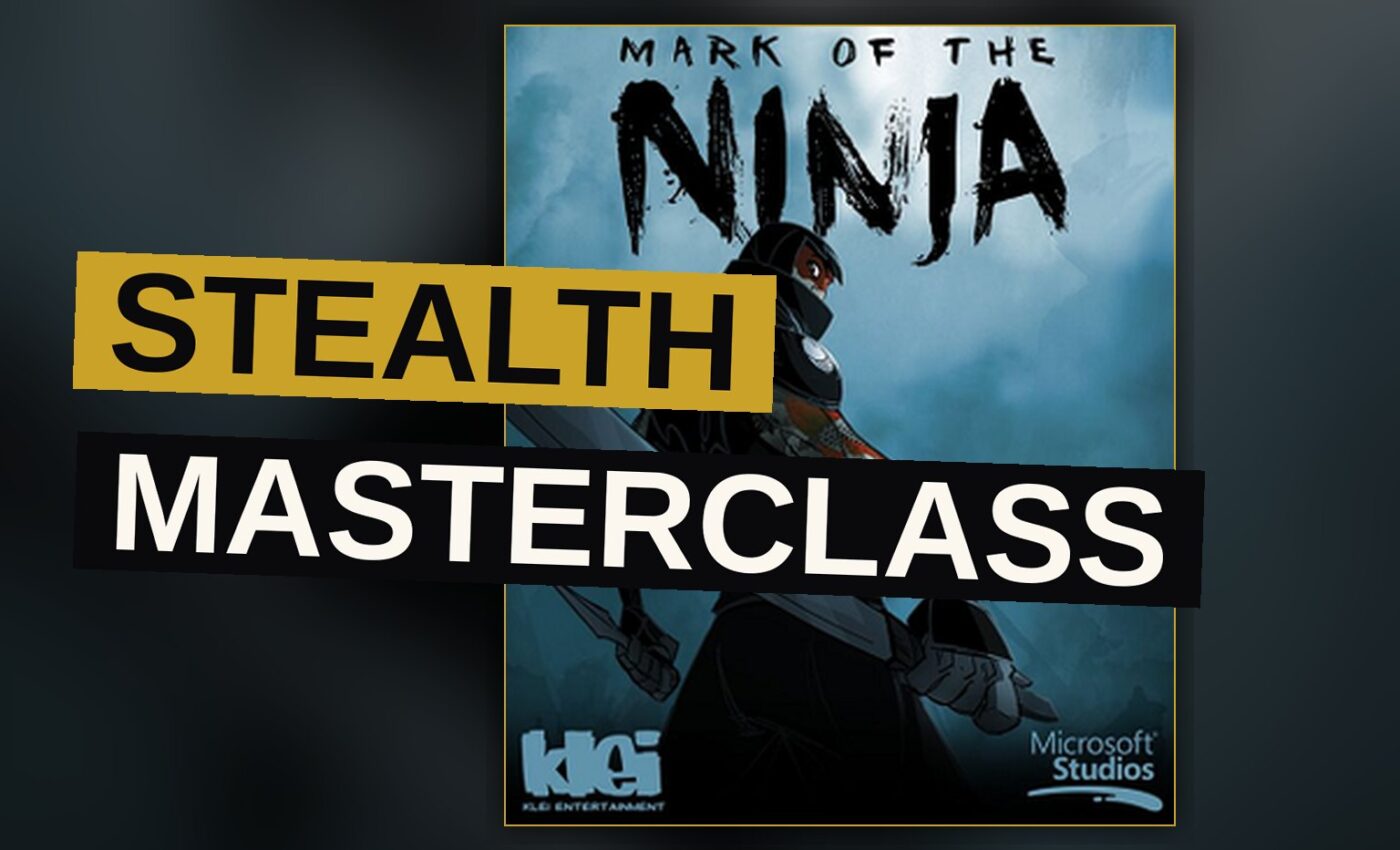
Mark of the Ninja is a side-scrolling stealth game that treats silence like a weapon and shadows like armor. Released in 2012 for Xbox 360, PC, and Mac, with a Linux version arriving later, it puts you in the role of a nameless ninja from the Hisomu clan. You are not a brawler. You are a ghost, and the game punishes you for forgetting that.
Every level is a carefully designed puzzle box where light, sound, and line of sight are the variables. It is one of the finest stealth games ever made, and it still holds up 14 years later. The core loop is simple: observe, plan, and execute.
Trailer, via GOG.
Hisomu Clan and the Mark
The story in Mark of the Ninja is thin, but it does the job. The Hisomu clan is under attack from a mercenary corporation called Hessian, which has hired a private army to wipe them out. Your character volunteers to wear a cursed tattoo, the Mark of the Ninja, which grants heightened senses but slowly drives the wearer insane. It is a classic trade-off: power for sanity.
The narrative is delivered through animated cutscenes and in-game dialogue. It is not Shakespeare, but it does not need to be. The real storytelling happens in the levels themselves. Each area tells you something about the world through its layout, its guards, and its environmental details. The game trusts you to read the space, which is more than most action titles do.
The voice acting is competent, and the character designs are distinct. Your ninja never speaks, which is the right choice. A silent protagonist fits a game about silence. The supporting cast, including your mentor and the clan leader, provides just enough context to push you forward.
Stealth as a Language
Stealth games often fail because they give you too many tools. Mark of the Ninja avoids that trap by making every ability feel meaningful. You have a grappling hook, smoke bombs, and a set of darts. You can distract guards with thrown objects. You can hang from ceilings and drop down silently. You can cut lights to create darkness.
The genius of the game is how it communicates information. When you are hidden, the screen desaturates. When you are in danger, colors sharpen. Sound is represented visually as ripples that spread from your footsteps. This is not just a stylistic choice. It is a mechanical one. The game lets you see exactly what the guards can hear, and that clarity makes planning possible.
Guards are not stupid. They investigate noises. They check corners. They alert each other when they find a body. If you are spotted, the game does not give you a quick reload. It forces you to deal with the consequences, often by running or hiding until the alarm passes. This creates tension, but it is a fair tension.
The level design is the real star. Each stage is a vertical and horizontal playground. You can move along walls, ceilings, and through vents. The path forward is never a single line. You are encouraged to experiment, to find the route that the developers did not explicitly mark. This is where Mark of the Ninja shines. It rewards curiosity.
Tools of the Trade
Your arsenal is small but versatile. The basic sword is for silent kills, but it is loud. A kill always leaves a body, and a body is a problem. You can drag corpses into shadows, but that takes time. The game constantly asks you to weigh risk and reward.
The darts are the most useful tool. They let you distract guards, put them to sleep, or create cover. The distraction dart is the workhorse. It lets you lure a guard away from his post, creating a gap. The sleeping option is a pacifist alternative, and the game rewards you for not killing.
The grappling hook lets you reach high ledges. It also lets you perform a quick, quiet takedown from above. Smoke bombs are for emergencies. They give you a moment of cover when you have been spotted. Every tool has a clear purpose, and none of them feel like filler.
There is also a focus meter. When it is full, you can slow time to chain kills together. This is the game’s one concession to action. It feels powerful, but it is limited. You cannot rely on it. The game wants you to be clever, not fast.
Terror of the Dog
One of the most memorable moments in Mark of the Ninja comes early. You encounter a guard dog. It is not a boss. It is just an enemy. But the dog changes everything. It can smell you. It does not rely on sight or sound. It tracks you through walls, and it is fast.
The dog sections are terrifying because they break the rules you have learned. You cannot hide from it. You have to outsmart it. The game introduces this enemy as a lesson: no plan survives contact with a new variable. The dog forces you to improvise, and improvisation is where the game’s tension lives.
Later levels introduce other threats. Searchlights, laser tripwires, and armored guards all add new wrinkles. The game never stops introducing new ideas. Just when you think you have mastered the mechanics, it throws a new one at you. This keeps the game fresh from start to finish.
The final levels take place in a museum and a skyscraper. These are not just set dressing. The museum is full of glass cases that shatter loudly. The skyscraper has vertical shafts and moving platforms. Each level is a new puzzle, and the solutions are rarely obvious.
Comparing Stealth Giants
Mark of the Ninja sits in a specific corner of the stealth genre. It is not a first-person immersive sim like Dishonored, and it is not a third-person cover shooter like Metal Gear Solid. It is a 2D platformer with stealth mechanics. This distinction matters.
| Game | Perspective | Core Mechanic | Main Strength |
|---|---|---|---|
| Mark of the Ninja | 2D side-scrolling | Sound and light manipulation | Clarity of information |
| Dishonored | First-person 3D | Teleport and possession | Player freedom |
| Metal Gear Solid | Third-person 3D | Camouflage and close-quarters | Narrative and spectacle |
| Splinter Cell | Third-person 3D | Light and shadow meters | Realism and tension |
Mark of the Ninja is the most legible of the group. You always know why you are spotted. You always know what the guard sees. That clarity is its superpower. Other games hide the rules. Mark of the Ninja puts them on screen.
This is not to say the other games are worse. They are different. But Mark of the Ninja is the purest expression of stealth as a puzzle. It is the game you show someone who says stealth is boring. It proves that the genre can be smart and fast and exciting all at once.
Art of Darkness
The visual style is striking. It looks like a hand-drawn animated film, with bold outlines and flat colors. The animation is fluid, especially for the ninja. Every movement has weight. When you hang from a ledge, you see your fingers grip. When you drop, you see the dust kick up.
The color palette is muted, mostly blues, grays, and browns. This is intentional. It makes the moments of danger pop. When a guard spots you, the screen flashes red. When you are safe, everything is calm. The game uses color as a language, and it speaks fluently.
The sound design is equally important. The game is quiet, but not silent. You hear the hum of machinery, the chatter of guards, the distant sound of rain. These ambient noises create atmosphere. They also serve a mechanical purpose. You can hear a guard approaching before you see him, and the game rewards you for listening.
The music is sparse. It swells during set pieces and fades during stealth sections. This is the right choice. Music would ruin the tension. The silence is the point. When the music does kick in, it is a signal that something big is happening.
Replay Value
The game is structured across multiple nights, each one a new level. The structure is tight. There are no filler missions. Every level introduces a new mechanic or a new challenge. The pacing is excellent, and each area builds on the last. By the end, you are using every tool in your arsenal. The final level is a test of everything you have learned. It is challenging, but it is fair. The game does not cheat.
There is also a New Game Plus mode. It unlocks after you finish the campaign. It is generally known as a harder mode that remixes the experience rather than a power-up mode. This adds replay value. The game is short, around six to eight hours, but it invites you to play it again with a different approach.
Final Score
Mark of the Ninja is a masterclass in game design. It takes a genre that is often slow and makes it feel immediate. It takes a character who is silent and makes him expressive. It takes a simple premise and builds a world that is worth exploring.
The game is not perfect. The story is forgettable. The boss fights are few and not particularly memorable. But these are minor complaints. The core experience is so strong that the flaws fade.
It is a game that respects your intelligence. It does not hold your hand. It gives you tools and trusts you to find solutions. That trust is rare. When a game gives you that kind of agency, it is worth celebrating.
Mark of the Ninja is a game you should play. If you have never touched it, now is the time. It is available on modern platforms, and it runs beautifully. It is a game about patience, precision, and the joy of being unseen.
The published IGDB critic aggregate across seven outlets gives it 9.1/10.
Get the Notebook.
The day's best stories and every fresh verdict, in plain English, in your inbox by seven. One email a day, no more.