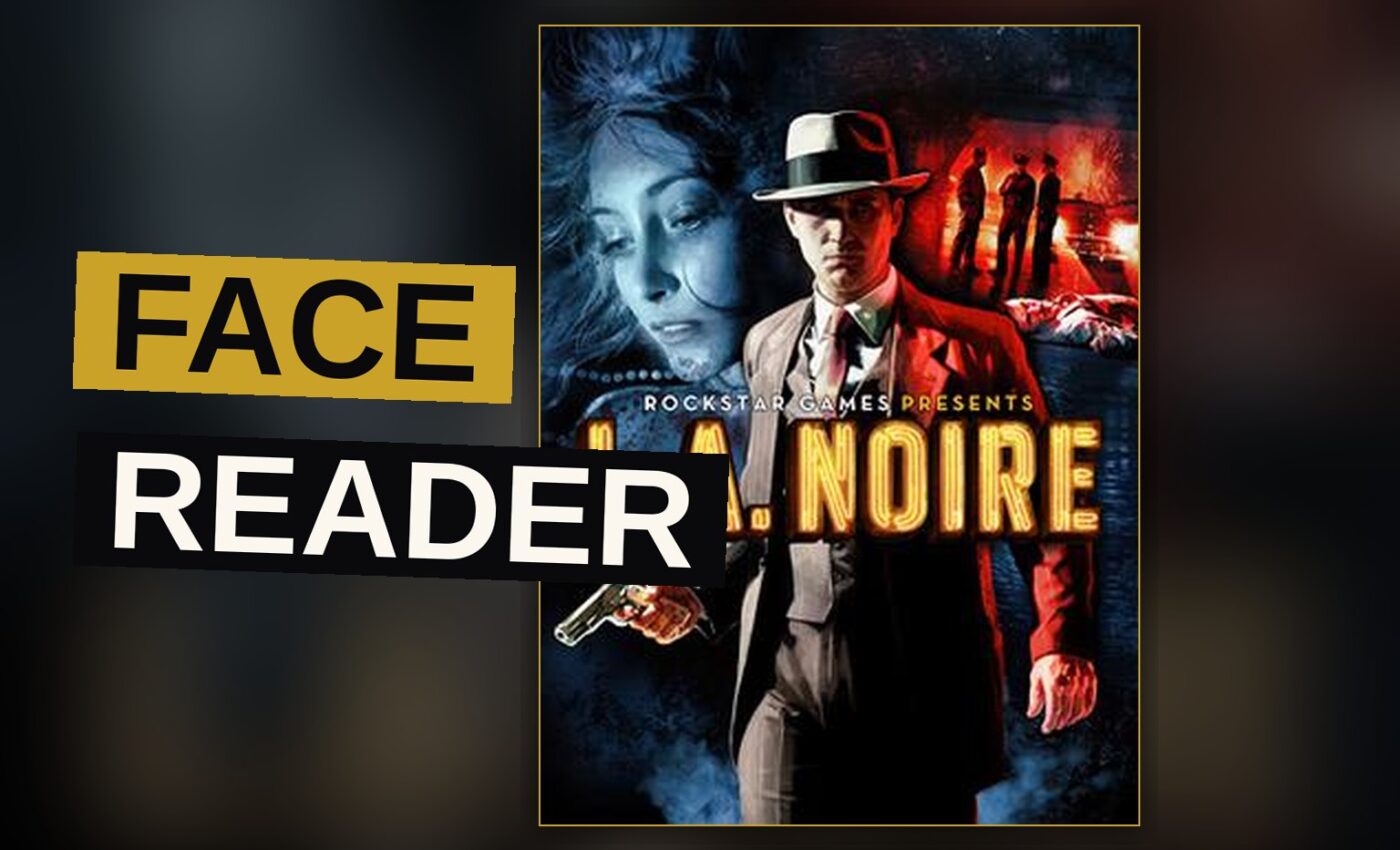
L.A. Noire is a game about looking at people. It came out in 2011, developed by Team Bondi and published by Rockstar Games, and it set the player down in 1947 Los Angeles as Cole Phelps, an LAPD patrolman climbing the ranks. The hook was never the shooting, though there is plenty of it. The hook was the faces.
Trailer, via Rockstar Games.
Cole Phelps and the Desks of the LAPD
Phelps is a decorated Marine Corps veteran of the Sixth Marines. The game opens with him as a patrol officer working alongside Ralph Dunn, another new recruit. From there he moves through the department’s bureaus — Traffic, Homicide, Vice, Arson — and each desk pairs him with a different partner and a different set of problems.
The structure is linear. You complete cases to advance the story, and the cases come in a fixed order. Within that order, how well you investigate decides how much of each case you actually see. Miss clues, botch interrogations, and the story narrows. Do the work and it opens.
Between cases you can roam the open world, a version of 1947 Los Angeles built from real landmarks of the period. Street crimes are optional, short and linear, with set objectives. So are the collectibles: golden film reels, vehicles, novels, golden records.
Interrogation Is the Whole Thing
When a suspect or witness answers a question, the player chooses to believe them, doubt them, or accuse them of lying. Accuse, and you have to produce the evidence that proves it. That is the mechanic the game lives or dies on, and it is the reason L.A. Noire still gets talked about.
The evidence system supports it. At a crime scene you find physical clues, some of which can be manipulated or investigated further for more information. You can pull information from non-player characters. You can use telephones and gamewells to reach the police radio. When all key clues at a scene are found, the investigation music concludes — a small, clean signal that you have what you need.
The game also lets you play in black and white, imitating film noir. It is a genuine option, not a filter gimmick, and it changes how the whole thing reads.
Roy Earle, Rusty Galloway, and the Company Phelps Keeps
The supporting cast does more work than the plot does. In Traffic, Phelps is partnered with Stefan Bekowsky, a Polish American he eventually befriends. In Homicide, it is Rusty Galloway, a weary and cynical detective who pushes back on Phelps’s theories. In Vice, it is Roy Earle, sardonic and corrupt, and the two clash repeatedly over morality, behavior and technique.
Phelps also begins an affair with Elsa Lichtmann, a German jazz singer, during his Vice years. He works regularly with coroner Dr. Malcolm Carruthers and crime scene investigator Ray Pinker. After his demotion to Arson, he is paired with Herschel Biggs, a former Marine who dislikes partners and eventually comes to respect him.
For some Arson cases, the player takes control of Jack Kelso, a former Marine and Phelps’s old rival. Kelso starts as a claims investigator at California Fire and Life and later becomes a District Attorney Investigator. He is the one who helps Phelps and Elsa get at the truth behind the Suburban Redevelopment Fund.
The cast is played by Aaron Staton as Phelps, Adam J. Harrington as Earle, Michael McGrady as Galloway, Gil McKinney as Kelso and Erika Heynatz as Lichtmann, among others.
The Morphine Ring and the Black Dahlia
The plot is where the game gets ambitious and where it starts to strain. Phelps’s Homicide tenure runs through a string of cases that echo the Black Dahlia murder. He and Galloway arrest suspect after suspect, and Phelps doubts they have the right people. He is right. They eventually find and kill the real murderer, but cannot name him publicly because of his connection to a powerful government official. The wrongfully arrested are set to be released by mistrial.
Then Vice, and the morphine. Phelps investigates military surplus morphine stolen from the ship that brought his former Marine unit home. Several members of that unit stole and distributed it. The case pulls in his old squadmates and eventually his estranged comrade Kelso.
When he is tasked with investigating a morphine distribution ring involving several of his former squadmates from World War II, Phelps finds both his personal and professional life falling into turmoil
What Holds Up and What Doesn’t
The interrogation system is the best idea in the game and the one most likely to frustrate you. Reading a face is a skill the game teaches badly and then tests constantly. Accusations require evidence, and the gap between what you noticed and what the game decided you noticed is where most players quit.
The open world is the weaker half. Roaming 1947 Los Angeles is atmospheric, and the landmarks are a nice touch, but the street crimes are thin and the collectibles are busywork. The linear case structure and the open map pull against each other rather than reinforcing each other.
Where L.A. Noire earns its reputation is in the pairing of the faces with the desks. Phelps rises through Traffic, Homicide, Vice and Arson, and each promotion makes him a little more compromised. By the time he is working the morphine ring and his own war record is the case file, the game has built something the shooting never could. The conspiracy behind the Suburban Redevelopment Fund lands because you have watched him earn his way into it.
This is a 7.5. The interrogation mechanic is genuinely novel and the period detail is committed, but the open world is padding and the plot’s back half leans on coincidence more than detection. Play it in black and white, and play it for the rooms where you have to decide whether a person is lying to you.
Get the Notebook.
The day's best stories and every fresh verdict, in plain English, in your inbox by seven. One email a day, no more.