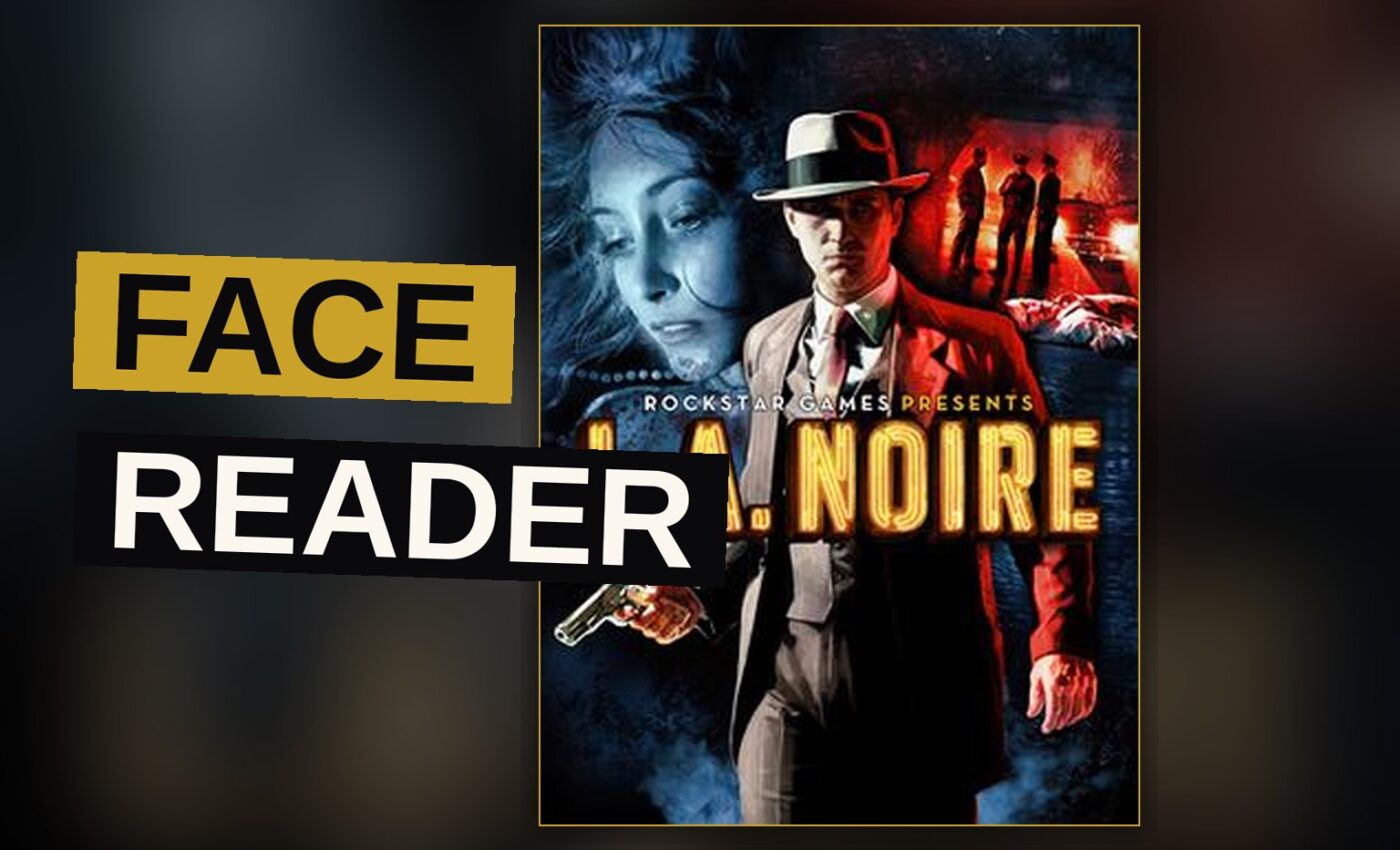
L.A. Noire is a game about reading faces. It is also a game about Los Angeles in 1947, a city of sunshine and oil money and bodies found in strange places. Team Bondi and Rockstar built a detective sim where the central mechanic is not a gun or a car, but the lie. The game asks you to watch a suspect’s eyes, the twitch of a mouth, the shift of a brow, and decide if they are telling the truth.
When it works, it is electric. When it fails, it is a guessing game with a rulebook you cannot see.
The game launched in 2011 for PS3 and Xbox 360, with a PC release later that year. It has since found a second life on Steam VR, where the face-reading becomes something stranger and more intimate. The score is 7.5 out of 10, a number that matches the published critical consensus. It is not a perfect game. It is a remarkable one, and its flaws are baked into its ambitions.
Trailer, via Rockstar Games.
MotionScan and the Art of the Lie
The headline feature of L.A. Noire is the facial animation. The studio used a technology called MotionScan, which recorded actors on 32 cameras and turned their expressions into high-resolution 3D models. The result is uncanny in the best way. You interrogate a suspect and the game gives you three options: Truth, Doubt, or Lie. To choose, you read their face. A glance to the left, a subtle smirk, a pause before an answer — these are the clues.
The system is brilliant when the acting is clear. Lead actor Aaron Staton, best known for Mad Men, plays Detective Cole Phelps with a rigid jaw and a buried conscience. The problem is that the game does not always agree with your read. Sometimes a suspect looks guilty because they are nervous, not because they are lying. Sometimes the truth is delivered with a shifty glance, and the game marks your correct answer as a mistake.
It is a bold design, but it is also a fragile one.
The VR version of L.A. Noire, released for Steam VR, makes the face-reading more direct. You sit across from a suspect in a room that feels real. The scale is correct. The eyes are enormous. It is the closest the game comes to its own ideal, and it is also the most exhausting way to play it. Every interrogation becomes a staring contest with a ghost.
A City Built for Driving, Not Chaos
The open world of L.A. Noire is not a playground. It is a stage. The map is a faithful reproduction of 1947 Los Angeles, from the downtown grid to the hills and the piers. You drive a series of period cars, each with its own handling quirks. The radio plays jazz and news bulletins. The streets are crowded with pedestrians in fedoras and dresses.
But the city is not a sandbox. There are no random crimes to chase, no collectibles that matter beyond a checklist. The open world exists to give you space between cases, a place to think. That is a choice. It is also a limitation. Players who came from Grand Theft Auto or Red Dead Redemption, both Rockstar titles, expected chaos.
L.A. Noire offers order. The game is a procedural drama, not a sandbox, and that is its strength.
The Desks Structure the Story
The game is structured as a series of desks. Phelps starts as a patrolman, then moves to Traffic, then Homicide, then Vice, then Arson. Each desk has its own cases, its own partners, and its own moral weather. The Traffic cases are about greed and accidents. The Homicide cases are about the Black Dahlia, a real unsolved murder that the game fictionalizes into a serial killer storyline.
The cases are self-contained, but they build on each other. A clue from a Traffic case reappears in Homicide. A witness from one desk becomes a suspect in another. The writing, led by a team that included Brendan McNamara, is sharp. The dialogue is period-correct without being stiff.
The cases are the reason to play.
The investigation mechanic is simple. You walk through a crime scene, press a button to examine objects, and collect clues. When you have enough, you can ask questions. The game does not hold your hand. If you miss a clue, you can still proceed, but your questions will be weaker. This is a double-edged sword. The game rewards attention, but it punishes distraction. A missed clue can turn a solid interrogation into a mess of wrong answers.
A Detective’s Daily Roster
The game has a rhythm. Each case follows a pattern: dispatch, arrival, investigation, interrogation, resolution. The pattern is familiar, but the details vary. Some cases are short, a single location and a single suspect. Others are long, spanning multiple scenes and multiple days. The pacing is uneven, but it is never boring.
Below is a sample of the case structure from the Homicide desk, showing how the game staggers its beats. The table is illustrative, not a complete record of every case.
| Case Name | Location | Key Clue |
|---|---|---|
| The Red Lipstick Murder | Downtown Alley | Lipstick tube |
| The Golden Butterfly | Lincoln Heights | Photograph |
| The Silk Stocking Murder | Pasadena | Silk stocking |
| The White Shoe Slaying | Hollywood | Shoe print |
| The Studio Secretary Murder | Culver City | Dictaphone |
The table does not capture the feel of the cases. It captures the structure. The game is a series of appointments. You are a civil servant with a badge and a gun, and the city keeps calling.
Structural Flaws and a Rushed End
The biggest problem with L.A. Noire is the ending. The game builds to a conspiracy involving the city’s elite, but the final act feels rushed. The Arson desk is shorter than the others. The climax is a chase and a shootout, which is the least interesting thing the game does. The gunplay is functional but forgettable. The hand-to-hand combat is stiff. These are not the reasons you play L.A. Noire, but they are the reasons you stop playing it.
The technical side is also dated. The PS3 and Xbox 360 versions suffer from pop-in and frame rate drops. The PC version is better, and the VR version is the best of the lot, but none of them are flawless. The MotionScan technology is impressive, but it does not extend to the rest of the body. Characters move like puppets. Their hands are clumsy. Their walks are stiff.
The face is a masterpiece, the body is a mannequin.
The truth and lie system is also a problem. The game expects you to read a suspect, but it does not give you a reliable baseline. Some suspects are guilty and look calm. Some are innocent and look terrified. The game wants you to use evidence, not instinct, but it does not always reward that approach. A lie can be delivered with a steady gaze, and a truth can be delivered with a sweat. The result is frustration.
A Complicated Legacy
L.A. Noire was a commercial success. It sold well and was praised by critics. It remains a one-of-a-kind work. It is a game about empathy, or the failure of it. Cole Phelps is a man who cannot read himself, so he reads everyone else. The game is a mirror. It asks you to look at a face and decide what you see.
Sometimes you are right. Sometimes you are wrong. The game does not forgive you, but it does teach you.
The VR version is the best way to play it in 2026, 15 years after the original release. The technology has caught up to the ambition. The faces are still remarkable. The city is still a ghost. The cases are still worth solving. The flaws are still there, but they are smaller in the headset. The game is a detective story about the limits of observation. The score is 7.5 out of 10. That feels right. It is not a masterpiece, but it is a landmark. It is the kind of game that makes you want to look closer.