
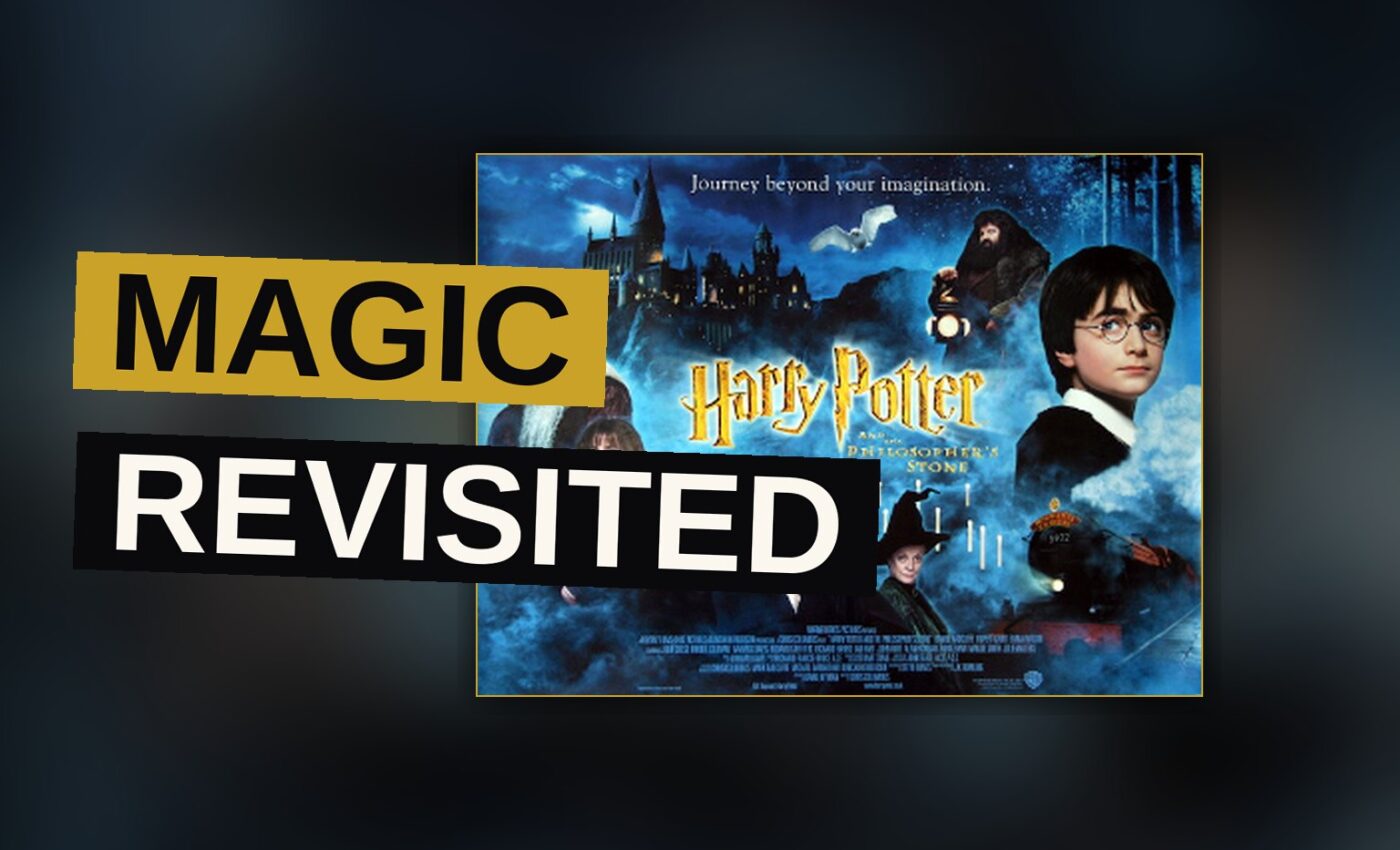
Harry Potter and the Philosopher’s Stone arrived in November 2001 with a tagline that promised everything: “Let the magic begin.” Chris Columbus directed. Steve Kloves wrote the script from J. K. Rowling’s 1997 novel. The film runs 152 minutes, and for most of that time it does the one thing a first instalment has to do — it builds a world solid enough to hold eight more films. That the world holds is the achievement. That the film rarely moves faster than a school tour is the cost.
Trailer, via Warner On Demand.
Daniel Radcliffe Under the Stairs
The story is simple and the film trusts it. Harry Potter has lived under the stairs at his aunt and uncle’s house his whole life. On his 11th birthday he learns he is a wizard and that a place waits for him at Hogwarts School of Witchcraft and Wizardry. Radcliffe plays him as a boy who has learned to be quiet, which is the right choice. His Harry watches before he speaks.
Columbus had wanted Radcliffe since seeing him in the BBC’s production of David Copperfield, before the open casting calls. Casting director Susan Figgis told him Radcliffe’s protective parents would not allow their son to take part, fearing he would lose a normal childhood. Columbus kept pushing. Figgis resigned over it. The director then met Radcliffe and his parents at a London production of Stones in His Pockets in 2000, and he and producer David Heyman convinced them their son would be protected from media intrusion.
Rowling approved. “Having seen [his] screen test I don’t think Chris Columbus could have found a better Harry,” she said. Radcliffe was reportedly paid £1 million for the film, though he said the fee was “not that important” to him. The Saunders triplets appear as Harry as a baby.
Rupert Grint and Emma Watson
Ron Weasley needed a best friend and a comic engine, and Rupert Grint supplies both. A fan of the series, Grint decided he was perfect for the part “because [he has] ginger hair.” He saw a Newsround report about the open casting and sent in a video of himself rapping about how he wanted the role. The casting team asked for a meeting.
Emma Watson’s Hermione Granger is the film’s most interesting problem. Hermione’s studious ways ostracise her from the other students. On Halloween, Ron insults her and she retreats to the girls’ toilets at the same moment a mountain troll is loose in the school. Harry and Ron rescue her from the troll. When the teachers find them, Hermione takes the blame — a small act of loyalty that turns three children into a trio. Watson plays the prickliness without softening it, which is why the turn lands.
The supporting cast is where the film spends its real money. Richard Harris as Albus Dumbledore. Maggie Smith as Professor McGonagall. Alan Rickman as Severus Snape, who makes every line sound like it is being weighed for a trap. Robbie Coltrane as Hagrid, the key keeper who fetches Harry when the Dursleys intercept the Hogwarts letters. John Hurt as Mr Ollivander. Ian Hart as Professor Quirrell and the voice of Voldemort.
Four Houses and a Three-Headed Dog
The mechanics of Hogwarts are laid out with unusual patience. First-year students are sorted into four houses. Harry, Ron and Hermione join Gryffindor. The haughty Draco Malfoy, played by Tom Felton, goes to Slytherin, known for producing dark wizards.
Three threads drive the middle of the film, and the order matters to how it plays:
- Hagrid tells Harry in Diagon Alley that he is celebrated for surviving Lord Voldemort, who seemingly perished after murdering Harry’s parents for working against him and left him with a lightning bolt-shaped scar.
- The trio wander onto a forbidden corridor on the third floor, guarded by a giant three-headed dog named Fluffy, and begin asking what it guards — and how anyone would acquire such a dog in the first place.
- Harry uncovers the truth about his parents’ deaths and the villain to blame.
That third thread is the film’s engine, and it idles. Columbus is a patient builder, and patience is the right instinct for a story whose audience already knows the ending. It is the wrong instinct for a 152-minute film that must also be a film.
Warner Bros. Bought the Rights for £1 Million
The business behind the film matters to how it looks. Warner Bros. Pictures bought the film rights to the book in 1999 for a reported £1 million ($1.65 million). Production began in the United Kingdom in 2000. Columbus was chosen from a short list of directors that included Steven Spielberg and Rob Reiner. Rowling insisted the entire cast be British and Irish, and the three leads were chosen in August 2000 following open casting calls. Filming ran at Leavesden Film Studios and historic buildings around the United Kingdom from September 2000 to March 2001.
The casting process was as thorough as the production design. Susie Figgis worked with Columbus and Rowling on the lead roles. Columbus’s experience filming Home Alone made him cautious, particularly after learning about Macaulay Culkin’s family abuse. Open calls considered only British children. Principal auditions came in three parts:
- Reading a page from the novel.
- Improvising the students’ arrival at Hogwarts.
- Reading several pages of the script in front of Columbus.
Scenes from Columbus’s script for Young Sherlock Holmes were also used. Figgis left the production on 11 July 2000.
The film premiered at Odeon Leicester Square in London on 4 November 2001. Warner Bros. released it on 16 November in the United Kingdom and the United States. It grossed $974 million at the box office during its initial run and over $1 billion with subsequent re-releases, against a $125 million budget.
The Film’s Real Problem Is Pace
Here is the ledger. The film works because the world is complete: the Dursleys’ house, Diagon Alley, the Hogwarts Express, the Great Hall, the third-floor corridor. Every set is built to be returned to. The cast is deep enough that a single scene with Maggie Smith or Alan Rickman carries more weight than most films manage in a whole act.
The film fails when it mistakes coverage for momentum. The plot is a mystery about what Fluffy guards, and the film keeps stopping to admire its own furniture. The troll sequence and the sorting ceremony are both well staged. Neither is allowed to build. Columbus shoots the wonder, not the fear.
The comparison that matters is Rowling’s novel, which is leaner and meaner. Kloves’s script keeps the beats and loses the bite. The film is faithful in the way a museum is faithful: everything is present and nothing is dangerous.
That is a defensible choice for a first instalment, and it is why the sequels had somewhere to go. It is also why this one, watched alone, feels like a prologue with a running time. The magic begins, as promised. It just takes its time getting there.
7.9 of 10.
Get the Notebook.
The day's best stories and every fresh verdict, in plain English, in your inbox by seven. One email a day, no more.


