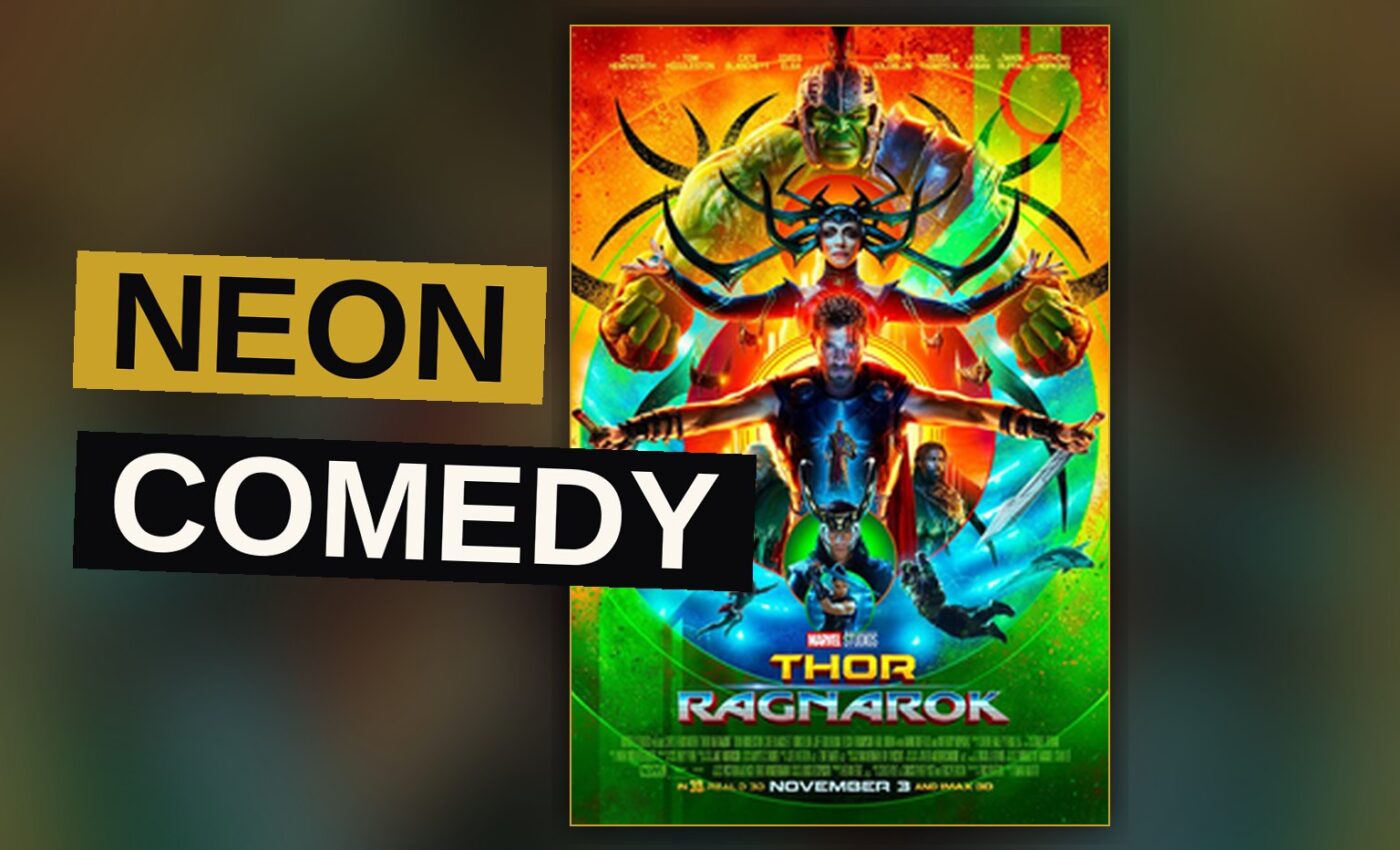
“No hammer. No problem.” That is the tagline Marvel sold for Thor: Ragnarok, and it doubles as a mission statement. Taika Waititi’s film, released in 2017, takes Chris Hemsworth’s Thor, strips away his hammer Mjolnir, his hair, his eye and his home, and asks what is left. The answer, it turns out, is a comedy. Thor: Ragnarok runs 131 minutes and lands as the 17th film in the Marvel Cinematic Universe, a sequel to Thor (2011) and Thor: The Dark World (2013). It is the funniest of the three by a wide margin, and the least interested in being solemn about any of it.
Trailer, via Marvel Entertainment.
Sakaar, and the planet that resets the franchise
The plot moves fast and does not apologize. Two years after the Battle of Sokovia, Thor is imprisoned by the fire demon Surtur, who tells him Odin is no longer on Asgard and that the prophesied apocalypse Ragnarök will come once Surtur unites his crown with the Eternal Flame in Odin’s vault. Thor frees himself, defeats Surtur and takes the crown, believing he has stopped it. He is wrong.
Back on Asgard he finds Heimdall gone and Loki posing as Odin. He forces his estranged brother to help find their father, and with directions from Stephen Strange they locate Odin in Norway. Odin explains he is dying, that Ragnarök is imminent despite Thor’s efforts, and that his death will free his firstborn child, Hela, from the prison she was sealed in long ago.
Hela is a sibling neither Thor nor Loki knew existed. She led Asgard’s armies and conquered the Nine Realms with Odin, who imprisoned her and wrote her out of history after she became too bloodthirsty and rejected his views on peace. She destroys Mjolnir, knocks the brothers into space, defeats Asgard’s army, slays the Warriors Three and resurrects the ancient dead who once fought with her, including her giant wolf Fenris.
Cate Blanchett, and what she does with a goddess
Cate Blanchett plays Hela, the goddess of death, based on the deity Hel. She is the film’s best idea and its most underused one. Screenwriter Eric Pearson included the twist that Hela is Thor’s sister in one of his drafts at the encouragement of executive producer Brad Winderbaum, and the decision to tie her to Thor rather than only to Loki gives the film a family quarrel where the earlier entries had a sibling squabble.
Blanchett arrives with a headdress, a disdain for everyone, and a plan to use the Bifröst to expand Asgard’s empire. She appoints the Asgardian Skurge, played by Karl Urban, as her executioner. Heimdall, played by Idris Elba, takes the sword that controls the Bifröst and becomes a fugitive in his own realm.
Meanwhile Thor crash-lands on Sakaar, a garbage planet surrounded by wormholes. A slave trader designated Scrapper 142 subdues him with an obedience disk and sells him. That trader is Valkyrie, played by Tessa Thompson, and she is the film’s second-best idea.
Hemsworth, Hiddleston and the case for comedy
Hemsworth had grown, in his own words, “a bit bored” of Thor after playing him four times. He wanted to take risks and experiment. The shorter hair, the different outfit, the destroyed hammer and the lost eye all come from that impulse. Waititi said stripping the character down this way allowed him to become a refugee by the end of the film.
That is the sharpest thing about Thor: Ragnarok. It is a comedy that ends with its hero displaced. Waititi also wanted to use more of the comedic skills Hemsworth showed in Vacation (2015) and Ghostbusters (2016), and he cited Kurt Russell’s performance in Big Trouble in Little China (1986) as an influence. You can see it. Thor in this film is a loud, friendly man who keeps getting knocked down and keeps talking.
Tom Hiddleston returns as Loki and was interested in how his character’s attitude has changed. “He is always a trickster,” Hiddleston said. “It is trying to find new ways for him to be mischievous.” As ruler of Asgard since the end of Thor: The Dark World, Loki has, in Hiddleston’s reading, “devoted most of his efforts to narcissistic self-glorification. Not so much on good governance.” Hiddleston also noted that “the idea that Thor might be indifferent to Loki is troubling for him.”
Korg, Valkyrie and the supporting cast that steals it
Mark Ruffalo joins as Bruce Banner and the Hulk, reprising a role from earlier MCU films. His presence let the film adapt elements of the 2006 comic storyline “Planet Hulk,” which is why Sakaar exists at all. Jeff Goldblum plays the Grandmaster, who runs the planet’s contest of champions, and Goldblum does what Goldblum does. Rachel House plays Topaz. Anthony Hopkins returns as Odin for what amounts to a long goodbye.
Then there is Korg, voiced by Waititi himself. Korg is a rock creature made of soft-spoken defeat, and he is the single funniest thing in the movie. A film that hands its best lines to a pile of stones is making a statement about how seriously it takes any of this.
The cast is the argument. Compare what each performer is asked to do across the three Thor films:
| Character | Thor (2011) | The Dark World (2013) | Ragnarok (2017) |
|---|---|---|---|
| Thor | Earnest prince, exiled | Earnest prince, grieving | Bored god, stripped down |
| Loki | Scheming brother | Scheming ruler of Asgard | Trickster, self-glorifying |
| Odin | Distant king | Father, dying | Dying, hiding a firstborn |
| Heimdall | Watchful gatekeeper | Watchful gatekeeper | Fugitive holding the sword |
| Hulk | Absent | Absent | Banner and Hulk, from “Planet Hulk” |
Craig Kyle, Christopher Yost and a crowded screenplay
A third Thor film was confirmed in January 2014, when Craig Kyle and Christopher Yost began work on the screenplay. Hemsworth and Hiddleston’s involvement was announced that October, and the title Thor: Ragnarok was revealed later that month. Waititi joined as director a year later, after Thor: The Dark World director Alan Taylor chose not to return.
Ruffalo’s casting as Banner and the Hulk allowed elements of “Planet Hulk” to be adapted. The rest of the cast, including Blanchett as Hela, was confirmed in May 2016, with Pearson’s involvement revealed at the start of filming that July. Principal photography took place in Brisbane and Sydney, Australia.
The screenplay is credited to Pearson and the writing team of Kyle and Yost. That is a lot of hands on one script, and in this paper’s view the seams show in places. Hela’s backstory arrives in a monologue. The Warriors Three are dispatched almost as an afterthought. Sakaar is more vivid than Asgard, which this paper counts as a problem when Asgard is the thing worth saving.
What the film gets right, and what it wastes
Thor: Ragnarok is at its best when it treats its own mythology as material rather than scripture. Destroying Mjolnir in the first act is a real decision. It removes the character’s crutch and forces him to fight, and it gives the film a clean visual idea: a god who has lost the thing that made him a god.
The film is at its worst when it rushes. In this paper’s reading, Hela conquers Asgard offscreen and on the cheap. Valkyrie’s history with Hela is gestured at rather than shown. The film has a 131-minute runtime and still feels like it is skipping chapters.
The tone is the other risk. Thor: Ragnarok is funny in a way the previous two films were not, and that is a deliberate correction. The earlier entries were dour. This one is loose, colorful and willing to undercut its own drama. Sometimes that undercutting costs the film real weight. Our verdict: the destruction of Asgard should land harder than it does.
7.6 out of 10 on TMDB
The 7.6 out of 10 that circulates for Thor: Ragnarok is the TMDB audience score, drawn from 22,453 votes, not a critical score and not this paper’s own number. Read as an audience figure, it is honest enough. It is the best of the three Thor films by this paper’s reckoning, and one of the better MCU entries of its era, but it is not a great film. It is a very good comedy wearing a superhero costume, and its best scenes are the ones where it stops pretending otherwise.
The case for it is simple. Hemsworth is finally allowed to be funny. Blanchett is finally given a villain worth her time, even if the script does not give her enough of it. Thompson’s Valkyrie is a genuine addition. Waititi’s Korg is the reason people quote this movie years later.
The case against it is just as simple. The film spends more care on Sakaar than on Asgard, and Asgard is what the story is about. Hela is introduced as a sibling and then mostly used as a problem to solve. The emotional beats are thin.
What matters here is the correction. Thor: Ragnarok showed that a Marvel franchise could be rebuilt by changing its tone rather than its cast. Our conclusion, and ours alone, is that a bored actor can be a useful thing if the director knows what to do with him. That is the part worth watching, and it is why the film still holds up better than its own plot does.
7.6 of 10 on TMDB.
Get the Notebook.
The day's best stories and every fresh verdict, in plain English, in your inbox by seven. One email a day, no more.