
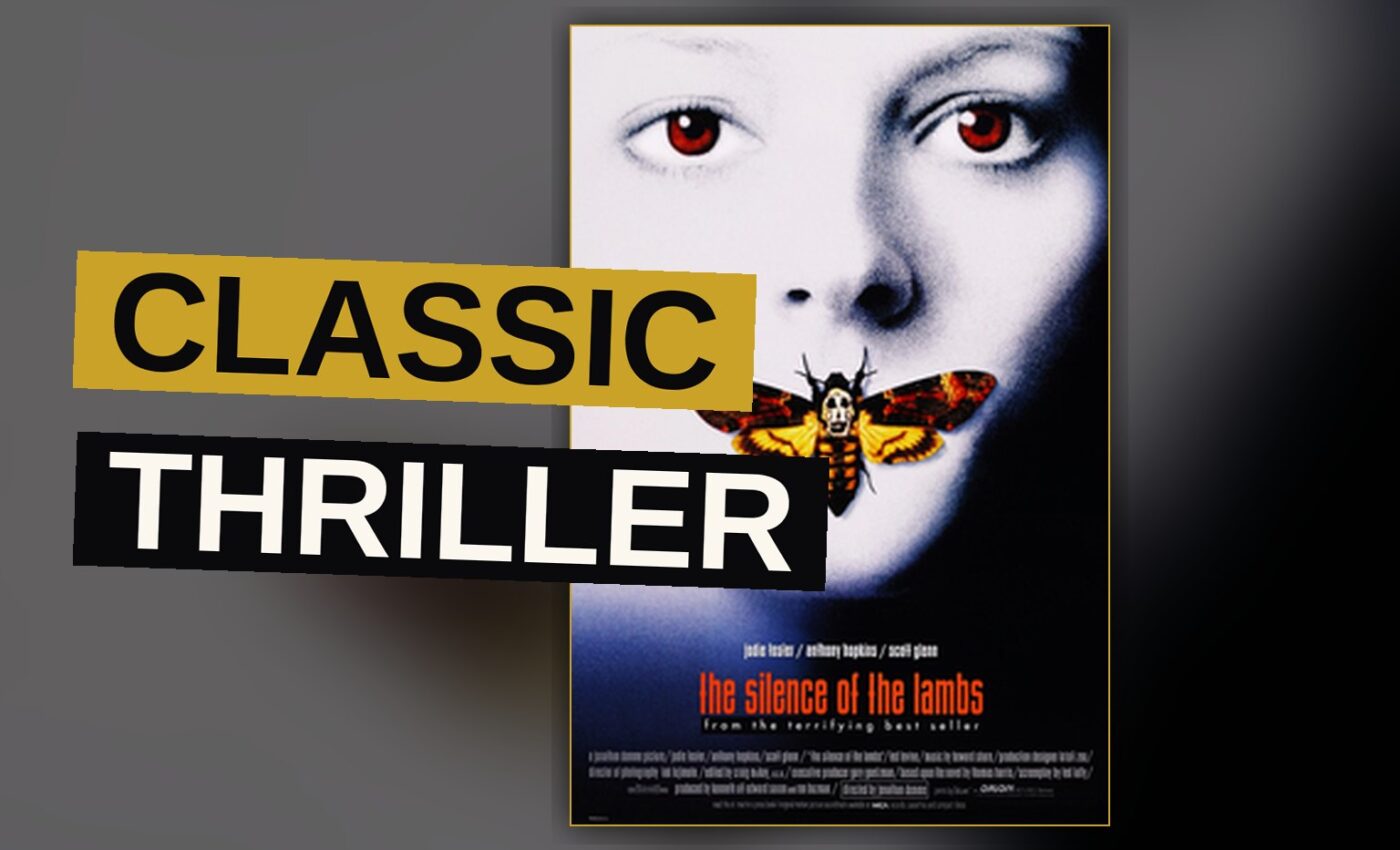
The Silence of the Lambs was released by Orion Pictures on February 14, 1991. It runs 119 minutes. It made $272.7 million worldwide against a $19 million budget, the fifth-highest-grossing film of that year. It is a crime thriller, a horror film, a drama about a young woman trying to be taken seriously in a building full of men. It is all of those at once, and it never drops one for the sake of another.
Trailer, via BFI.
Clarice Starling at Quantico
Jodie Foster plays Clarice Starling, a top student at the FBI’s training academy at Quantico. Jack Crawford, chief of the Behavioral Science Unit, pulls her out of class and hands her an assignment that is not really the assignment he describes.
Crawford wants her to interview Dr. Hannibal Lecter, a brilliant psychiatrist and cannibalistic murderer serving life at the Baltimore State Hospital for the Criminally Insane. Crawford tells her it is a psychological survey. What he wants is Lecter’s insight into a killer called Buffalo Bill, and he thinks Starling, as an attractive young woman, may be the bait to draw him out.
That is the engine of the whole picture, and it is a cruel one. Crawford is using her. Chilton, the hospital’s manipulative director, makes unwelcome advances toward her before he even walks her to the cell. Everyone in the building is measuring her. The film knows exactly what it is doing with that.
Anthony Hopkins and the First Ten Pages
Demme did not want Foster at first. His first choice was Michelle Pfeiffer, who had just worked with him on Married to the Mob. Pfeiffer turned it down. “It was a difficult decision, but I got nervous about the subject matter,” she later said. Meg Ryan turned it down too, for its gruesome themes. The studio was skeptical about Laura Dern as a bankable choice. Molly Ringwald auditioned and was deemed too young. Foster got the part because she wanted it more than anyone in the room, and she had been interested in it since reading the novel.
For Lecter, Demme approached Sean Connery first. Connery said no. Anthony Hopkins was offered the role based on his performance in The Elephant Man. When Hopkins’s agent told him a script was coming called The Silence of the Lambs, Hopkins asked, “Is it a children’s story?” He called back after ten pages. “This is the best part I’ve ever read,” he said. He accepted the role after having dinner with Demme.
Al Pacino, Robert De Niro, Dustin Hoffman, Jeremy Irons, Derek Jacobi and Daniel Day-Lewis were all considered. Forest Whitaker has said he auditioned. The mask Hopkins wore became the film’s most recognizable image.
A Quid Pro Quo in the Baltimore Cell
The plot turns on exchange. Lecter is courteous at first, then dismissive once he works out Crawford’s real motive. On her way out, inmate Miggs throws semen at Starling. Lecter is disgusted. He calls her back and gives her an anagram that leads to a storage unit holding a severed head in a jar, later identified as Benjamin Raspail, a former patient of Lecter’s.
Miggs turns up dead soon after, having swallowed his own tongue. The film implies Lecter arranged it as retribution and does not say so outright. That restraint is the whole method.
Lecter agrees to help in return for a transfer away from Chilton. Another victim is found with a death’s-head moth lodged in her throat, the same species found in the severed head. When Buffalo Bill abducts Catherine Martin, the daughter of Senator Ruth Martin, Crawford authorizes Starling to offer Lecter a fraudulent deal. Lecter counters with a quid pro quo of his own, trading information for pieces of her life.
Starling tells him her father, a police officer, was murdered when she was ten, leaving her orphaned. In return, Lecter tells her Buffalo Bill is not a genuine transsexual. He is something else, and the film lets that distinction sit.
Ted Levine and the Death’s-Head Moth
Ted Levine plays Jame Gumb, the killer the film calls Buffalo Bill. He murders young women and removes their skin. He is not a showman. He is a man with a basement, a sewing machine and a plan, and Levine plays him as small and ordinary, which is far worse than theatrical.
The film’s violence is largely offscreen. Demme shows the aftermath, the moth, the jar, the photographs, and lets the audience do the rest. That is a choice, and it is the reason the picture holds up better than most of its imitators. You are never watching a set piece. You are watching a young woman walk into rooms she should not be in, alone, with a gun she may or may not be ready to use.
The Big Five at the 64th Academy Awards
The Silence of the Lambs premiered at the 41st Berlin International Film Festival, where Demme won the Silver Bear for Best Director. At the 64th Academy Awards it won Best Picture, Best Director, Best Actor, Best Actress and Best Adapted Screenplay. It was the third film ever to take all five, and it remains the most recent. It is still the only horror film to have won Best Picture.
Ted Tally wrote the screenplay, adapted from Thomas Harris’s 1988 novel. Scott Glenn plays Crawford. Anthony Heald plays Chilton. Brooke Smith plays Catherine Martin. Diane Baker plays Senator Ruth Martin. Kasi Lemmons plays Ardelia Mapp. Frankie Faison plays Barney. Tracey Walter, Charles Napier and Danny Darst fill out the edges.
The tagline is “To enter the mind of a killer she must challenge the mind of a madman.” That is marketing, and it undersells the film. Starling is not entering a mind. She is negotiating with one, on terms she did not set, for a man who will not stop until he has something of hers.
Where It Sits Now
In 2018, Empire ranked The Silence of the Lambs 48th on its list of the 500 greatest movies of all time. The American Film Institute ranked it the sixty-fifth greatest film in American cinema and the fifth-greatest thriller. Starling and Lecter were both included among the greatest film characters.
Those lists are not the argument. The argument is simpler. Here is what the film gets right, in order of how much it matters:
- Foster’s Starling, who is competent, frightened, and never once written as a victim waiting to happen.
- Hopkins’s Lecter, who is charming in the way a locked door is not.
- Demme’s refusal to show the worst of it, which makes the worst of it worse.
- Tally’s script, which treats an interview as an action sequence.
- Levine’s Gumb, who is not a monster but a man, which is the point.
The fifth item is the one people skip. Buffalo Bill is not Lecter’s equal and the film never pretends he is. He is the case. Lecter is the weather.
Score: 8.3 of 10
The Silence of the Lambs is not a perfect film, and the 8.3 it carries from 18,467 votes is about right. It is a procedural wearing a horror film’s coat, and it works because Foster plays Starling as a professional in a room that refuses to treat her as one. The scenes between her and Lecter are the best thing in it, and they are best because nothing happens in them except talk. Everything else in the picture is built to serve that talk.
What matters most is not the mask or the moth or the basement. It is the moment Starling tells a cannibal about her father because it is the only currency she has. She pays it. She gets what she needs. That is the film.
Get the Notebook.
The day's best stories and every fresh verdict, in plain English, in your inbox by seven. One email a day, no more.


