
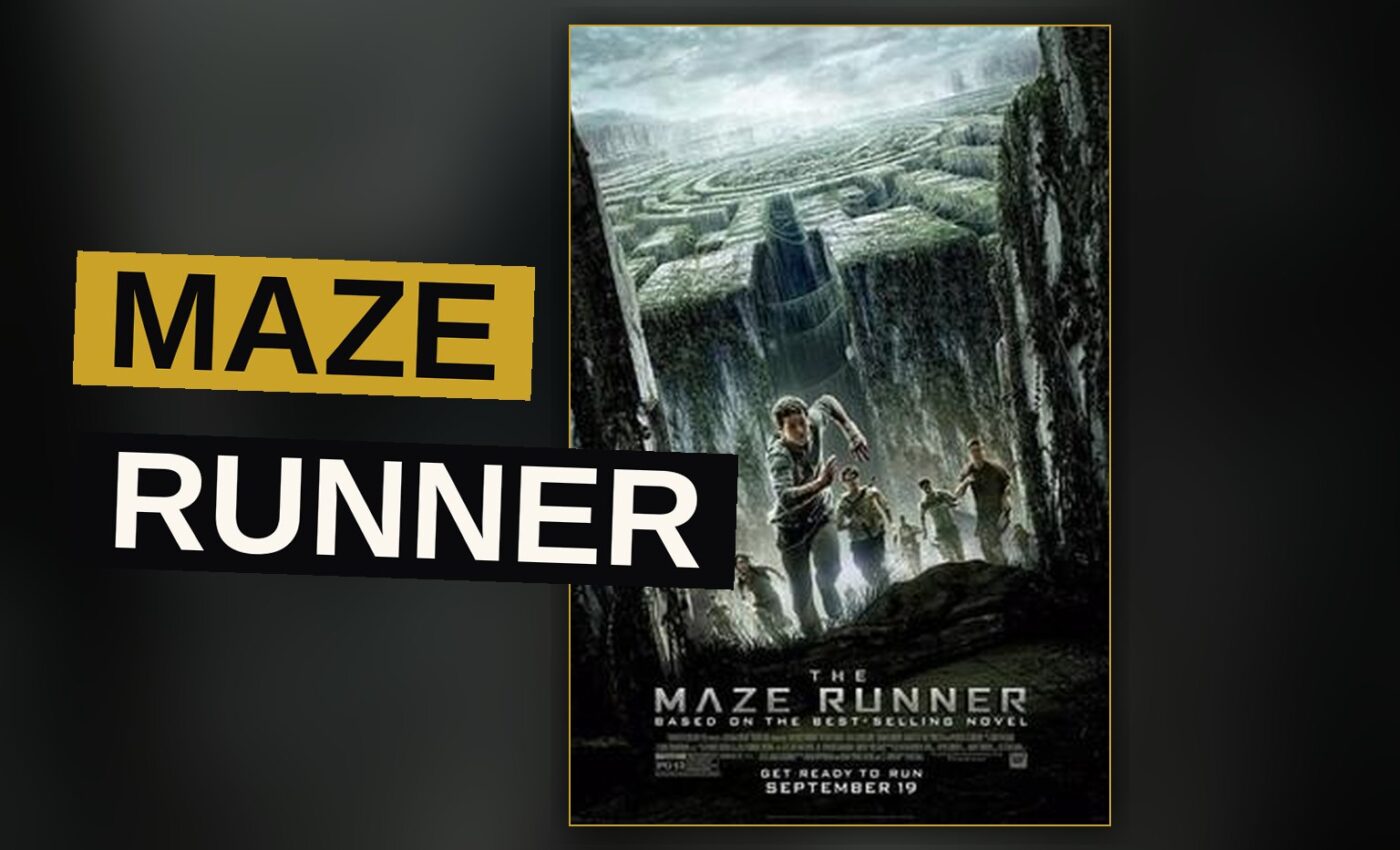
Wes Ball’s The Maze Runner drops a teenage boy into a grassy clearing with no memory and no way out, and then asks him — and us — to run.
The 2014 American dystopian science fiction film is the first installment in The Maze Runner film series, based on James Dashner’s 2009 novel. It was directed by Wes Ball, in his feature directorial debut, and written by Noah Oppenheim, Grant Pierce Myers and T. S. Nowlin. It runs 113 minutes and carries a tagline that tells you everything about its ambitions: “Get ready to run.” Dylan O’Brien plays Thomas, the newest arrival in a walled enclosure called the Glade, where a society of boys has organized itself while searching for an exit from a massive, ever-changing maze.
The Maze Runner is a lean, competent piece of dystopian science fiction that never quite becomes the movie its best ideas promise. It holds a 57/100 on Metacritic — 5.7/10.
Trailer, via 20th Century Studios.
The Glade and Its Rules
The premise is the film’s strongest asset. Thomas wakes in an underground elevator with no memory of his identity, and a crowd of boys greets him in the Glade, a grassy area ringed by massive stone walls. The Gladers have formed a rudimentary society, each taking on specialized roles.
A vast maze encircles the Glade and is their only means of escape. During the day, designated Runners search the maze for an exit and return before its gate closes at sunset. After a fight with Gally, played by Will Poulter, Thomas remembers his name.
That structure gives The Maze Runner a clock. Every day has a deadline. Every sunset is a threat. It is a clean mechanic, and Ball uses it.
Grievers, Runners, and the Cost of a Sting
The maze is not empty. Grievers — biomechanical, spider-like creatures — roam it at night. A sting from one leaves a Runner delirious, and there is no cure.
Thomas is attacked by Ben, a Runner who was stung. The Gladers force Ben into the maze and leave him to die. It is a brutal scene, and the film does not flinch from it.
The next morning, Alby, the Glade’s leader, and Minho, the lead Runner, retrace Ben’s steps inside the maze. As the sun sets, Minho reappears near the gate, dragging a badly injured Alby who has been stung. Unable to reach the Glade in time, Thomas runs into the maze to help, leaving all three trapped.
Thomas is chased by a Griever but manages to lure it into a closing passageway, crushing it. The three survive the night and return the next morning.
That sequence is the film’s best. It is the moment The Maze Runner stops being a premise and becomes a story.
Teresa Arrives, and Gally Wants a Punishment
A girl arrives in the elevator with two syringes of Griever anti-venom and a note saying she is the last to enter the Glade. She is Teresa Agnes, played by Kaya Scodelario. She recognizes Thomas, but he does not remember her.
Gally accuses Thomas of disrupting the peace between the Gladers and the Grievers and insists he be punished. Newt, Alby’s second-in-command and played by Thomas Brodie-Sangster, designates Thomas as a Runner and punishes him with one day in the Pit.
Thomas, Minho, Frypan, Winston and Zart enter the maze to locate the Griever’s corpse and retrieve a mechanical device inside it.
The cast around O’Brien does solid work. Ki Hong Lee’s Minho carries the Runner’s weariness. Aml Ameen’s Alby holds authority until he cannot. Blake Cooper’s Chuck is the film’s emotional center, and Cooper got the part in an unusual way.
How Ball Found His Thomas
Ball’s casting process produced the film’s most interesting production story. For Teresa, Scodelario was Ball’s first choice. He called her “fantastic” and said he loved her in the TV show Skins.
O’Brien was a different matter. Ball initially rejected him, and he later said the miss taught him something. Ball has described overlooking the actor early on, and said the reason was O’Brien’s hair — the look he had from Teen Wolf. Ball could not see past it.
Ball has also said the role is hard to cast because Thomas enters the story as a boy and leaves it as a man. The part cannot go to a badass action star, in his account. It needs vulnerability first, then growth, and the later films need a leader to emerge from the group.
Fox then pointed Ball toward O’Brien’s work in The Internship. Ball watched the tape, realized he had seen the actor before, and looked him up online. He found one picture of O’Brien with a totally shaved head — “this sweet vulnerable-looking kid.”
Ball went back through his old audition tapes. There was Dylan. The same actor he had said “No, definitely not him” about. They brought him back in, and Ball’s verdict changed completely: “he’s the coolest dude ever.”
It is a good story, and it explains something real about the performance. O’Brien’s Thomas works because he reads as vulnerable first. The film needs that. Thomas is not a chosen one who arrives fully formed. He is a kid who runs into a maze because someone is going to die if he does not.
Cooper entered the film via Twitter. Ball revealed a lot on Twitter, and many kids wanted to be Chuck. Cooper constantly bugged Ball, until Ball told him to give his tape to his casting director, and Ball was impressed by Cooper’s tape and cast him.
Where The Maze Runner Loses Its Way
Development began in January 2011, when Fox purchased the film rights to Dashner’s novel with Gotham Group and Temple Hill Entertainment as producers. Catherine Hardwicke was intended to direct. In 2012, Ball was hired after presenting an animated short film titled Ruin with a similar tone.
Principal photography began in Baton Rouge, Louisiana on May 13, 2013, and concluded on July 12, 2013. The Maze Runner was released on September 19, 2014, in the United States by 20th Century Fox.
That is a fast turnaround for a film with this much world-building, and it shows. The Glade’s society is sketched rather than built. The boys have roles, but the film rarely slows down to show how those roles actually function. The maze is the star, and the maze is a set.
The film’s biggest missed opportunity is Teresa. She arrives with anti-venom, a note, and a recognition Thomas cannot return. That is a loaded introduction. The Maze Runner does not do enough with it. Scodelario is given little to play beyond mystery, and the film treats her arrival as a plot turn rather than a character.
What The Maze Runner Gets Right
The film received positive reviews, with praise for Ball’s direction, the performances and the film’s tone.
At 113 minutes, The Maze Runner does not overstay. It sets up its world, runs its clock, and gets out. That discipline is rarer than it should be in dystopian science fiction aimed at young audiences.
The action is legible. When Thomas runs into the maze, you can follow him. When the Griever chases him, you can see the trap closing. Ball stages the sequence with a clear sense of space, which matters more than spectacle in a film like this.
What Matters Most in The Maze Runner
Here is where the film’s elements land for this paper:
- The maze itself — a hostile, well-designed space that gives the film its engine.
- Dylan O’Brien as Thomas — a vulnerable lead who earns the film’s final act.
- The night in the maze — the sequence where the premise becomes a story.
- The supporting cast — Minho, Newt, Alby and Chuck all register.
- Teresa — a promising introduction the film does not develop.
- The Glade’s society — sketched, not built, and the film’s biggest structural weakness.
The Maze Runner is a good start that never becomes a great film. It is the first installment in a series, and it plays like one. It builds a world and establishes a threat. Whether it withholds answers or saves them for later films is a question the source material does not settle, and this piece will not pretend otherwise.
That is not a failure. It is a choice, and it is a choice that mostly works. The film’s 57/100 reflects a movie that is better than its premise and thinner than its ambitions.
What matters most here is the maze. The Glade is where the boys live, but the maze is where the film lives. Every time The Maze Runner leaves the stone walls, it loses momentum. Every time it goes back in, it finds it again. The film knows this, and to its credit, it keeps running.
The Maze Runner is worth watching for Ball’s direction and O’Brien’s performance. It is not worth watching for the society it builds or the questions it raises. Those are promises the film makes and does not keep.
Get the Notebook.
The day's best stories and every fresh verdict, in plain English, in your inbox by seven. One email a day, no more.


