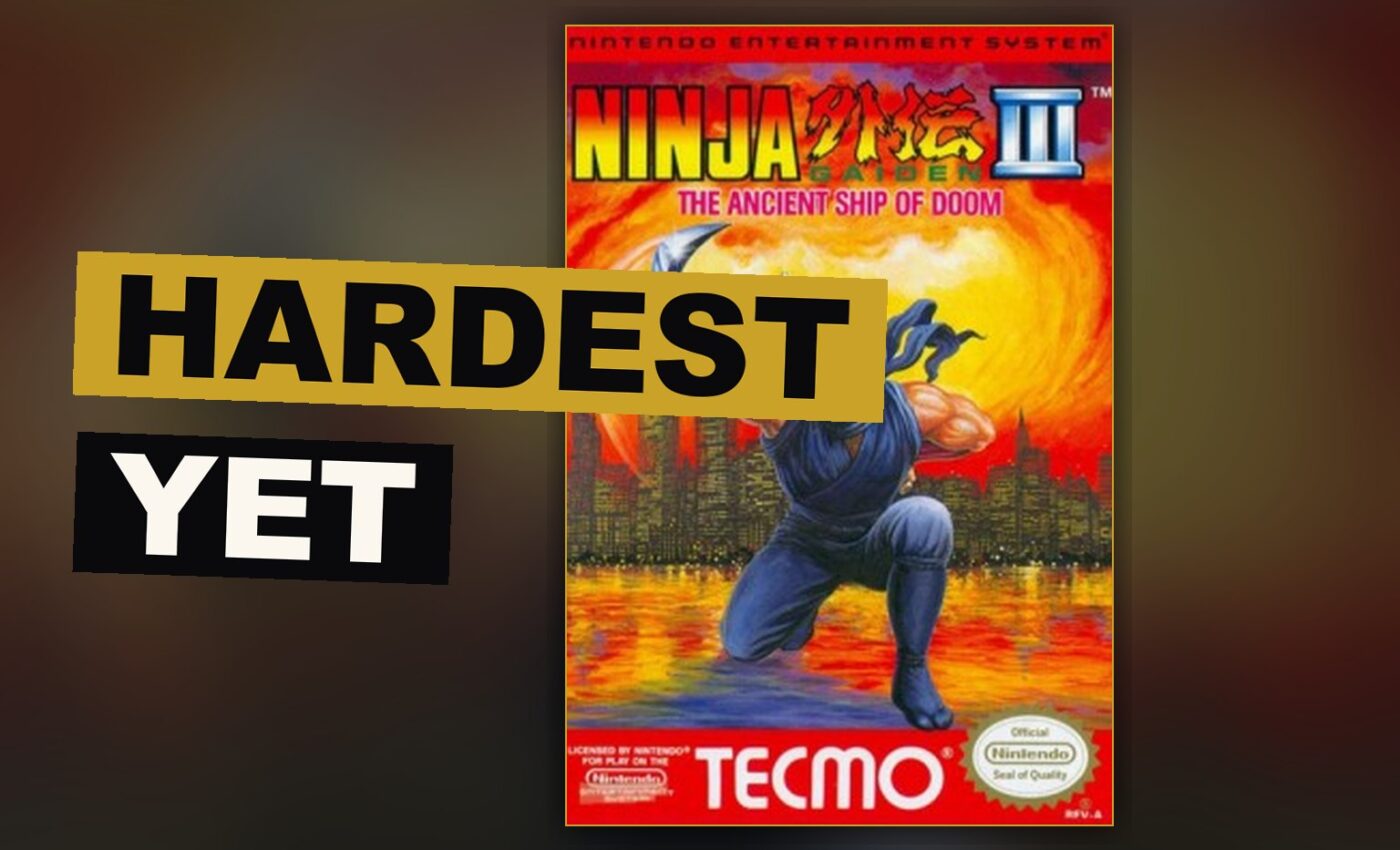
Ninja Gaiden III: The Ancient Ship of Doom arrived on the Nintendo Entertainment System in 1991 with a problem the first two games never had to solve. The trilogy’s original designer, Hideo Yoshizawa, had moved on. Masato Kato took over. What Kato built is a leaner, stranger, harder game than its predecessors — one that trades some of the series’ breakneck momentum for a story that actually tries something.
It mostly works. It also stumbles in ways that are hard to forgive.
Masato Kato Takes the Lead
Kato inherits a series built on speed. The first two Ninja Gaiden games asked players to move fast, die often, and memorize. Ninja Gaiden III keeps the skeleton — Ryu Hayabusa runs, jumps, climbs walls, springs off them — and adds a new trick: the ability to hang overhead from pipes and ivy. Ryu can swing up on top of them or drop from them. He can attack while hanging, but only with secondary weapons.
That restriction matters. The game wants you to think about positioning, not just reaction time.
The sword power-ups are new too. Ryu still fights with his Dragon Sword, and secondary weapons still drain his ninja power. Recovery Medicine bottles sit inside crystal balls that Ryu must slash open. The life meter sits at the top of the screen and drops when Ryu takes a hit.
The Ancient Ship of Doom’s Chronology Problem
Here is where Ninja Gaiden III gets genuinely interesting, and genuinely messy. The game is the third installment by release order, but it is set between Ninja Gaiden and Ninja Gaiden II: The Dark Sword of Chaos. The Japanese version places it there. The ending screen briefly acknowledges this.
The American box art and in-game dialogue tell a different story — suggesting the game takes place years after the first. The Dark Sword of Chaos supposedly takes place one year after the first game. So the American packaging muddles a timeline the Japanese version keeps clean.
That is not a small thing. It makes a trilogy feel like a collection of loosely related products rather than a story.
Irene Lew, Foster, and the Interdimensional Rift
The plot is the most ambitious in the NES trilogy. CIA agent Irene Lew is chased to a cliff edge by a man who looks like Ryu Hayabusa. She falls to her apparent death. Ryu investigates the laboratory where she was killed to clear his name.
A mysterious man tells Ryu to go to the Castle Rock fortress. On the way, Ryu encounters A. Foster via a video image. Foster claims to be unaware of Irene’s whereabouts. The look-alike who killed Irene appears and flees, saying Foster has ordered him not to eliminate Ryu quite yet.
The stranger from the laboratory reveals his name as Clancy. He says he and Foster were working together until Foster began to design creatures called “bio-noids” — transformed superhumans infused with “life energy” from an interdimensional rift that appeared after the demon from Ninja Gaiden was defeated. Clancy pleads with Ryu to stop Foster.
Foster reveals his plan to kill Ryu and make a powerful bio-noid from his corpse. Irene appears, to the surprise of both Ryu and Foster. Ryu’s look-alike transmutes into a bio-noid, which Ryu defeats. A door to the interdimensional rift opens. Clancy appears and tells Ryu, Irene, and Foster that they were all used as pawns in his plan to take over the ruins and claim the life energy as his. Foster tries to follow Clancy through the door, but the energy destroys him utterly.
Five Continues and a Wall of Difficulty
The most consequential change in Ninja Gaiden III is not a mechanic. It is a punishment. In the US version, players get five continues total before being required to restart the game from the beginning.
That single decision reshapes the entire experience. Ninja Gaiden games are hard. They are meant to be hard. But a continue limit turns difficulty into a test of endurance rather than skill. A player who has mastered a section can still lose everything to a bad run three acts later.
The game ends when players lose all their lives. They can continue and resume at the beginning of the Act where they lost all their lives — until those five continues are gone.
What Ninja Gaiden III Gets Right
The hanging mechanic from pipes and ivy is a real addition. It changes how levels read. Ryu’s ability to attack from a hanging position with secondary weapons only forces players to plan their ninja power carefully.
The story, for a 1991 NES platformer, is unusually dense. Kato’s script tries to give the action a reason to exist beyond “save mankind.”
The game looks and moves like a Ninja Gaiden game should. The Cinema Screen Animation that unfolds story beats level by level is still here. Ryu’s fighting skills have improved, as the marketing promised, and the new powers show it.
The series’ moving parts, at a glance:
- Ryu’s Dragon Sword, plus secondary weapons that consume ninja power
- Windmill Throwing Stars that move back and forth like boomerangs
- The Fire Dragon
- Recovery Medicine bottles inside crystal balls
Where the Game Falters
The chronology confusion is a genuine flaw, not a footnote. A trilogy that cannot agree on its own timeline undercuts the emotional weight of its story. The box art’s suggestion that the game takes place years after the first makes Irene’s death and Ryu’s framing land differently than intended.
The continue limit is worse. It is not difficulty design. It is a wall. It punishes players who have already proven they can handle the game.
And the plot, while ambitious, sometimes buckles under its own weight. Clancy’s reveal as the true manipulator is a solid twist. But the bio-noid concept, the life energy, the rift — these ideas pile up faster than the game can develop them.
Ninja Gaiden III: The Ancient Ship of Doom is the weakest of the NES trilogy, but it is not a failure. It is a game with a real vision, undercut by a port decision that never should have shipped. Kato’s story tries something the series had not attempted before. The hanging mechanic adds a layer the first two games lacked. And the five-continue limit remains one of the most baffling choices in the NES catalog.
This is a game worth playing. It is also a game worth playing the Japanese version of, if you can.
Get the Notebook.
The day's best stories and every fresh verdict, in plain English, in your inbox by seven. One email a day, no more.