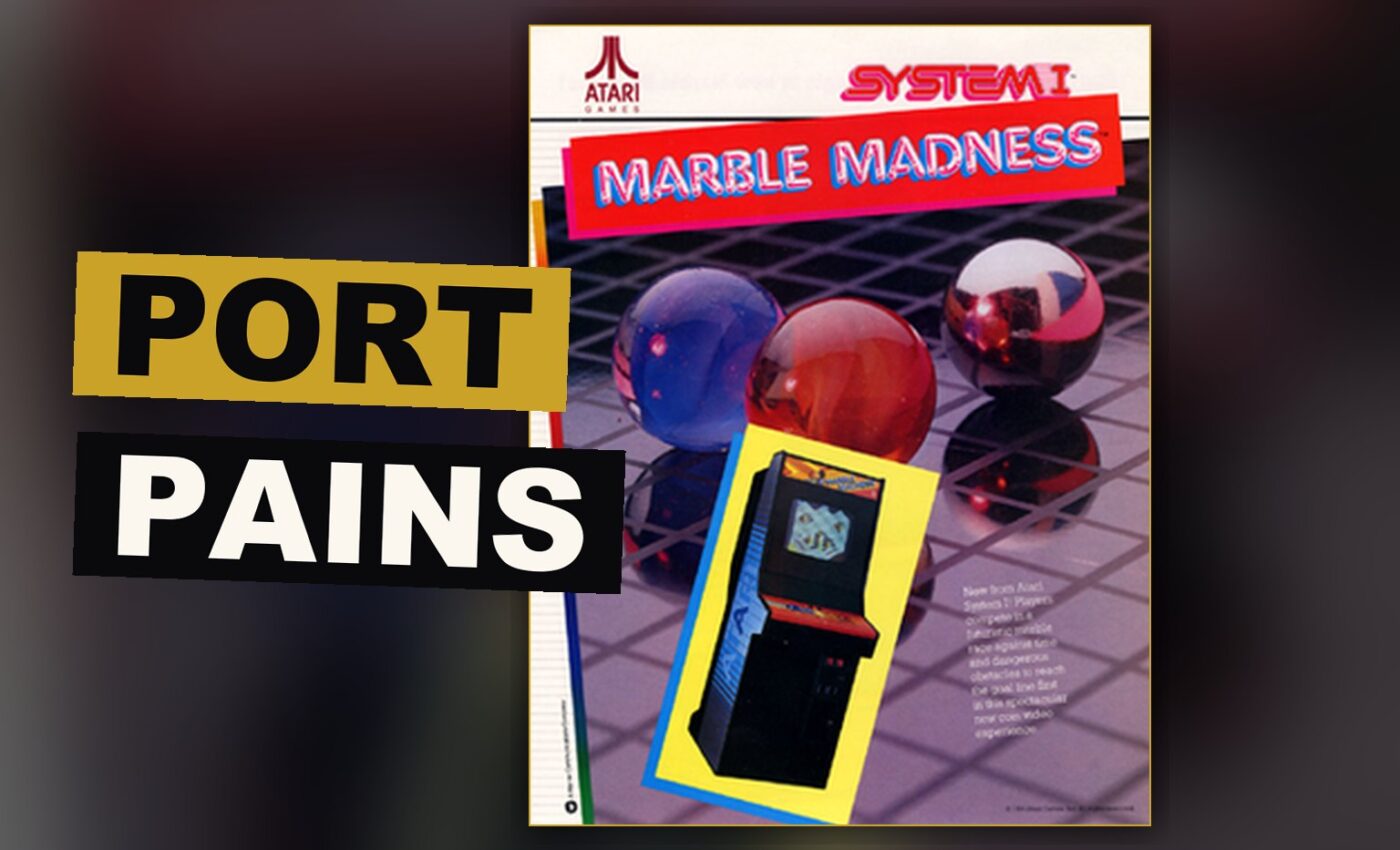
Marble Madness was designed by Mark Cerny for Atari Games in 1984, and its idea is as clean as any in arcade history: guide a marble through six isometric courses full of obstacles and enemies before the clock runs out. In the arcade you did that with a trackball, and the trackball was the game. The home versions, including the NES cartridge, kept the courses and handed you a directional pad instead. That trade is the whole review.
The Courses
Cerny drew on miniature golf, racing games and the art of M. C. Escher, and the courses show all three. They tilt and fold in ways that make the isometric view a puzzle in itself, because the direction the marble needs to go is not always the direction your eye reads. Tight corridors, sudden drops and enemies that shove you off the edge fill six short, sharp levels. A minimalist approach to the look keeps the geometry readable, and readable geometry is what the game needs.
The Race
You race the clock, and in the two-player mode you race each other to the finish. The two-player race is the version worth playing at home. It turns a solitary test of nerve into a scramble, and the marbles can knock each other off course, which is the best thing in the game.
The Technology
In the arcade Marble Madness was a landmark: Atari’s first game on the System 1 hardware, its first programmed in C, and one of the first with true stereo sound. None of that survives the trip to the NES, and it should not be held against the cartridge. What matters is whether the design survives.
The Control Problem
It survives partially. The trackball gave the arcade version a physical relationship between your hand and the marble’s momentum. The NES directional pad gives you eight directions and no feel for speed, and the isometric layout means that pressing right sends the marble diagonally on screen, which takes real adjustment. Once adjusted, the game is playable and often fun. It is never what it was in the cabinet.
Where It Falls Short
Six courses are short even by 1980s standards, and the time limits are stingy enough that most players see the last two only after long practice. The difficulty curve is a wall in the back half. And without the trackball, the precision the later courses demand is more frustration than skill.
The Verdict
Marble Madness is a great arcade game and a decent NES port. The idea is intact, the courses are intact, and the thing that made it feel special is not. That is a fair description of most arcade conversions of its era, and this one is better than most.
Get the Notebook.
The day's best stories and every fresh verdict, in plain English, in your inbox by seven. One email a day, no more.