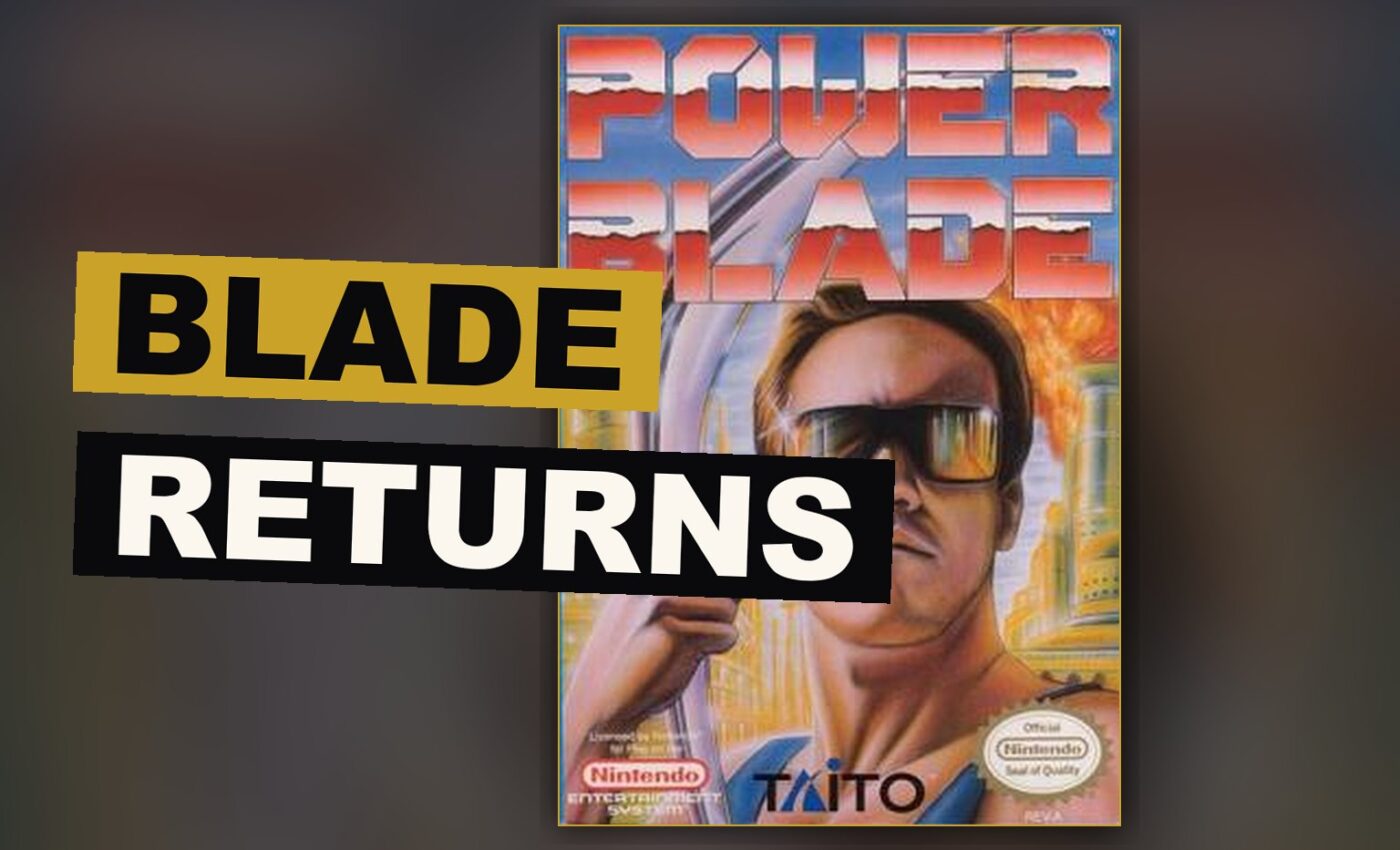
Power Blade puts players in charge of an agent fighting a dangerous computer that has taken over a city of the future, and gives them one main instrument to do it: a blade that flies out and returns to the thrower’s hand. The 1991 NES game asked a simple question: how far can one instrument carry a whole game built around it? The answer, after playing it again now, sits somewhere in the middle.
The Blade Carries the Game
Every part of Power Blade turns around its title instrument. The player throws a blade that flies out and comes back, and that blade can be made stronger with new types picked up from beaten enemies. The throw and return feel gives fighting in this game its own shape, set apart from the style of running and shooting common on NES at the time.
The upgrade system gives players a reason to look around. Secret items placed through each stage grant new blade types, extra health, or brief shields. Finding them means going back through parts of a stage already crossed, and this gives otherwise short stages some reason to be played again.
Stage Design That Goes Up and Down
Power Blade’s eight stages differ a great deal in quality. Some stages build clever running and timing challenges around the blade’s arc and how fast it returns, forcing players to time their throws while getting past enemy shots. Others feel like filler, long parts of empty ground and the same few enemies placed again and again, doing little to test the ideas the game built its whole design around.
Boss fights come off better than most regular stages. Each stage ends with an enemy that fights in its own way, one that asks players to use the items they have picked up with some thought, rather than just pressing the throw button over and over.
“The blade is the whole game, and when the stage design respects that, Power Blade is at its best.”
In looks, Power Blade holds up as a good NES game, though not one of the best of its year. Sprites are neat, the scenery changes across its city of the future setting, and the throwing motion reads clearly even when the action moves fast. The music rests on driving synth tunes that suit the game’s setting, and the songs don’t go on any longer than they need to.
None of it reaches the high points that some other NES games of the time hit, but nothing here feels cheap either.
What Holds It Back
The level of challenge is not steady from stage to stage. Early stages can rise in difficulty before later ones ease off, which makes the game feel less well matched than it could, rather than building step by step. Where checkpoints are placed makes this worse: dying late in a stage often means playing through long parts again that offer little new to learn.
Enemy variety is another weak spot. Many enemies are simply the same sprite with a new color standing in for something new, especially in the stages in the middle of the game.
How Power Blade Measures Up
| Part of the game | Strength | Weakness |
|---|---|---|
| Main instrument (returning blade) | Distinct throw and return feel | Limited use outside fighting |
| Stage design | Strong boss fights | Stage pacing that is not steady |
| Look | Neat sprite work, different scenery | Rarely excellent |
| Challenge | Rewards searching for upgrades | Level of challenge not steady, harsh checkpoints |
This table shows the game’s main draw in one direction and its weight in the other: a strong idea, built in an irregular way across the time it takes to finish.
Power Blade never fully works out the problem its own idea creates. The returning blade is clever enough to carry a few stages that stick in the mind, and the upgrade system gives looking around a point. Filler stages, repeated enemies, and a level of challenge that rises and falls keep the game from standing with the NES titles most players still speak of today.
Years later, what a new player takes from Power Blade is not the story of a city under threat, but the small pleasure of a single throw finding its way back to the hand that sent it.
Power Blade earns a 6.2 of 10.