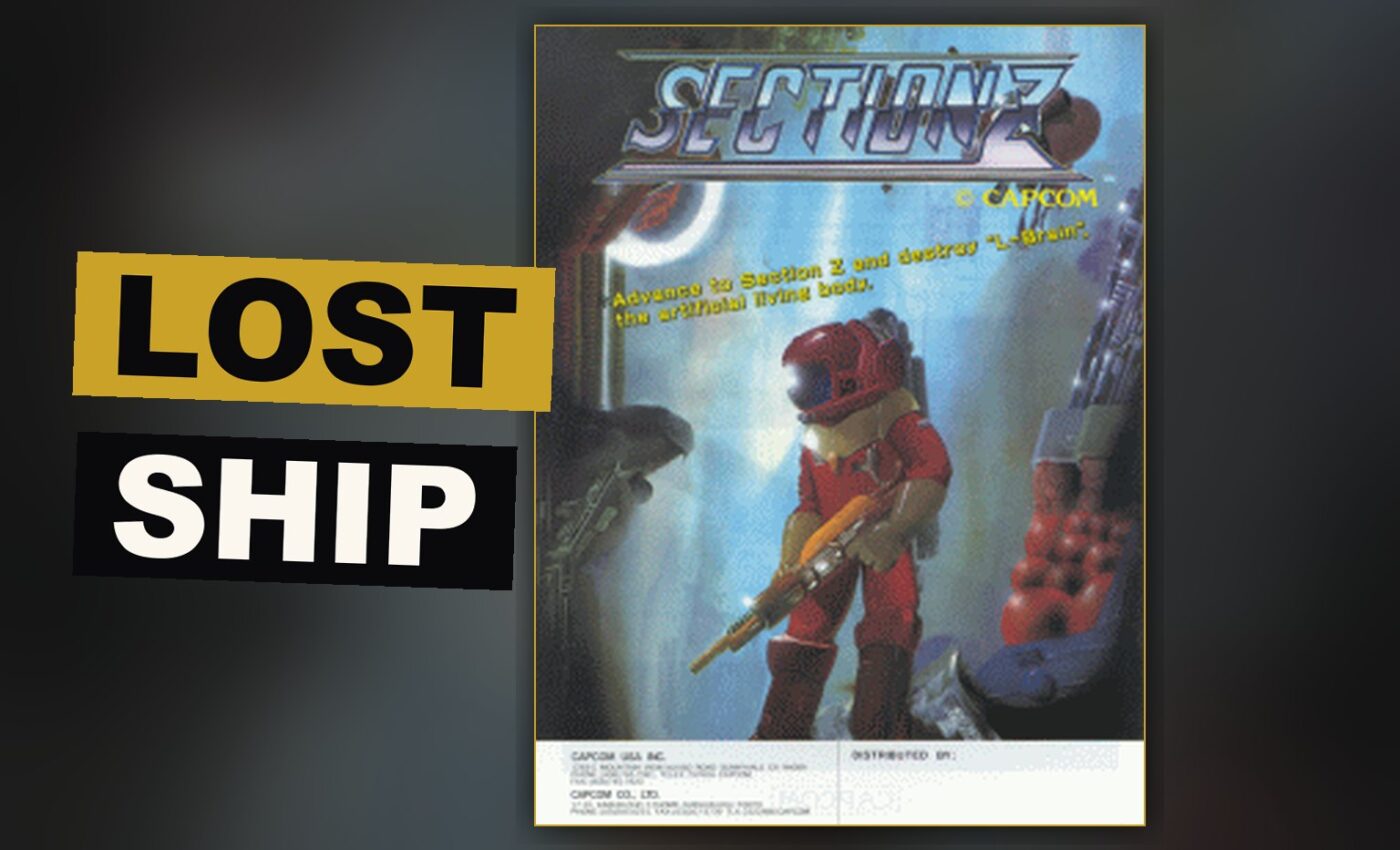
Capcom’s Section Z hit arcades in 1985 and reached the Nintendo Entertainment System in 1987. The arcade game sends a lone astronaut through a space station carved into 26 corridors, with a final fight waiting at the end of the alphabet. It is a shooter built on a clean idea: the map is the level, and the letters are the map.
The Balangool Station and Section A
The setup is spare, even for 1985. The game is set in an unspecified year during the third millennium. The player is an astronaut sent to infiltrate and destroy a space station orbiting near Earth.
The station is not what it appears to be. It is the secret base of an alien empire called the Balangool. That is the whole story.
Section Z does not pretend otherwise. There are no cutscenes, no dialogue, no named hero. The astronaut is a sprite with a rifle, and the Balangool are whatever the station throws at him.
26 Corridors, Five Stages, One L Brain
The structure is the most interesting thing about Section Z. The player moves through the enemy space station, which consists of 26 alphabetically ordered corridors called “sections.” The run starts at Section A and ends at the titular Section Z.
The game is divided into five stages. Each stage contains five sections, except the final stage, which has six sections to accommodate the spare letter. At the end of each stage, the player fights an enemy boss. The last of these is the “L Brain” at Section Z.
The stages alternate between horizontal-scrolling and upwards vertical-scrolling. One stretch pushes left or right; the next pushes up. That alternation does more for the game than any single enemy type. It forces the player to re-read the screen every few minutes, and it keeps the station from feeling like one long hallway with different wallpaper.
A Rifle, Two Buttons, and a Directional Aim
The controls are where Section Z separates itself from the shooters around it. The cabinet uses an eight-way joystick and two buttons. One button fires. The other changes the character’s aim to the left or the right.
That second button is the whole game. It lets the player shoot in one direction while moving away toward the opposite. You can retreat left while firing right, or push forward while covering your back.
Most shooters of the era asked you to point your ship where you wanted to go. Section Z asks you to point your gun somewhere else.
The player fires a rifle to the left or right with the fire button, and drops bombs at the same time to the ground. The bombs are not a separate input. They come out with the shot.
S, P, and B in the Dome Containers
Destroying certain dome-shaped containers yields one of three power-up items, each represented by a letter. S increases the player’s mobility speed. P increases firing power. Both can be improved for up to three increments.
The B item simply gives bonus points. It is the odd one out. In a game where survival depends on stacking S and P, a pickup that pays out in score instead of capability is a small insult, and this paper would rather have the third slot do something.
The power-ups are lost whenever the player loses a life. That rule is the source of the game’s real tension. A death does not just cost a life; it strips the speed and firepower the player has spent the stage building. The penalty compounds.
Lives, Continues, and the Score Threshold
The life system is conventional. The player loses a life every time they get hit by enemy fire. Additional lives can be obtained if the player achieves a high enough score. The game ends if the player loses all of their lives, though a chance to continue is provided.
The source does not say what a continue costs the player or what state it restores. It only says the chance is there. That is the honest reading, and it leaves the continue as the one part of Section Z’s design this paper cannot fully weigh.
| Element | Arcade (1985) | Home version (1987) |
|---|---|---|
| Developer | Capcom | Capcom |
| Publisher | Capcom | Capcom |
| Platform | Arcade | Nintendo Entertainment System |
| Structure | 26 sections, five stages | 26 sections, five stages |
| Final boss | L Brain at Section Z | L Brain at Section Z |
| Power-ups | S, P, B from dome containers | S, P, B from dome containers |
The Home Version and the Re-Releases
The home version landed in 1987, two years after the arcade original. The arcade game has since been re-released several times. It is included in Capcom Classics Collection Vol. 1 for PlayStation 2 and Xbox, in Capcom Classics Collection Remixed for PlayStation Portable, and in Capcom Arcade Cabinet for Xbox 360 and PlayStation 3.
Those collections are the practical way to reach the 1985 version now. The source does not rank them or say which port plays best, and it does not describe how the 1987 cartridge differs from the cabinet. What it does say is that the arcade original is the one preserved in all three collections.
What Section Z Gets Right, and What It Does Not
The directional aim is the best thing in Section Z, and it is not close. The two-button scheme turns every encounter into a small decision about which way to face and which way to move, and that decision repeats across 26 sections without wearing out. Few arcade shooters of 1985 gave the player that much control over the geometry of a fight.
The alphabet is the second-best thing. Labeling the corridors A through Z gives the player a sense of place. You are not on a numbered stage. You are in Section H, and Section Z is still out there. The map is a promise, and the game keeps it.
The Weaknesses and the Score
The weaknesses are real. Losing every power-up on death makes the back half of the game a grind for players who slip once, and the B item is dead weight in a system that only has room for two useful pickups.
None of that breaks the game. Section Z is a shooter with one strong mechanical idea and a structure clever enough to show it off. The Balangool station, the alternating scroll, the L Brain waiting at the end of the alphabet — it all fits together, and it fits together better than most of its contemporaries managed.
It is not a classic on the level of Capcom’s best arcade work. The published critical score for Section Z sits at 7/10, a user average from GameSpot, and that number is a fair landing spot for a game with a genuinely good idea and a handful of rough edges.
It is a good game with a great control scheme, and the control scheme is the reason to play it. Score: 7 of 10.
Get the Notebook.
The day's best stories and every fresh verdict, in plain English, in your inbox by seven. One email a day, no more.