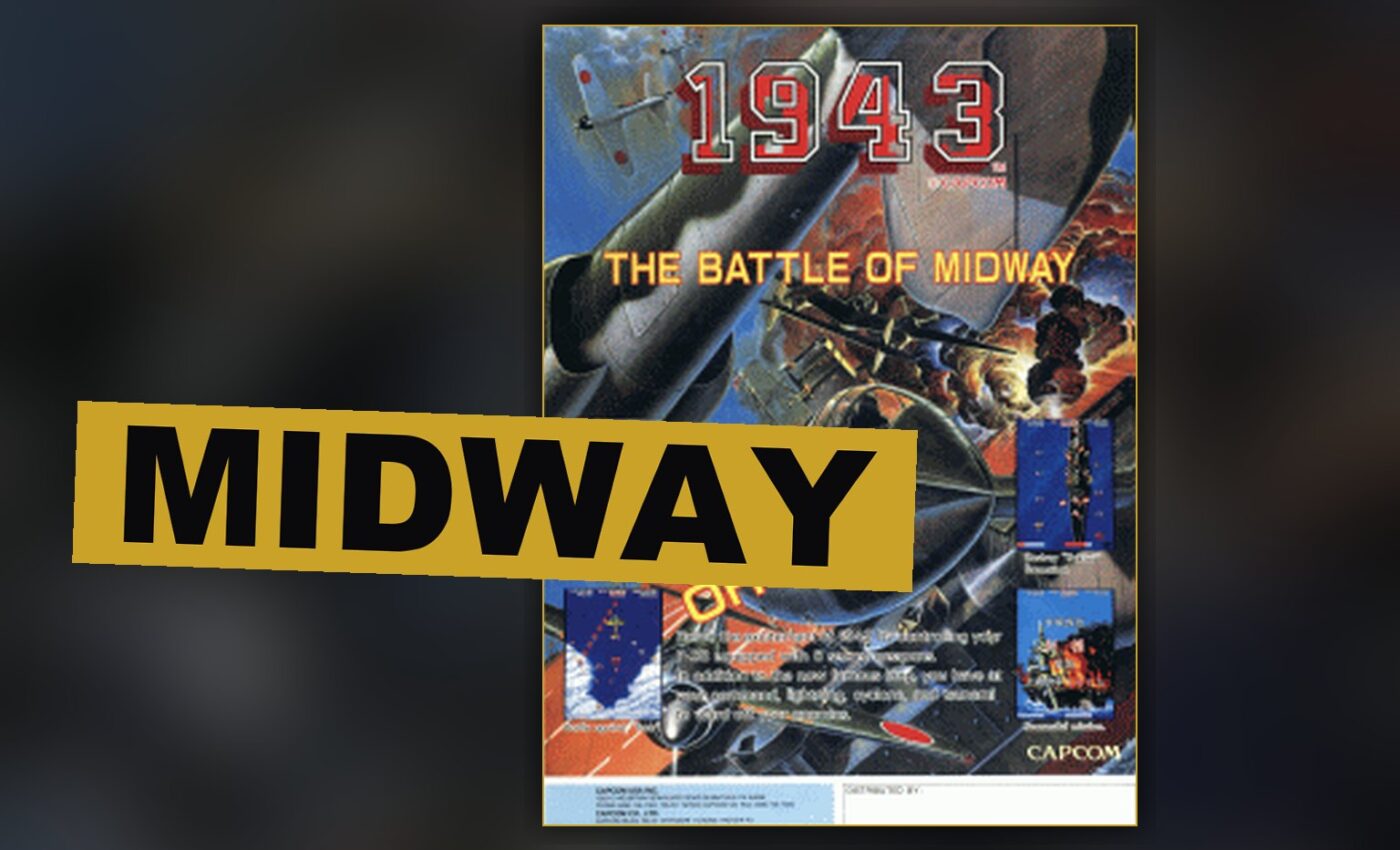
Capcom built its name on arcade shooters, and 1943: The Battle of Midway is one of the earliest places that name was tested. The game is a 1987 vertically scrolling shooter for arcades, developed and published by Capcom, and it also came to the Family Computer and the Nintendo Entertainment System. It is the first follow-up to 1942. Its published critical score is 6.7 out of 10.
The Header Says 1988, the Text Says 1987
The source material’s header lists 1943: The Battle of Midway as a 1988 title, while its own text calls the arcade game a 1987 release. This article uses 1987, the year the text supports, and flags the mismatch rather than pretending it is settled.
A Sequel Aimed at Western Arcades
The game is a direct continuation of 1942, and it keeps the same frame: the player flies an American plane against a Japanese air fleet. That choice was deliberate. Capcom designed the game with Western markets in mind, one of its first titles built that way.
The title points at the Battle of Midway, fought in June 1942. The game is set in the Pacific theater, off the coast of Midway Atoll, with the Imperial Japanese Armed Forces as the antagonists.
One Life, One Fuel Meter
The player is an unnamed U.S. Navy ace pilot. The goal is revenge: take down the Japanese naval aerial forces that attacked the American aircraft carrier, clear all Japanese air and sea forces, fly through 16 stages, and destroy the battleship Yamato, the final boss.
Those 16 stages split into two kinds. Eleven are air-to-sea battles, each ending with a battleship or an aircraft carrier as the stage boss. Five are all-aerial, against either a squadron of strategic bombers or a single heavy bomber. The heavy bomber has to be brought down by shooting its engines.
Players pilot a P-38 Lightning, same as in 1942. Button 1 fires the main weapons. Button 2 handles two special actions: one of three lightning attacks, paid for with fuel, or a loop maneuver if buttons 1 and 2 are pressed together.
The Fuel Meter Is the Whole Design
The biggest change from 1942 is the life system. Players get one life, shown as a large fuel meter that drains constantly. Powerups refill it.
In 2-player mode, overlapping the two planes lets fuel move from the player with more to the player with less. Destroying a full formation of red enemy planes drops a power-up, either a health boost or a new main weapon. Cheat codes differ by stage, from holding a fire button to pointing the joystick a certain way, and reward players with fully upgraded weapons.
What the Home Versions Carry Over
The Family Computer and Nintendo Entertainment System versions carry the same bird’s-eye view and the same single-player focus. The source lists both platforms together and gives no separate release date for either, so this article does not claim one.
The 16 stages are the game’s other structural fact. Eleven boss fights against ships and carriers repeat well before the Yamato shows up. The five aerial stages break the pattern, and the heavy bomber, with its engine targets, is the most distinct idea in the game.
Where the Design Actually Lands
Strip away the fuel meter and the boss list and one thing stands out: Capcom understood that a shooter needs a single idea the player thinks about between shots. 1943: The Battle of Midway has one. The mistake, in this paper’s view, is not the idea but the dosage. A meter that refills from powerups and drains on its own could have rewarded aggressive play. Instead it reads as a leash, and that is a judgment about the design, not a fact the source states.
The structure is stronger than the score suggests; the tuning is weaker. Both of those are this paper’s read, not claims from the source. What the record does support is narrower: 16 stages, 11 ship bosses, five aerial fights, one life, and a meter that never stops running. That meter is what a reader should watch, because it is the one design choice Capcom never repeated at this dosage.
By the Numbers
- Release year: 1987 (arcade), per the source text; the source header lists 1988
- Developer and publisher: Capcom
- Platforms: Family Computer, Nintendo Entertainment System
- Genre: Vertically scrolling shooter
- Stages: 16
- Final boss: Battleship Yamato
- Player aircraft: P-38 Lightning
- Published critical score: 6.7/10
Get the Notebook.
The day's best stories and every fresh verdict, in plain English, in your inbox by seven. One email a day, no more.