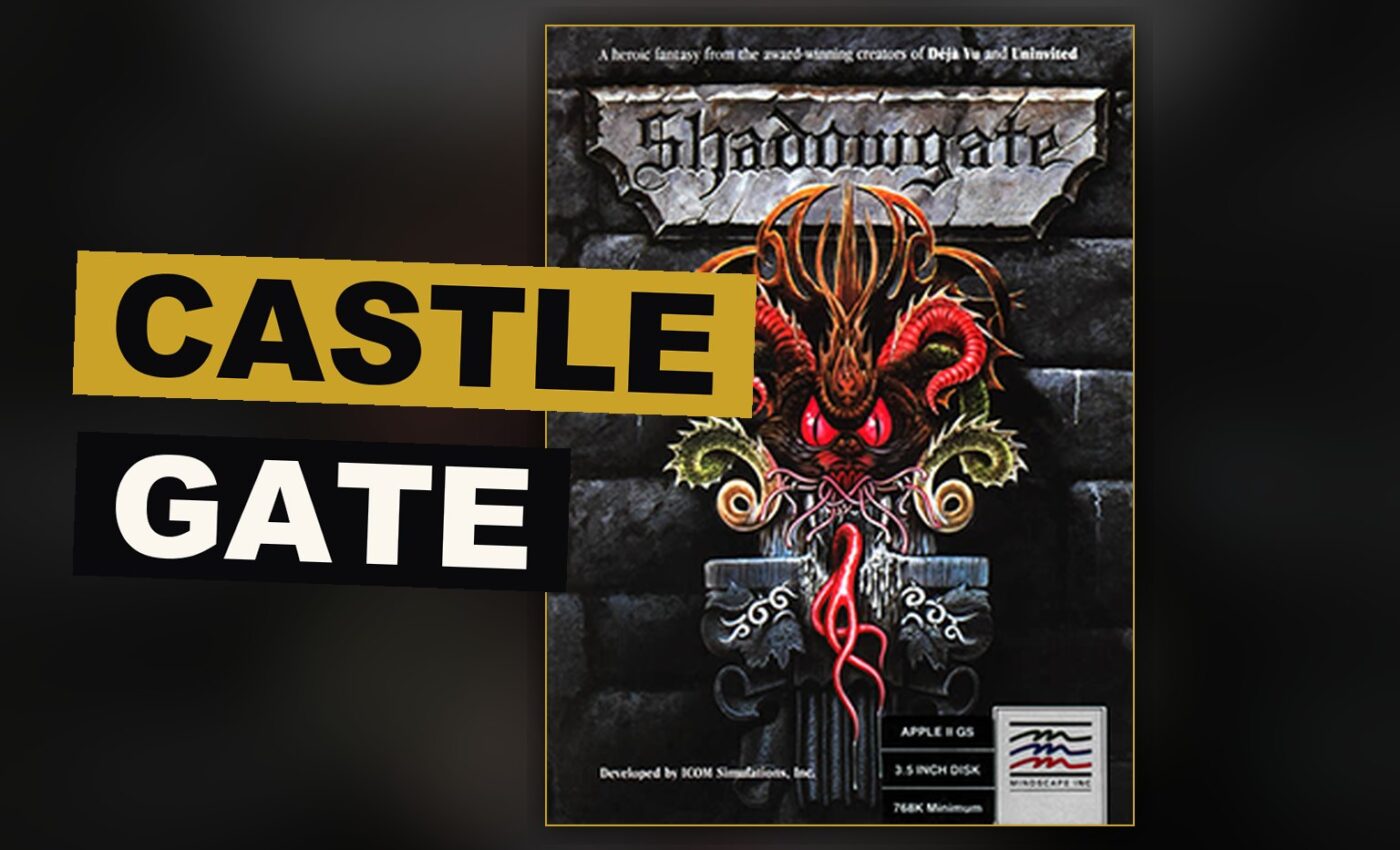
Shadowgate (2014) is a re-imagining of a 1987 Macintosh game. IMDb gives the 2014 release a 7.5 out of 10. The original came from ICOM Simulations and Mindscape, and it is the version most players remember.
Zojoi and Abstraction Games Built the 2014 Version
The 2014 Shadowgate was developed by Zojoi and Abstraction Games. It was published by Reverb Triple XP and Abstraction Games. It shipped on PlayStation 4, Linux, PC, iOS, Mac, Xbox One and Nintendo Switch.
The original Shadowgate arrived in 1987 for the Macintosh, developed by ICOM Simulations and published by Mindscape as part of the MacVenture series. That version was black-and-white. Color versions later reached the Amiga and Atari ST, and in 1989 the Nintendo Entertainment System got its own.
The 2014 game is a re-imagining of that 1987 original. The source describes it that way and stops there.
A Castle Built to Kill the Player
You are the last of a great line of hero-kings. The wizard Lakmir sent you to Castle Shadowgate to stop the Warlock Lord before he raises the Behemoth out of Hell and ends the world. The game drops you at the entry and lets you fend for yourself.
The castle is the antagonist. It is packed with traps, monsters and puzzles, and the game’s text describes your failures with a sardonic tone that reads less like a fantasy epic and more like a dungeon master who has watched too many players die in the same room. Virtually any action that is not the correct solution to a puzzle results in a fatality.
That is not a design flaw. It is the design.
Torches as a Countdown
The torch system is the smartest thing in Shadowgate. You must keep at least one lit torch in your possession at all times. If all your torches go out, you stumble, break your neck, and restart from a saved game — or from the area where you died, in the console versions.
Only a limited number of torches exist in the castle. That turns a resource into a countdown. You are not just solving puzzles. You are solving them fast enough.
The console versions let you continue from the area where you died rather than reloading a save. That is a real change to how the game plays, and it is the only death-handling difference the source records.
Dragon’s Breath and the Cyclops
The list of ways Shadowgate kills you is the game’s calling card. Dragon’s breath burns you. A cyclops attacks you. A broken mirror sucks you into outer space. Acidic slime dissolves you. Sharks eat you. A wolf-woman mauls you. The game even includes suicide as an outcome.
These deaths are described graphically in the game’s text, with frequent sardonic and humorous comments attached. The NES version kept that voice despite Nintendo’s policy of censorship at the time. The descriptions are part of the reward. You poke at the castle, you get a paragraph about how badly it went, and you learn something.
Shadowgate is a point-and-click adventure game in which the player must solve a series of puzzles throughout a castle to proceed to the Warlock Lord’s chamber.
Trial, Error, and the Save Button
Shadowgate’s puzzles lean hard on trial and error. The game expects you to save frequently to avoid losing progress, and that expectation is not a suggestion. It is the only way the difficulty stays bearable.
Hints exist, but they are buried. Books and descriptive text carry subtle clues about what matters in a room. The NES version swaps those for a hint feature that gives vague clues about what is noteworthy in any given room. Vague is the right word. The game wants you to work.
You also collect items along the way: a sword, a sling and other ancient weapons. Each one has a correct moment. The source says they can be used at the appropriate time to deliver a fatal blow to specific enemies.
Three Artifacts and the Staff of Ages
The plot runs on three sacred artifacts. Collect all three and they form the Staff of Ages, a holy weapon capable of stopping the Warlock Lord for good. That structure gives the castle a spine. You are not wandering. You are assembling the one thing that can end this.
The finale delivers. You reach the Warlock Lord’s chamber just as he opens the gates of Hell and summons the Behemoth. You assemble the Staff and mortally wound the Behemoth. As it dies, it drags the Warlock Lord into Hell with it.
You return victorious, betrothed to the King’s daughter and named High Lord of the Westland. It is a clean, earned ending, and it lands because the castle made you pay for every step of it.
The Hard Numbers
- Platforms: PlayStation 4, Linux, PC, iOS, Mac, Xbox One, Nintendo Switch
- 2014 release developer: Zojoi, Abstraction Games
- 2014 release publisher: Reverb Triple XP, Abstraction Games
- 2014 genres: Point-and-click, Puzzle, Role-playing (RPG), Adventure, Indie
- Original release: 1987, Macintosh, ICOM Simulations and Mindscape
- NES version: 1989
- Mode: Single player
- Perspective: First person
- Published critical score: 7.5/10 (IMDb)
What the 1987 Original Did Differently
The Macintosh original was black-and-white. Color versions arrived later for the Amiga and Atari ST, and the NES got its own in 1989. The source records the shift but does not say how the castle reads in color.
The hint feature is the one place the NES version clearly departs from the Mac original. Books and descriptive text carried the clues on Mac. On NES, a hint system hands you vague direction instead. The source notes the swap without judging it.
The source also notes that the NES version kept the graphic death text and the sardonic comments, despite Nintendo’s policy of censorship at the time. That is the version’s most surprising detail.
Where the Castle Wears You Down
The trial-and-error design is brutal in a way that modern players will feel immediately. Progress depends on guessing the right action for the right object in the right room, and the game punishes every wrong guess with a death. That loop is thrilling for a while. It wears thin when you are replaying the same corridor for the fifth time.
The torch limit compounds it. A time limit on top of a puzzle game that already demands patience is a lot to ask. The two systems fight each other. You want to experiment. The castle wants you to hurry.
The console versions’ death handling eases the cost of a wrong guess. Whether that makes the game better is a judgement the source does not make.
Why 7.5 Is the Right Score
The original Shadowgate earned its reputation as one of the most well-known and beloved adventure titles in gaming history. The atmosphere, the perilous locations, the puzzles and the sheer volume of gruesome deaths add up to something no other game quite matches. It is a castle that feels hostile in a way that is genuinely rare.
The 7.5 out of 10 is fair. Shadowgate is not a perfect game. The trial-and-error structure will frustrate anyone who expects a fair fight, and the torch system is a time limit dressed as a resource. But the game commits to its own rules without apology.
What matters most is the voice. The sardonic death text, the constant threat, the sense that the castle is mocking you — that is the thing worth preserving. The hint feature is a small betrayal of that spirit. The rest of the game holds the line.
Shadowgate is a hard, strange, funny game about dying in a castle. That is still enough.
Get the Notebook.
The day's best stories and every fresh verdict, in plain English, in your inbox by seven. One email a day, no more.