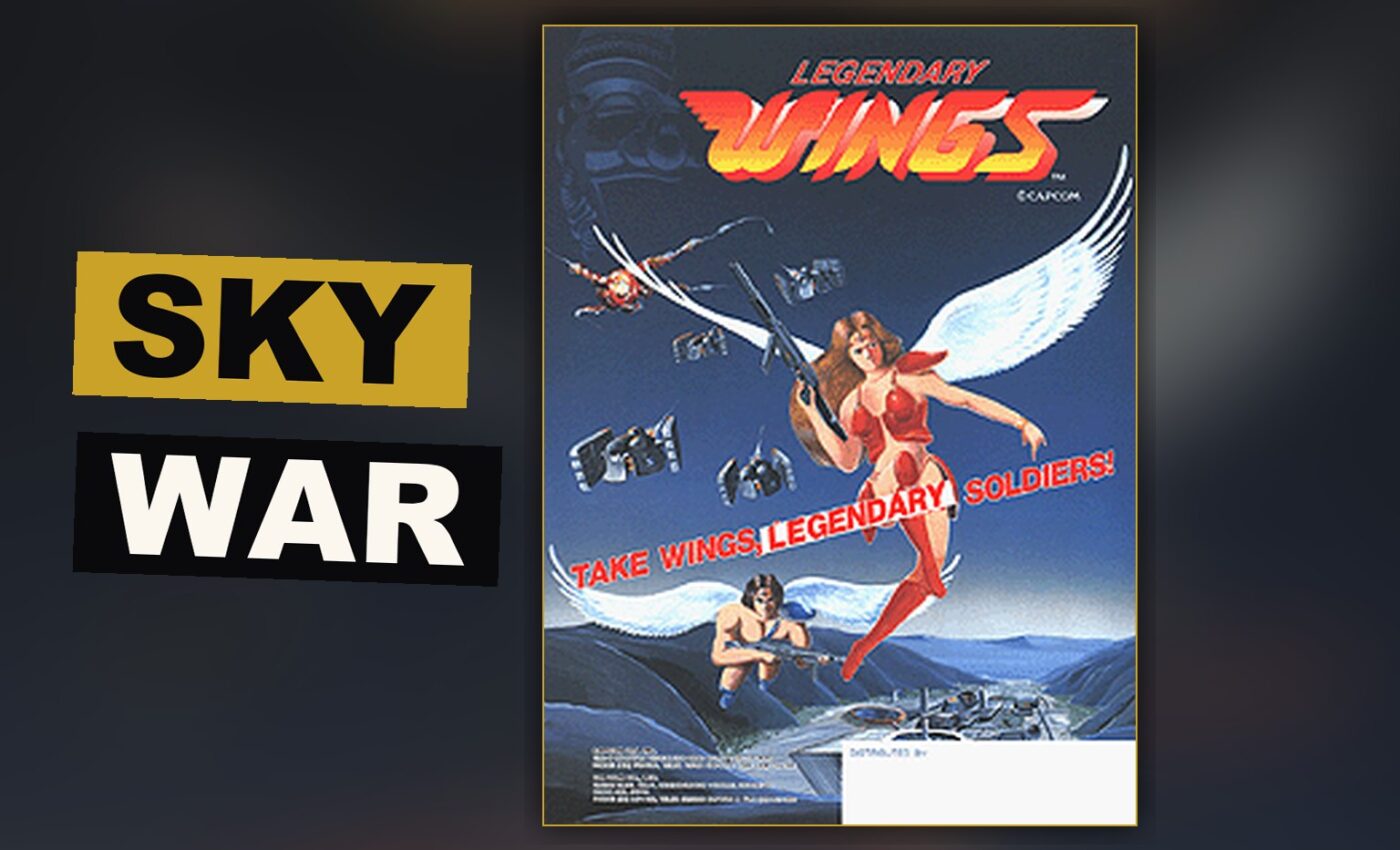
Legendary Wings gives you wings and then spends half its runtime taking them away. Capcom’s 1986 arcade shooter, released in Japan as Aresu no Tsubasa, arrived on the Nintendo Entertainment System in 1988 as a North American exclusive. It is two games in one, and only one of them is any good.
A Supercomputer Named Dark
The setup is pulp in the best sense. Twenty thousand years in the future, mankind builds a giant supercomputer called DARK to govern the planet. DARK rules with wisdom and justice for hundreds of years, then malfunctions. It builds a fleet of robot warships, raises an army of mutant monsters, and turns a peaceful civilization into a police state.
Two young warriors receive the Wings of Love and Courage from the God of War, Ares. Armed with the last guns and missiles from a crumbling arsenal, they fly across continents and oceans to find DARK’s hidden fortress. If they fail, mankind is lost.
That premise is the whole pitch, and it holds. It is Greek mythology bolted onto a machine rebellion, and it gives the shooting a reason to matter.
Flying, Then Walking
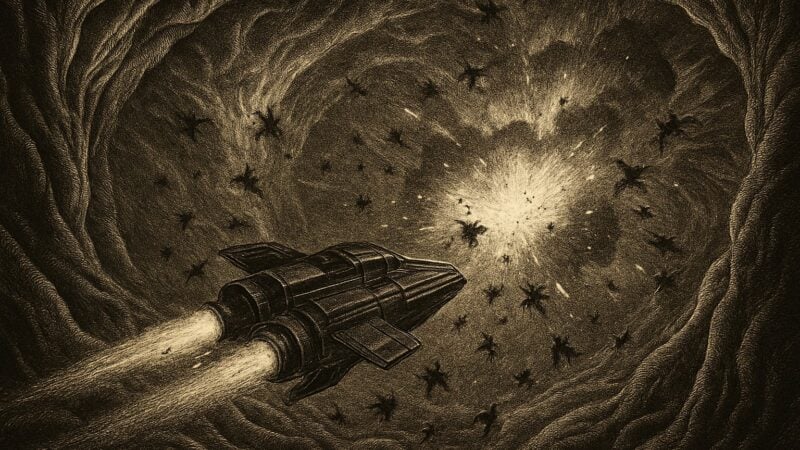
The game runs five areas, each split into two styles. The first segment scrolls vertically, top-down, as you fly and shoot airborne enemies while dropping bombs on ground targets. Reach the palace, beat the guardian, and the perspective flips to side-scrolling. Now you walk, crouch, climb ladders and jump toward the boss, and only then do the wings come back.
The player can improve their gun by destroying certain enemies or weapon capsules and picking up the “P” item stored inside.
That power-up ladder runs five levels deep. The first raises speed. The second swaps your gun for a twin shooter and raises speed again. The third unlocks continuous ground attacks. The fourth turns your gun into a three-way spread.
Two optional areas break up the flight: a “Danger” zone you must escape after a giant mechanical face inhales you, and a hidden “Lucky” area full of treasure chests that boost your score. The coin-op version supports two players at once, with a second player free to join mid-game or continue after a game over.
| Segment | Perspective | What you do |
|---|---|---|
| Sky | Top-view vertical scroll | Fly, shoot air enemies, bomb ground enemies |
| Palace | Side-scrolling | Walk, crouch, climb ladders, jump to the boss |
| Danger | Escape sequence | Flee the giant mechanical face |
| Lucky | Hidden | Open treasure chests for score |
The Walking Is the Problem
Here is the verdict: the flight sections are the game, and the ground sections are the tax you pay for them. A shooter built on speed and open sky does not improve when it forces you to crouch and climb ladders. The side-scrolling halves slow the pulse of a game whose entire appeal is momentum.
The power-up curve is the strongest argument for the design. Five tiers of improvement give the shooting a real arc, and losing ground when you die stings the way it should. The Danger and Lucky detours add variety without overstaying.
The NES port arrives two years after the arcade original, and it lands in North America alone. The coin-op version later resurfaced in Capcom Classics Collection for PlayStation 2 and Xbox, and in Capcom Classics Collection Remixed for PlayStation Portable. That is where the two-player mode lives best.
Legendary Wings is a sharp vertical shooter stapled to a mediocre platformer, and it never fully resolves the marriage. The premise, the power-ups and the flying carry it. The ladders do not.
Get the Notebook.
The day's best stories and every fresh verdict, in plain English, in your inbox by seven. One email a day, no more.