
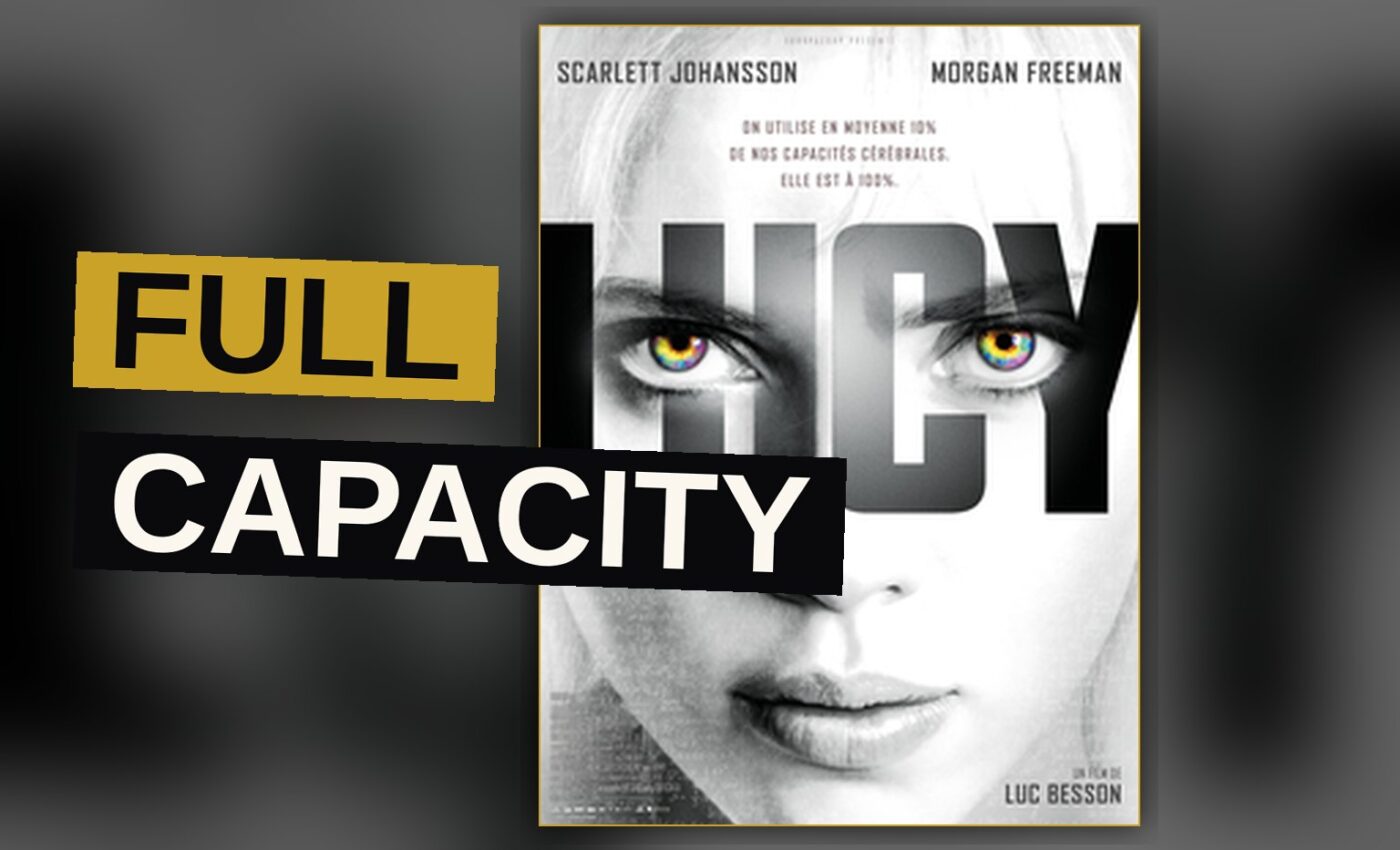
Luc Besson’s Lucy runs 89 minutes and moves like a film that knows it cannot afford to slow down. Scarlett Johansson plays Lucy, an American studying in Taipei who is forced into carrying a briefcase of the synthetic drug CPH4 for a South Korean drug lord named Mr. Jang. The bag is sewn into her abdomen. A kick to the belly breaks it. What follows is not a revenge story so much as a rapid ascent through every power a human being can be imagined to hold.
The tagline says the average person uses 10 percent of their brain capacity, and asks what Lucy could do with 100 percent. That line is the whole engine of the film, and it is also the thing that sinks it. Lucy is a blast for about an hour. Then it asks you to take the premise seriously, and the floor gives way.
Trailer, via Universal Pictures.
Scarlett Johansson and the briefcase in Taipei
The setup is lean. Lucy’s boyfriend Richard coerces her into delivering a briefcase containing four bags of CPH4 to Mr. Jang at the Regent Taipei. Richard is shot dead in front of her. She is captured, and one bag of the drug is sewn into her abdomen for transport to Europe.
The role called for an actress who could be believable as both extremely vulnerable and superpowered. Johansson has to play a woman who starts as one and becomes the other. She does. Her early scenes are all panic and pleading, and the turn is quick enough to feel like a switch being thrown.
Angelina Jolie is widely reported to have been originally cast and to have dropped out before filming. Besson has said she was not his first choice. That is a useful footnote, but it is not the interesting part. The interesting part is that Johansson plays the transformation with almost no dialogue once it starts. She goes still. She goes flat. It works.
The drug, the hospital, and what CPH4 does
The mechanics matter, so here they are. When the bag breaks, Lucy acquires enhanced physical and mental capabilities: telepathy, telekinesis, mental time travel, and negated emotions. She stops feeling pain. She kills her captors and escapes.
She goes to Tri-Service General Hospital to have the bag removed. The operating doctor tells her that natural CPH4 is produced in tiny quantities by pregnant women during their sixth week of pregnancy, to give fetuses the energy to develop. That is the film’s one attempt to ground the drug in something like biology.
It does not hold up. Many critics found the plot nonsensical for exactly this reason, and specifically for its focus on the ten-percent-of-the-brain myth and the abilities it produces. The question is whether that matters.
Morgan Freeman, Professor Norman, and the 24-hour clock
Morgan Freeman plays Professor Samuel Norman, a scientist at the University of Paris who studies human capabilities. Lucy contacts him because his research helps her understand what is happening to her. She demonstrates her abilities to an amazed Norman and tells him she will die in 24 hours.
When she asks what to do with her newfound knowledge, Norman tells her to pass it on. She agrees and flies to Paris to meet him. Producer Virginie Silla said that given Freeman’s experience playing characters of wisdom, it was obvious he was perfect for the role. He is. He is also doing the thing he always does, which is to sit in a chair and look impressed.
The 24-hour clock is the best decision in the script. It gives the back half a shape. Lucy is not trying to win. She is trying to finish before she runs out.
Choi Min-sik and the drug mules across Europe
Choi Min-sik plays Mr. Jang, and Besson has called him the best villain he has written since Gary Oldman’s Norman Stansfield. Besson said: “Whereas Lucy is the ultimate intelligence, Mr. Jang is the ultimate devil.” That is a clean description of the design. Jang is not a character. He is a counterweight.
Besson and his team had to go to Korea to meet Choi, talk with him, and discuss the story. Only at the very end did Choi say he was interested and wanted in. You can feel that deliberation in the performance. Jang is patient and unpleasant, and he does not need to shout.
Lucy returns to Jang’s hotel, kills his bodyguards, assaults him, and telepathically extracts the locations of the drug mules carrying the three other bags of CPH4. She then contacts Pierre Del Rio, a French police captain played by Amr Waked, to help her find them. Besson has said Del Rio represents the audience, that he is basically you and me. He is the only person in the film who reacts to Lucy the way a person would.
The champagne, the cells, and the Paris collapse
On the flight to Paris, Lucy has a sip of champagne. The drug interaction causes her cells to become unstable. That is the film’s second clock, and it is the one that turns the last act into a countdown.
The back half runs on a fixed order, and it is worth laying out plainly, because the film’s structure is more deliberate than its reputation suggests.
| Beat | Location | What happens |
|---|---|---|
| 1 | Taipei hotel | Lucy confronts Mr. Jang and extracts the mules’ locations |
| 2 | Taipei | Lucy contacts Professor Norman and demonstrates her abilities |
| 3 | Flight to Paris | Champagne triggers instability in her cells |
| 4 | Paris | Lucy and Del Rio hunt the three remaining drug mules |
| 5 | Paris | Lucy meets Norman and chooses what to do with what she knows |
That is a clean five-beat finish. The problem is not the shape. The problem is what fills it. The Paris stretch leans on montage and exposition more than the Taipei setup does, and the momentum the two clocks built starts to thin.
What Lucy gets right and what it wastes
Here is the ranking of what works, in order.
- Johansson’s performance, which carries the film through its weakest stretches without ever asking for sympathy.
- The 24-hour deadline and the cell-instability clock, which give the back half real forward motion.
- Besson’s visual sense, which the reviews singled out for praise alongside the film’s themes.
- Choi Min-sik’s Mr. Jang, a villain built to be a counterweight rather than a person.
- The CPH4 explanation, which is the film’s one attempt at grounding its premise and its most obvious failure.
The film grossed over $469 million worldwide against a budget of $40 million. That is more than eleven times its budget. It was released on 25 July 2014. It was shot in Taipei, Paris, and New York City. It is an English-language French science fiction action film written and directed by Besson for EuropaCorp and produced by his wife, Virginie Besson-Silla.
None of that explains why it works as well as it does for as long as it does. The answer is pace. Besson never lets a scene sit. He cuts before a moment can become a speech, and the film’s 89 minutes go by fast.
The ten-percent myth is the whole problem
Critics found the premise nonsensical, and the film never winks at it. That is the central issue. A movie can build on a myth, but it has to know it is building on one. Lucy presents the ten-percent idea as a fact and then stacks telekinesis, telepathy, and mental time travel on top of it. By the time Lucy is traveling through time, the film has stopped asking you to believe and started asking you to nod along.
The reviews split on this. Praise went to the themes, the visuals, and Johansson. Criticism went to the plot, and specifically to the brain myth and the abilities it produces. Both sides are describing the same movie. Lucy is a film whose ambition and whose nonsense come from the same source. Besson wanted to make a movie about the outer limit of human capability. He did. He just did not bother to check whether the limit was real.
What saves it from being a write-off is that it never pretends to be more than it is. It is 89 minutes. It has a premise, a clock, and a star. It does not have a third act that earns its own scale, and the final stretch in Paris is more montage than story.
The verdict on Lucy
Lucy is a good bad movie that occasionally becomes a good one. Johansson is the reason. She plays a woman losing her humanity in real time, and she does it without a single scene that asks you to feel sorry for her. That is harder than it looks, and it is the difference between a film that collapses under its own premise and one that survives it.
The supporting cast is doing exactly what the script needs. Freeman is the exposition. Waked is the audience. Choi is the wall Lucy has to go through. None of them are asked to be more, and none of them try.
Where the film fails is where it always failed: the science. The ten-percent myth is not a foundation. It is a slogan. Besson built a $40 million movie on a slogan and grossed over $469 million, which tells you something about what audiences will forgive when the pacing is right and the star is committed.
This is not a film to think about. It is a film to watch at speed and then argue about. The argument is the point. Lucy is loud, short, and confident, and it never once apologizes for the thing it is. That is worth something, even when the thing it is does not hold up.
Get the Notebook.
The day's best stories and every fresh verdict, in plain English, in your inbox by seven. One email a day, no more.


