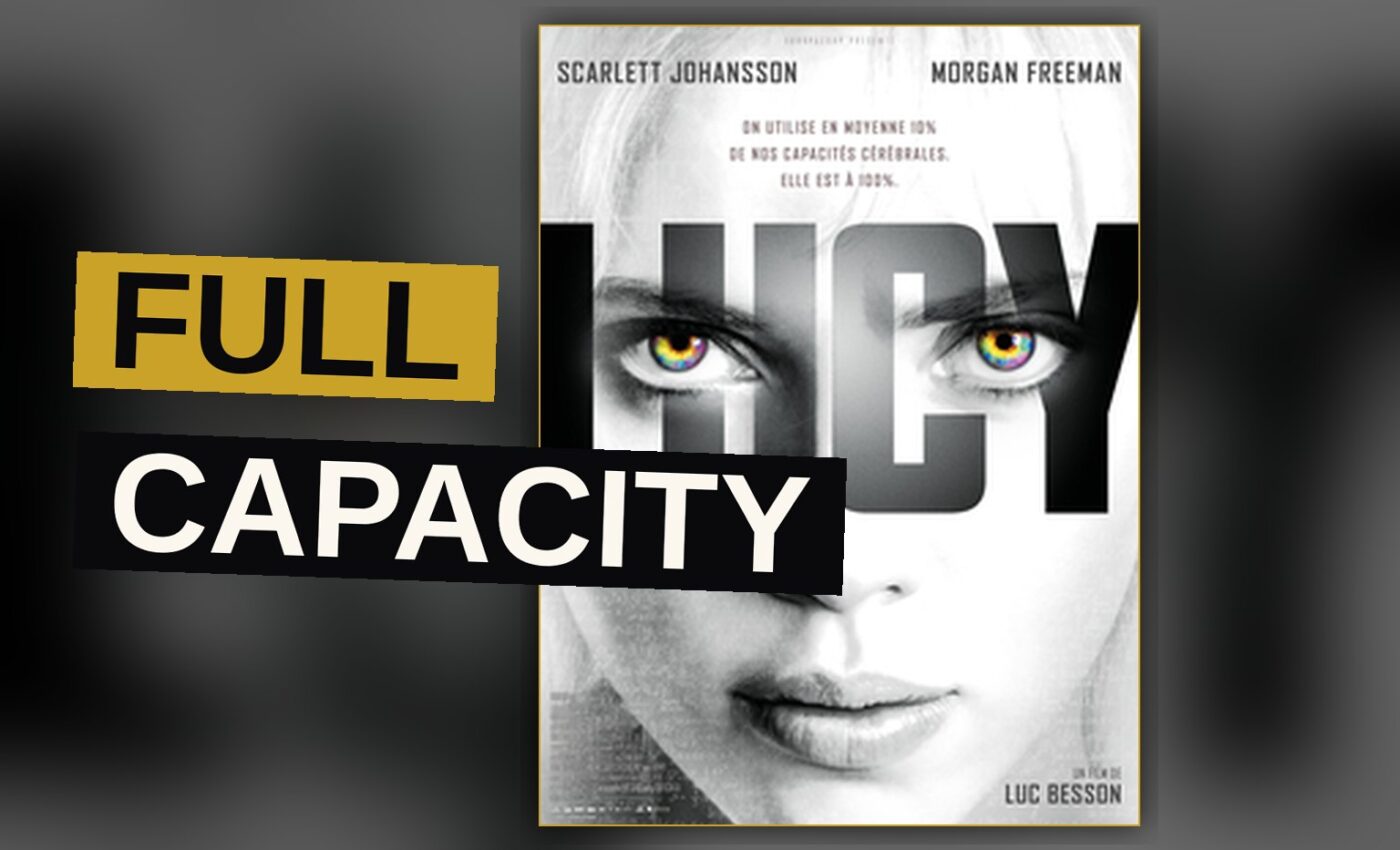
Lucy is a film about a woman who gets drugged, wakes up in a hotel room, and discovers she can access far more of her brain than usual. That setup sounds promising. The execution doesn’t quite land.
Scarlett Johansson plays the title character, a woman who gets forced into a dangerous situation and ends up with a substance in her system that pushes her brain capacity way past normal limits. The film wants to be a smart thriller, a study of human potential, and a chase movie all at once. Mostly it settles for the chase.
Trailer, via Universal Pictures.
The Chase
The action scenes are where Lucy mostly holds together. Her sudden bursts of speed and strength are staged with real energy, and the film knows how to build tension through movement rather than dialogue. The problem is that the film leans too heavily on spectacle without giving the audience much reason to care about Lucy beyond what she can do.
The Science
The central idea — that humans only use a fraction of their brains and could do anything if they used more — is presented as fact rather than speculation. The film treats this as settled science instead of a hypothesis, and that choice shows in the writing. Explanations come fast, delivered by a professor played by Morgan Freeman, and they often feel less like teaching and more like padding between explosions.
Tone Trouble
The film struggles to decide whether it’s a serious scientific exploration or a summer blockbuster. The tone shifts from a quiet, cerebral talk between characters to a loud, fast action sequence without much warning. This inconsistency is the film’s biggest weakness, because it never lets the audience settle into either mode.
“It is not a question of how much we know, but how much we can remember.”
That line, spoken by Freeman’s character, captures the film’s ambition. It also captures its flaw: the film is constantly talking about knowledge and memory, but rarely lets the story sit still long enough to let those ideas breathe.
A Running Order
| Scene | What Happens |
|---|---|
| Opening | Lucy is drugged and wakes up in a hotel room |
| Middle stretch | She gains new abilities and starts fighting back |
| Late stretch | The chase scenes ramp up, ending in a final confrontation |
The film is at its best when it commits fully to one mode. The quieter moments, where Lucy reflects on what her new abilities mean, are the most interesting parts of the script. But those moments are rare, buried beneath constant motion.
Lucy isn’t a bad film. It has a strong premise, a talented lead, and some genuinely exciting sequences. But it never quite commits to being anything besides a summer blockbuster, and that lack of commitment shows in the finished product.
The film’s score sits at 6.2 out of 10.