
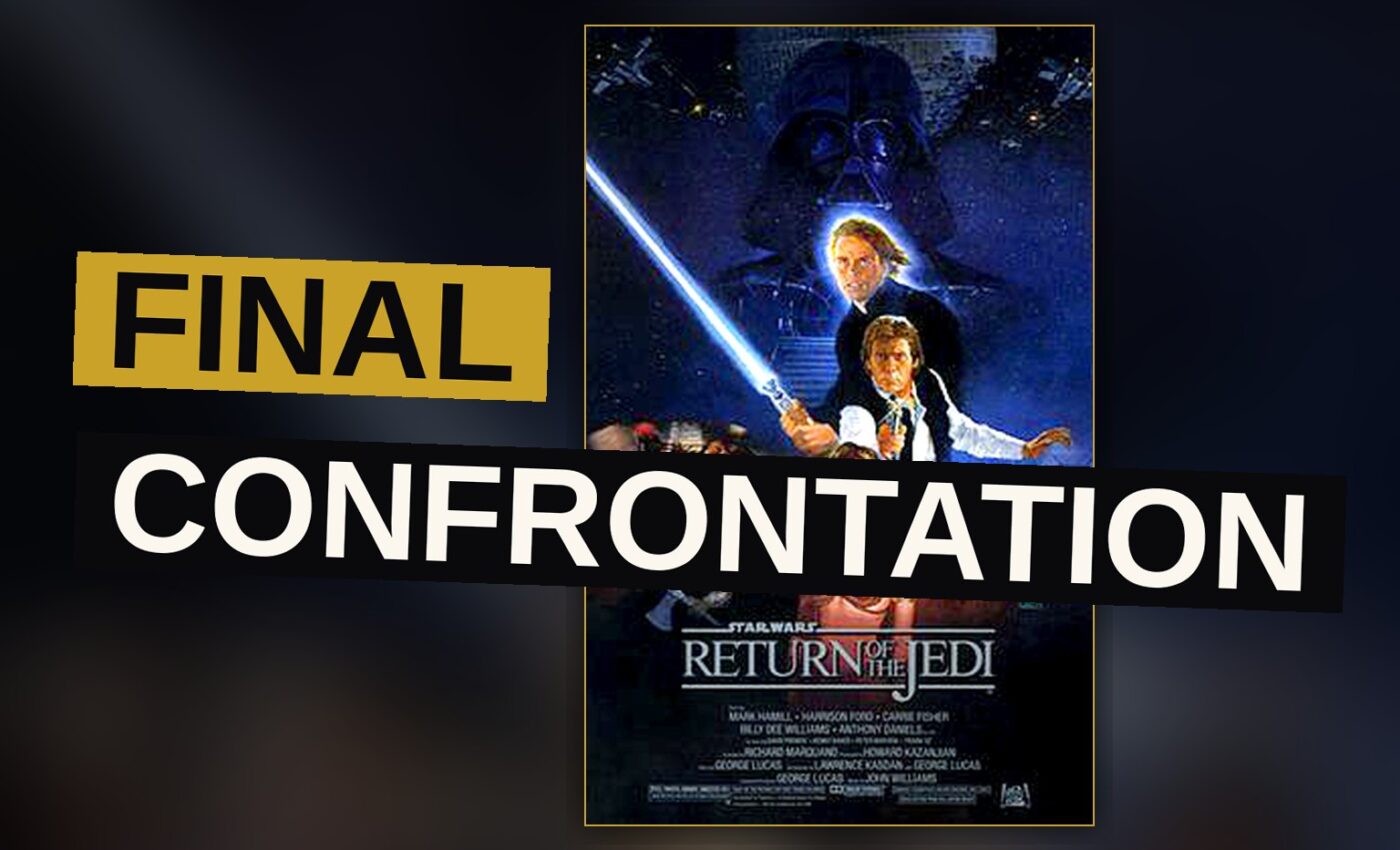
The second Death Star is not finished. Neither is the movie around it.
“Return of the Jedi” arrived in theaters on May 25, 1983, directed by Richard Marquand from a screenplay by Lawrence Kasdan and George Lucas. It is the third installment in the original Star Wars trilogy, the sequel to “The Empire Strikes Back,” and the sixth film in the chronological “Skywalker Saga.” It runs 132 minutes. It is an adventure, an action picture, and a science fiction film, and it is the weakest of the three.
That verdict is not a provocation. The film’s critical score sits at 5.8 of 10 on Metacritic, a 58 out of 100 — a number that lands almost exactly where a careful viewer lands after the Ewoks stop being cute and the second act starts repeating the first.
Trailer, via Star Wars.
Luke Skywalker Walks Into Jabba’s Palace
The film opens one year after Han Solo’s capture and imprisonment in carbonite. C-3PO and R2-D2 enter the palace of the crime lord Jabba the Hutt on Tatooine, sent as a goodwill gift from Luke Skywalker, who hopes to negotiate Han’s release.
Princess Leia infiltrates the palace disguised as a bounty hunter, pretending she has captured Chewbacca. She frees Han from the carbonite. Jabba catches her and enslaves her.
Luke arrives to bargain. Jabba drops him through a trapdoor to be eaten by a rancor. Luke kills the beast. Jabba then decrees that Luke, Han, and Chewbacca will be fed to a Sarlacc, the deadly ground-dwelling creature. Luke retrieves his new lightsaber from R2-D2. The group battles Jabba’s thugs aboard his sail barge. Boba Fett is swallowed by the Sarlacc. Leia strangles Jabba to death with her chains. The sail barge is destroyed and the group escapes.
This is the best stretch of the film, and it is worth saying plainly why. It is a rescue, it has a plan, the plan fails, and the heroes improvise their way out. The stakes are personal and small. Nobody is saving a galaxy yet.
Dagobah, Endor, and a Second Death Star
Luke goes back to Dagobah to finish his Jedi training with Yoda, and finds the old master dying. Yoda lives long enough to tell him the truth he has been dodging: Darth Vader is his father, the former Jedi Knight Anakin Skywalker. Yoda also says there is another Skywalker.
Obi-Wan Kenobi’s Force spirit then tells Luke that Leia is his twin sister, and that he has to face Vader again to finish his training and defeat the Empire.
The Alliance learns the Empire is building a second Death Star under the Emperor’s supervision, protected by an energy shield on the forest moon of Endor. Han leads a strike team — Luke, Leia, Chewbacca — to destroy the shield generator. On the moon, the team gains the trust of an Ewok tribe. Luke tells Leia she is his sister.
Then the film splits into three endings running at once. Luke confronts Vader and the Emperor. The Rebel fleet attacks the space station. Han’s team fights on the ground. Only one of those threads earns its runtime.
The Emperor Is the Best Thing in the Movie
Ian McDiarmid plays the Emperor, the ruler of the Galactic Empire and Vader’s master. He is the only performer in the film who seems to be having a genuinely good time, and the only villain whose menace does not depend on a costume.
The confrontation between Luke, Vader, and the Emperor is the film’s dramatic spine, and it is the reason “Return of the Jedi” is remembered at all. David Prowse plays Vader’s body; James Earl Jones provides the voice. Sebastian Shaw plays Anakin Skywalker, the unmasked Vader, who also appears as a Force spirit.
The unmasking is the emotional payload the whole trilogy was building toward. It works. It works despite the Ewoks, despite the second Death Star, despite a finale that keeps cutting away from the one scene the audience actually came for.
A Cast Doing Familiar Work
Mark Hamill plays Luke Skywalker, a Jedi in training, a Rebel pilot, the son of Darth Vader and Leia’s twin brother. Harrison Ford plays Han Solo, a rebel general and captain of the Millennium Falcon. Carrie Fisher plays Leia Organa, a Rebel leader, Luke’s twin, and Vader’s daughter.
Billy Dee Williams plays Lando Calrissian, the former administrator of Cloud City, Han’s friend, and a rebel general. Anthony Daniels plays C-3PO, the protocol droid. Peter Mayhew plays Chewbacca, Han’s Wookiee friend and co-pilot.
Kenny Baker plays R2-D2, the astromech droid, and also Paploo, an Ewok who aids the Rebels on Endor. Frank Oz provides the voice and puppetry for Yoda, the centuries-old Jedi Master who trained Luke. Ian McDiarmid plays the Emperor, ruler of the Galactic Empire and Vader’s master. David Prowse plays Darth Vader’s body, with James Earl Jones providing the voice. Sebastian Shaw plays Anakin Skywalker, the unmasked Vader. Alec Guinness plays Obi-Wan Kenobi, the deceased mentor who guides Luke as a Force spirit.
The supporting roster includes Michael Pennington as Moff Jerjerrod, Kenneth Colley as Admiral Piett, Michael Carter as Bib Fortuna, Denis Lawson as Wedge, Tim Rose as Admiral Ackbar, Dermot Crowley as General Madine, Caroline Blakiston as Mon Mothma, and Warwick Davis as Wicket W. Warrick. Jabba the Hutt is performed by puppeteers Toby Philpott, Mike Edmonds, and David Barclay, with Larry A. Ward providing the voice.
Hamill, handed the film’s hardest assignment, is the one who holds it together.
Two Space Stations, One Problem
The structural failure is easy to name. The film’s climax is a bigger version of a thing the audience already watched get destroyed.
| Element | The first space station | The second space station |
|---|---|---|
| Status at start of film | Fully operational | Under construction |
| Defense | Not specified in source | Energy shield projected from Endor |
| Vulnerable point | Not specified in source | Shield generator on the forest moon |
| Oversight | Not specified in source | The Emperor |
| Outcome | Destroyed | Destroyed |
The table is not a cheap shot. It is the actual architecture of the film. Lucas and Kasdan built a finale that reprises a beat instead of escalating it, and then handed the ground half of that finale to a tribe of small bears.
The Ewoks Are Not the Real Problem
It has been fashionable for forty-three years to blame the Ewoks. That is a misdiagnosis.
The Ewoks are, in this paper’s view, a merchandising decision that happens to be on screen. Warwick Davis plays Wicket W. Warrick, the Ewok who befriends Leia; he had no film acting experience when he was cast. Kenny Baker was originally cast as Wicket but fell ill with food poisoning, which is how Davis got the part.
The real problem is that the film has three climaxes and gives each of them roughly equal weight. The Emperor’s throne room is where the film’s genuine suspense lives — will Luke turn, will Vader turn back — and the movie keeps leaving the room to check on a space battle.
What Marquand Inherited
The production history explains some of the shapelessness. Steven Spielberg, David Lynch, and David Cronenberg were considered to direct before Marquand signed on. Alan Webb was originally cast as the Emperor but dropped out due to illness. Lindsay Anderson was offered the role and turned it down over scheduling conflicts. Ben Kingsley and David Suchet were also considered. Alan Rickman auditioned for Moff Jerjerrod; Michael Pennington got the part.
For the unmasked Vader, Marquand wanted a famous actor such as Laurence Olivier or John Gielgud. Lucas worried such a face would distract audiences. Shaw got the role instead.
The production team leaned on Lucas’ storyboards during pre-production. While writing the shooting script, Lucas, Kasdan, Marquand, and producer Howard Kazanjian spent two weeks in conference working out ideas. Kazanjian’s schedule pushed shooting to start a few weeks early so Industrial Light & Magic would have more time on the effects in post-production.
| Phase | Window |
|---|---|
| Shooting script conferences | Two weeks, pre-production |
| Principal photography | January 1982 to May 1982 |
| Locations | England, California, Arizona |
| Post-production effects | Extended by early shoot start |
| Theatrical release | May 25, 1983 |
Filming ran from January to May 1982 across England, California, and Arizona. 20th Century-Fox released the film in theaters on May 25, 1983. The source’s gross figure is incomplete — it reads “$374” — so the total is not fully reported here and should be treated as unconfirmed.
What Actually Holds Up
Here is the case for the film, and it is a real one.
The rescue of Han Solo is a clean, well-built sequence with a genuine reversal and a satisfying payoff. Leia killing Jabba with the chains he put on her is the single best image in the trilogy that does not involve a lightsaber. The Yoda death scene gives the character a quiet exit and hands Luke the last piece of his origin. The throne room delivers the payoff the previous two films promised.
And the film ends. That matters more than it sounds like it should. “Return of the Jedi” closes a trilogy without a cliffhanger, without a setup for a fourth film, and without cheating the audience out of a resolution.
Where This One Lands
“Return of the Jedi” is a good film with a great film buried inside it, and the burial is the story.
The Jabba sequence is confident, self-contained, and inventive. The throne room is the emotional summit of the original trilogy. Between them sits a second Death Star, a shield generator, a forest moon, and a battle the film never makes you care about — and the decision to spend the final act cutting between a duel that matters and a space fight that does not is the decision that costs this movie its place alongside “The Empire Strikes Back.”
The Ewoks are a symptom. The reprise is the disease. Lucas and Kasdan, working from Lucas’ own storyboards, chose to end the trilogy by rebuilding the thing the trilogy already destroyed, and then let a tribe of Ewoks carry the ground war. It is not fatal. It is just smaller than everything that came before it.
What survives is McDiarmid’s Emperor, Hamill’s best work in the role, Shaw’s few minutes as Anakin, and the correct instinct that the real climax of Star Wars was never a space station. It was a father and a son in a room with an old man watching.
That instinct is right. The film around it is uneven, overstuffed, and too often content to repeat itself. It closes the trilogy. It does not elevate it.
Get the Notebook.
The day's best stories and every fresh verdict, in plain English, in your inbox by seven. One email a day, no more.


