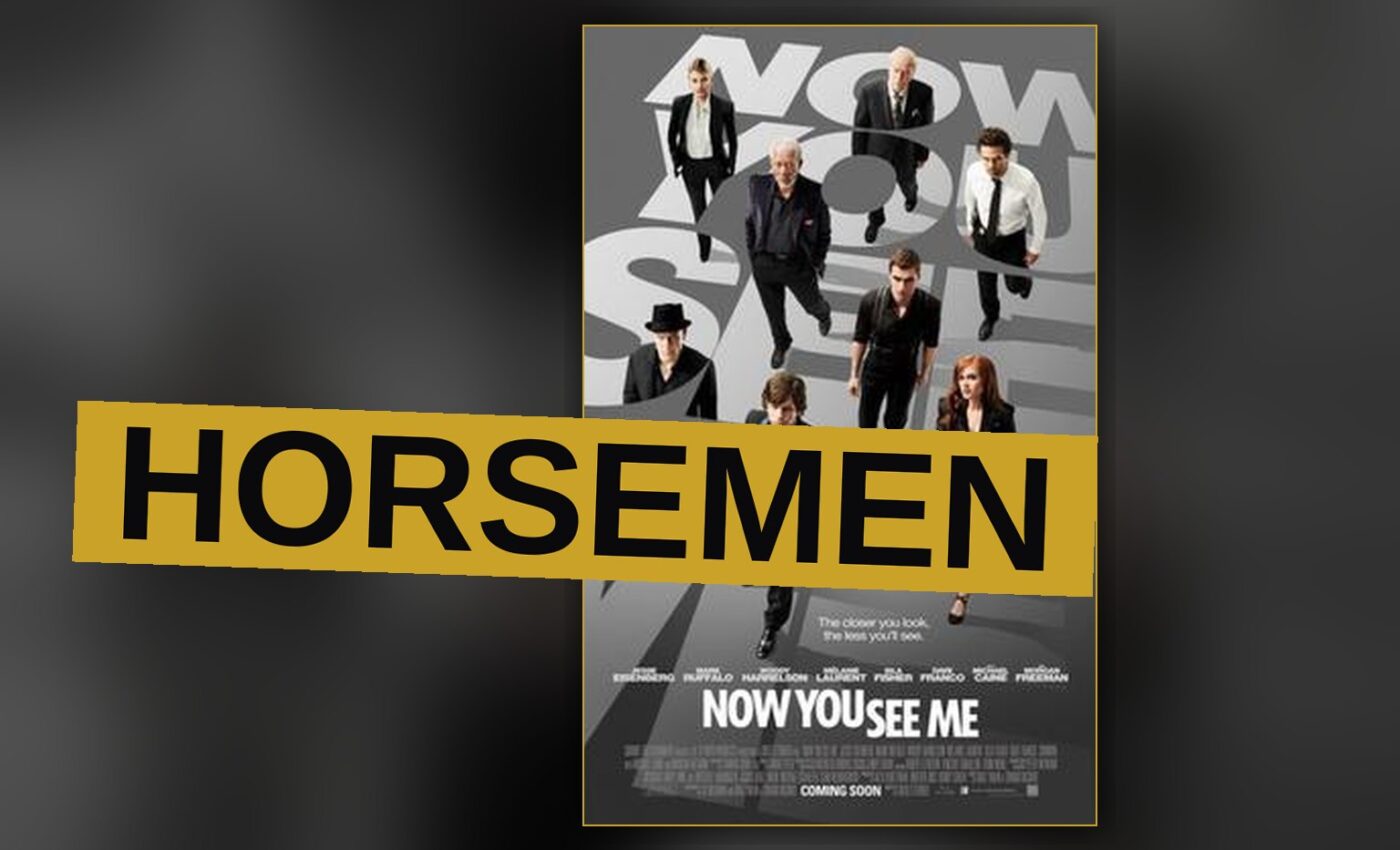
“Magic tricks work because everyone wants to believe.” That line opens “Now You See Me,” and it sets the tone for a film that spends nearly two hours trying to convince us we’re watching something clever. The movie stars Jesse Eisenberg, Mark Ruffalo, Woody Harrelson, and Isla Fisher as the Four Horsemen, a team of magicians who pull off a series of bank heists across the world. Their target is the financial elite, and their weapon is illusion.
The premise is simple and seductive. The execution is not.
Trailer, via The Dollar Theater.
The Horsemen’s Plan
The Horsemen start small, performing street magic in Times Square. They build their audience with a trick involving a deck of cards and a disappearing coin. Then they scale up. Their second act involves a casino in Macau, where they steal millions while the audience watches. The third act takes them to Las Vegas, where they stage a robbery during a live broadcast.
Each heist is meant to expose corruption. The Horsemen claim they are redistributing wealth from the rich to the poor. They leave messages for the FBI agent tracking them, played by Morgan Freeman, and for the IMF analyst played by Michael Caine, who runs the show from behind the scenes.
The problem is that the film never quite commits to its own politics. The Horsemen talk about justice, but their methods are showmanship. They want to be heroes and celebrities. They want to be celebrated in the media. That tension is the heart of the script, and it’s also the source of the movie’s biggest flaw.
The FBI Agent’s Job
Morgan Freeman plays Dylan Rhodes, the FBI agent chasing the Horsemen. He’s older, experienced, and he knows the game. His job is to figure out how the Horsemen do their tricks. He studies the patterns, the timing, and the psychology of the crowd.
Freeman’s character is the closest thing the film has to a moral center. He’s patient, observant, and genuinely curious about the magic. He doesn’t want to catch the Horsemen to put them in jail. He wants to understand them.
But the film doesn’t trust him to do the heavy lifting. The Horsemen always know more than he does. They always see the angle he hasn’t considered. The result is that Rhodes becomes a plot device rather than a character. He exists to be baffled, to be proven wrong, and to be sidelined.
The IMF Analyst’s Scheme
Michael Caine plays Thaddeus Bradley, the former magician who now runs the show. He’s the architect of the plan. He’s the one who designs the heists. He’s the one who controls the information the Horsemen receive. He’s the one who makes sure everything lines up.
Caine’s performance is the best reason to watch this movie. He plays Bradley as a man who’s been burned by love and betrayed by ambition. He’s calculating, but he’s also lonely. He’s the kind of man who builds a machine and then can’t get out of it.
The problem is that the film doesn’t let Bradley’s scheme breathe. It’s revealed too late in the story, and it’s explained through exposition rather than action. The twist is meant to be shocking, but it feels rushed. The audience has spent an hour and a half waiting for the reveal, and when it comes, it’s over quickly.
The Magicians’ Act
Jesse Eisenberg plays Daniel Atlas, the smooth-talking leader of the Horsemen. Mark Ruffalo plays Jack Wilder, the ex-husband who’s the group’s technical expert. Woody Harrelson plays Henley Reeves, the wild card who’s the group’s muscle. Isla Fisher plays Lula Mayweather, the socialite who’s the group’s public face.
The four actors play off each other well. They have chemistry, and they make the banter feel natural. But the script doesn’t give them much to work with. Their motivations are thin. Atlas is a narcissist. Wilder is a cynic. Reeves is a romantic. Mayweather is a poser. None of them are particularly likable, and none of them grow.
The film tries to make the Horsemen relatable by showing their personal lives. We see them arguing, making jokes, and falling in love. But these moments don’t stick. They’re interruptions in the main plot, and they’re forgotten as soon as the next heist begins.
The Heist Sequence
The heist sequences are the film’s strongest elements. They’re shot with energy, and they’re edited with precision. The camera follows the action, and the music builds tension. The crowds react, and the Horsemen perform. These scenes are the reason people walk out of theaters talking about the movie.
But the heists are also the film’s weakest elements. They’re designed to be impossible. The Horsemen move too fast, hide too easily, and guess too accurately. The film asks us to suspend disbelief, and then it stretches it thinner and thinner. By the third act, the heists stop feeling clever and start feeling arbitrary.
“Magic tricks work because everyone wants to believe.”
That line is repeated several times. It’s the film’s thesis statement. But the film doesn’t follow its own advice. It wants us to believe in the Horsemen’s genius, even when the logic falls apart. It wants us to believe in the plan, even when the plan is full of holes.
The Running Order
| Act | Location | Target |
|---|---|---|
| 1 | Times Square | A small audience |
| 2 | Macau | A casino |
| 3 | Las Vegas | A live broadcast |
| 4 | New York City | The IMF analyst |
The table shows the progression of the film. It starts small, goes global, and ends with a confrontation. Each location raises the stakes. Each heist is bigger than the last. But the pattern is predictable. The film follows a formula, and it doesn’t deviate from it.
The Final Trick
The final act is where the film tries to redeem itself. The Horsemen perform one last trick, and it’s the biggest one yet. They steal a fortune, and they do it in front of the whole world. The film wants us to be amazed, but we’ve been primed for disappointment.
The twist is meant to be a revelation. It’s meant to explain everything. But it doesn’t. It leaves questions unanswered. It leaves threads loose. It leaves the audience confused.
The film ends on a note of triumph, but it’s a hollow one. The Horsemen have won, but they haven’t changed anything. The rich are still rich. The poor are still poor. The system is still broken. The film acknowledges this, but it offers no solution.
The Verdict
“Magic tricks work because everyone wants to believe.” That line is true, but it’s not enough. A film needs more than belief. It needs craft. It needs structure. It needs characters we care about.
“Now You See Me” has the craft. Its heists are well-choreographed. Its performances are strong. Its visuals are sharp. But it lacks structure. The plot is a jumble of twists and turns that don’t add up to a coherent story. And it lacks characters we care about. The Horsemen are talented, but they’re also shallow.
The film is entertaining in patches. The heist sequences are fun. The chase scenes are tense. The dialogue is snappy. But the whole is less than the sum of its parts. The film is a collection of good ideas, not a great idea.
It’s a film that wants to be smart and fails. It’s a film that wants to be exciting and succeeds. It’s a film that wants to be meaningful and doesn’t try hard enough.
The film is worth a rental if you’re looking for a light evening. It’s not worth a purchase. It’s a film that’s better in the moment than it is on reflection.
The review was written 13 years later.