
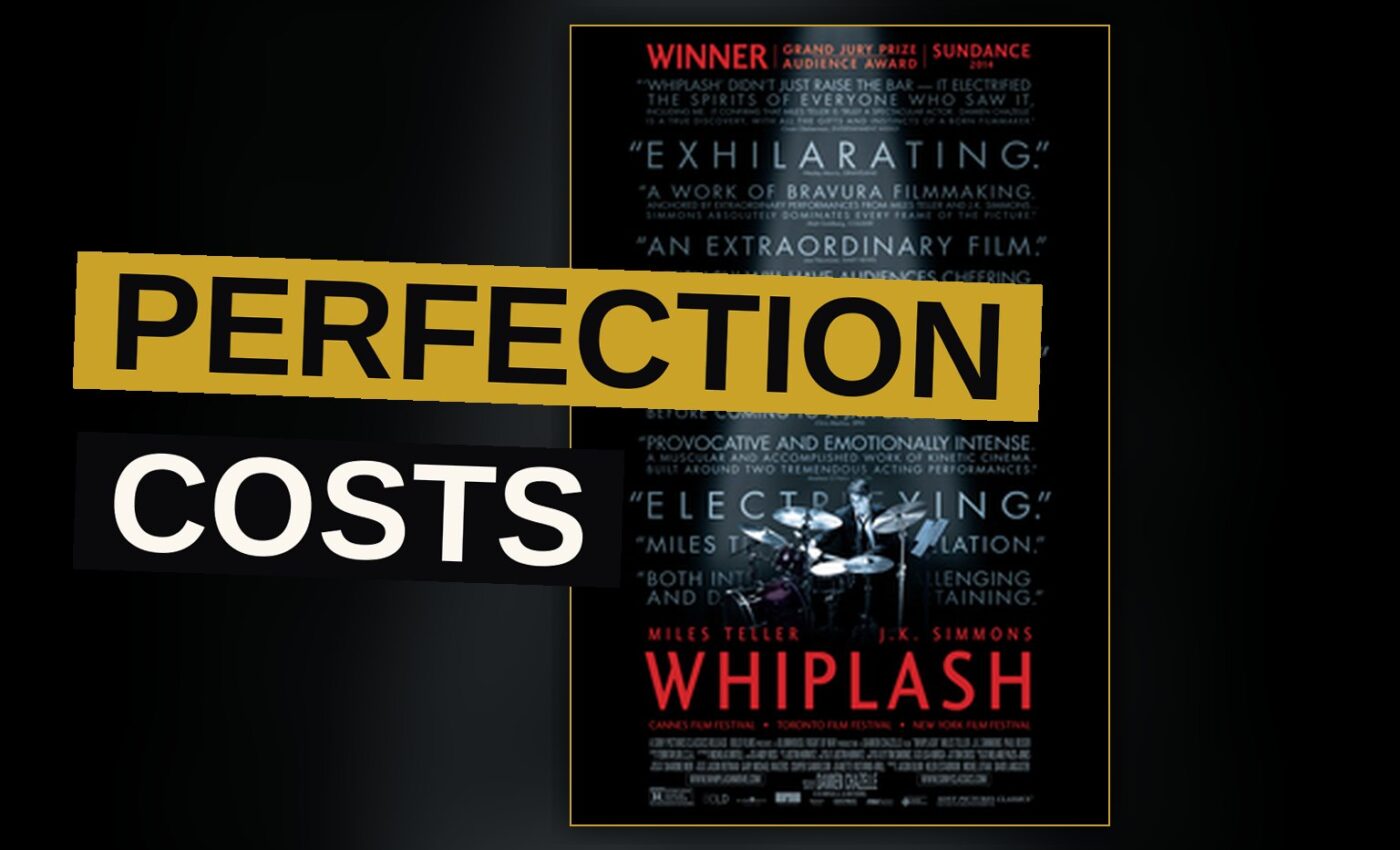
Damien Chazelle wrote the script for Whiplash in 2013, drawing on his time in what he has called a “very competitive” jazz band in high school. The film runs 107 minutes and stars Miles Teller as Andrew Neiman, a 19-year-old drummer at the Shaffer Conservatory in New York City, and J.K. Simmons as Terence Fletcher, the instructor who pushes him past every limit he has. It is a drama, a music film and a thriller at once, and it earns all three labels.
Trailer, via Sony Pictures Classics.
From Fifteen Pages to Sundance
Chazelle finished the screenplay in 2013. Right of Way Films and Blumhouse Productions then helped him shoot fifteen pages of it as an 18-minute short, also called Whiplash, which debuted at the 2013 Sundance Film Festival and drew enough acclaim to bring in investors for the full version. Filming took place in September 2013 across Los Angeles over twenty days.
The feature premiered in competition at the 2014 Sundance Film Festival on January 16, as the festival’s opening film. It won both the Audience Award Dramatic and the Grand Jury Prize Dramatic. Sony Pictures took distribution rights for most of the world, releasing under Sony Pictures Classics in North America, Germany and Australia, and under Stage 6 Films in the UK, Scandinavia, Benelux, Eastern Europe outside the CIS, Greece, South Africa, Spain, Italy, Portugal and Latin America.
That path matters. A first feature built from a short, shot in twenty days, opening the festival it premiered at — Whiplash arrived with the kind of momentum most films spend years buying.
Andrew Neiman and the Studio Band
Andrew attends Shaffer Conservatory. Fletcher, who conducts the school’s most prestigious ensemble, overhears him practicing, asks for rudiments and a double-time swing beat, and appears unimpressed. He leaves. He comes back and recruits Andrew as a backup for the core drummer, Carl Tanner, played by Nate Lang.
The first rehearsal tells Andrew what he has signed up for. On Hank Levy’s “Whiplash,” Fletcher decides Andrew has lost the tempo. He throws a chair at him, slaps his face repeatedly and berates him. Fletcher is verbally, physically and psychologically abusive, and the film does not soften a frame of it.
Andrew responds by practicing until his hands bleed. He wants Fletcher’s approval more than he wants anything else, and that want is the engine of the whole film.
The Chair, the Sheet Music, the Bus
At the first jazz competition, Andrew misplaces Tanner’s sheet music. Tanner cannot play without it, so Fletcher lets Andrew sit in. Shaffer wins. Fletcher promotes Andrew to core drummer, then reassigns the seat to Ryan Connolly, played by Austin Stowell, a drummer from Andrew’s earlier ensemble at Shaffer.
The cost lands offstage. Andrew breaks up with his girlfriend Nicole, played by Melissa Benoist, and clashes with his family. His single-mindedness has a bill, and Chazelle makes him pay it in full.
Then comes the sequence the film is built around. Fletcher opens a rehearsal by announcing that Sean Casey, a former member of the Studio Band, has died in a car crash. He then drives the three drummers through “Caravan” at a faster tempo, keeping them for a grueling five-hour practice. Andrew wins the core seat back because he is the only one who can hold the tempo.
On the way to the next competition, Andrew’s bus gets a flat tire. He rents a car, arrives late, and has left his drumsticks at the rental office.
A Running Order of Costs
| Moment | What Andrew gives up | What he gets |
|---|---|---|
| First ensemble rehearsal | His sense of safety | Proof that Fletcher is watching him |
| Misplaced sheet music | Tanner’s trust | The core drummer seat |
| Breakup with Nicole | The relationship | More hours to practice |
| Five-hour “Caravan” rehearsal | His hands, his stamina | The core seat back |
| Flat tire before the competition | His punctuality | Nothing yet |
A Cast Built Around Two Performances
Simmons won the role of a lifetime here, and Teller matches him beat for beat. Paul Reiser plays Jim Neiman, Andrew’s father, the one person in the film who asks Andrew to stop. Melissa Benoist makes Nicole a real person rather than a plot device, which is harder than it looks in a film this focused on one man’s obsession.
The rest of the ensemble is precise. Austin Stowell as Ryan Connolly, Nate Lang as Carl Tanner, Chris Mulkey as Uncle Frank, Damon Gupton as Mr. Kramer, Suanne Spoke as Aunt Emma, Max Kasch as Dorm Neighbor, Charlie Ian as Dustin, Jayson Blair as Travis, Michael D. Cohen as a stagehand, April Grace as the lawyer Rachel Bornholdt. Everyone knows their job.
What the Film Is Actually About
The tagline says it plainly: “The road to greatness can take you to the edge.” Whiplash explores perfectionism, dedication and success, and it deconstructs ambition rather than celebrating it. The film never resolves whether Fletcher is a monster, a mentor, or both at once, and it never lets Andrew off the hook for choosing him.
That is the smartest thing in the script. Andrew is not a victim who wanders into abuse. He keeps coming back, he keeps practicing, and he keeps trading pieces of his life for a seat in a band. Fletcher throws the chair. Andrew stays in the room.
Where Whiplash Leaves Andrew
Whiplash is a 107-minute thriller disguised as a music drama, and the disguise is the point. Chazelle shoots drumming like a fight scene, and the tension holds because the stakes are small and specific: a tempo, a seat, a pair of sticks left at a rental counter. The film has one idea and it commits to it without apology.
The weaknesses are real but minor. The family scenes and the Nicole subplot exist mainly to show what Andrew is sacrificing, and they do that job efficiently rather than deeply. The film is so tightly wound around two men that everything else feels like a receipt.
What makes Whiplash worth its reputation is that it refuses the easy ending. It does not tell you whether Fletcher broke Andrew or made him, because Andrew does not know either. That ambiguity is not a cop-out. It is the argument.
Get the Notebook.
The day's best stories and every fresh verdict, in plain English, in your inbox by seven. One email a day, no more.


